Advertisement Consent: When Does a Business Sign Need Planning Approval?
A business sign can seem like a small change, but it may still need advertisement consent before it is installed. In England, outdoor advertisements and signs are controlled through a specific advertisement consent system within planning. Some signs can be displayed without express consent, some benefit from deemed consent, and others need an application to the local planning authority before they are installed. The key issues are usually visual amenity and public safety, especially where the sign is large, illuminated, digital, close to a road junction, in a conservation area, on a listed building or visually prominent in the street scene.
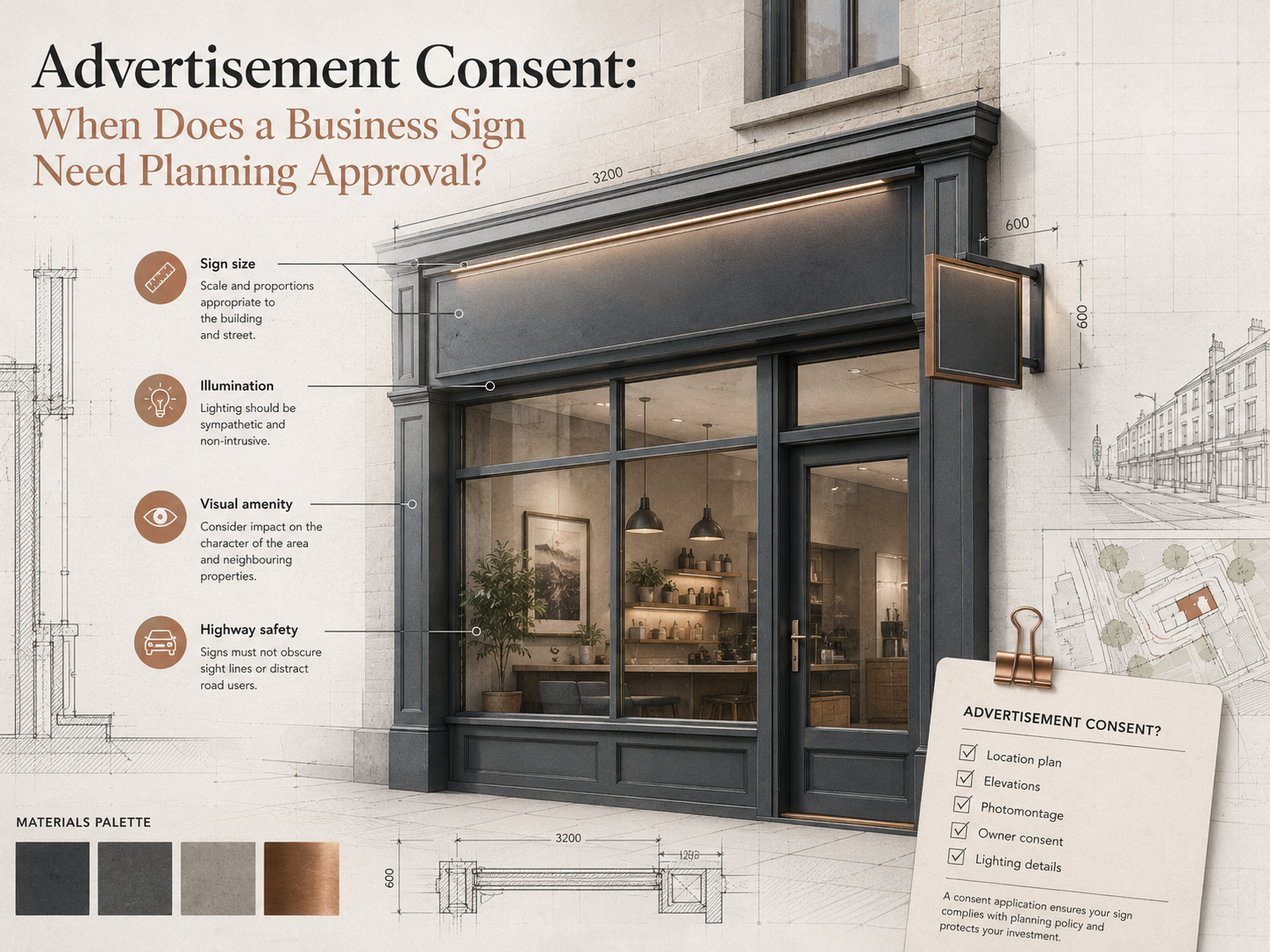
The short answer
A business sign may need advertisement consent if it does not fall within a category of advertisement that is automatically permitted or treated as having deemed consent.
This is not always the same as ordinary planning permission. Advertisement consent is a separate approval process within the planning system. GOV.UK explains that the display of advertisements is controlled mainly by the Town and Country Planning (Control of Advertisements) (England) Regulations 2007, and that advertisement control is focused on amenity and public safety.
In practical terms, you should check before installing a sign if it is:
- illuminated;
- digital or LED;
- large or highly prominent;
- above fascia level;
- projecting from the building;
- freestanding;
- close to a road, junction, crossing or roundabout;
- on or near a listed building;
- in a conservation area;
- on a residential building;
- on scaffolding, hoarding or a temporary structure;
- an A-board placed on the highway;
- different from the type of signage already approved for the site.
What counts as an advertisement?
For planning purposes, the definition of advertisement is broad. GOV.UK guidance quotes the Town and Country Planning Act 1990 definition, which includes words, letters, models, signs, placards, boards, notices, awnings, blinds, devices or representations used wholly or partly for advertisement, announcement or direction.
That means the rules can apply to many common business signs, including:
- fascia signs;
- shopfront signs;
- projecting signs;
- hanging signs;
- freestanding signs;
- digital screens;
- LED displays;
- window graphics;
- hoardings;
- banners;
- directional signs;
- menu boards;
- A-boards;
- illuminated signs;
- temporary promotional signs.
A sign supplier may be able to manufacture the sign, but that does not mean the sign has the necessary consent.
Is advertisement consent the same as planning permission?
Not exactly.
Advertisement consent is a specific planning control for signs and advertisements. GOV.UK says separate planning permission is not required in addition to advertisement consent for the display of advertisements, because planning permission is deemed to be granted for development involved in displaying advertisements in accordance with the regulations. However, this does not necessarily cover every associated structure unless its primary purpose is to display the advertisement.
In plain English: if the issue is simply the display of a sign, advertisement consent may be the relevant route. But if the proposal also involves a new shopfront, external cladding, structural support, plant, lighting equipment, a new canopy, alterations to a listed building or other building works, additional consent may still be needed.
The three consent categories
GOV.UK explains that there are three broad categories of advertisement consent:
- advertisements that do not require deemed or express consent, provided they meet the relevant criteria;
- advertisements that have deemed consent, provided they comply with the restrictions and conditions;
- advertisements that require express consent from the local planning authority.
The difficult part is working out which category your sign falls into. That depends on the type of sign, size, height, illumination, location, wording, building type and surrounding context.
When does a business sign usually need express advertisement consent?
A business sign is more likely to need express advertisement consent where it is not a simple, modest on-premises sign.
Common examples include:
- large illuminated fascia signs;
- LED advertising screens;
- digital display boards;
- signs with moving images;
- signs with flashing lights;
- signs in visually sensitive locations;
- signs close to highways or junctions;
- high-level signs;
- freestanding roadside signs;
- signs on hoardings or scaffolding;
- large banners or wraps;
- signs on listed buildings;
- signs in conservation areas where visual impact is sensitive;
- A-boards on highways or footways where traffic is prohibited.
GOV.UK specifically notes that A-boards on highways, including footways where vehicular traffic is prohibited, require express advertisement consent and also need the relevant highway consent.
What do councils consider when deciding advertisement consent?
Councils mainly consider two issues: amenity and public safety.
GOV.UK guidance states that local planning authorities control advertisements in the interests of amenity and public safety. It also says consent cannot generally be refused simply because the council considers the advertisement unnecessary, morally offensive or misleading, unless the nature of the advertisement itself is harmful to amenity or public safety.
This means the design and location matter more than whether the council likes the business or message.
What is visual amenity?
Visual amenity is about the effect of the sign on the place around it.
GOV.UK says amenity includes visual and aural amenity and that councils consider local characteristics, including historic, architectural, cultural or similar features. In practice, amenity usually means the effect on the immediate neighbourhood where residents or passers-by will be aware of the advertisement.
A sign may raise amenity concerns if it is:
- too large for the building;
- visually dominant;
- out of scale with the shopfront;
- too bright;
- poorly positioned;
- cluttered;
- harmful to a listed building or conservation area;
- inconsistent with the character of the street;
- visually intrusive for nearby residents;
- noisy, if the advertisement includes sound.
A large sign that may be acceptable in a commercial or industrial setting could be unacceptable in a historic high street or residential area.
What is public safety?
Public safety is often about road safety, but it is broader than that.
GOV.UK says public safety includes considerations relevant to the safe use and operation of traffic or transport on land, including pedestrian safety, and also over water or in the air.
A sign may raise public safety concerns if it:
- distracts drivers;
- is close to a junction;
- is close to a crossing;
- includes moving images;
- includes flashing lights;
- resembles a traffic sign;
- obscures official road signs;
- creates glare;
- affects pedestrians;
- blocks sightlines;
- affects railway, waterway or aircraft safety.
For signs visible from the highway with moving features, moving parts or flashing lights, the highway authority must be consulted. GOV.UK also says that if the local planning authority has any doubt about the effect of any advertisement on public safety, it should consult the local highway authority.
Why illuminated and digital signs are higher risk
Illuminated signs, LED displays and digital screens can be more complicated than ordinary static signage.
They may raise questions about:
- brightness;
- glare;
- hours of illumination;
- motion or animation;
- changing images;
- driver distraction;
- impact on neighbours;
- visual prominence;
- relationship to traffic signals;
- impact on conservation or heritage settings.
For digital or LED signs, councils may want to understand the exact specification, luminance, image change frequency, static or moving content, hours of operation and whether the sign is visible from the highway.
In some cases, a transport or road safety consultant may be useful, especially where a sign is close to a busy road, junction or pedestrian crossing.
What drawings are usually needed?
A good advertisement consent application should make the proposal easy to understand.
GOV.UK says an express consent application must include a completed application form and a scaled plan identifying the site location and proposed position of the advertisement. It also notes that photo montages showing the proposed advertisement on the site may be helpful.
A practical package may include:
- application form;
- site location plan;
- existing elevation;
- proposed elevation;
- sign dimensions;
- sign position;
- materials;
- colours;
- illumination details;
- luminance or brightness details for digital signs;
- method of fixing;
- photographs of the existing building;
- photomontage or visualisation;
- heritage statement, where relevant;
- highways or transport note, where relevant;
- owner consent confirmation;
- design statement, where helpful.
For a simple fascia sign, the package may be modest. For a digital screen, illuminated sign or sensitive site, a stronger visual and technical package is usually needed.
Do you need the owner’s consent?
Yes. Even if the sign benefits from deemed consent, you still need permission from the site owner or other person entitled to give permission.
GOV.UK states that it is illegal to display an advertisement, even one with deemed consent, without first obtaining permission from the owner of the site or another person entitled to give permission.
For leasehold or managed buildings, this may mean checking with:
- the landlord;
- freeholder;
- managing agent;
- head tenant;
- management company;
- shopping centre landlord;
- highway authority, if the sign or A-board is on highway land.
What happens if a business puts up a sign without consent?
Displaying an advertisement without the necessary consent is not a harmless technicality.
GOV.UK states that anyone who displays an advertisement in breach of the regulations commits an offence. The local planning authority can prosecute, and the penalty on conviction is a level 4 fine, currently up to £2,500, with further daily fines for a continuing offence. The authority can also remove an advertisement that it considers to be displayed in breach of the regulations.
This is why it is safer to check consent requirements before fabrication and installation.
How long does advertisement consent take?
GOV.UK says a local planning authority’s decision on an express advertisement consent application must be given within 8 weeks unless the applicant agrees in writing to a longer period.
In practice, timing can depend on:
- whether the application is valid;
- whether the correct plans and visuals are included;
- whether highways consultation is needed;
- whether heritage or conservation comments are needed;
- whether neighbours are consulted;
- whether the council asks for amendments;
- whether the sign is controversial.
If the sign is needed for a business opening date, it is best to check the planning route early.
What if the council refuses advertisement consent?
If advertisement consent is refused, you may have options.
You might:
- appeal the refusal;
- revise the design;
- reduce the size;
- adjust the position;
- reduce brightness;
- remove animation or flashing;
- change the operating hours;
- provide highways evidence;
- seek pre-application advice;
- submit a new application.
GOV.UK confirms there is a right of appeal against refusal of advertisement consent, against unacceptable non-standard conditions, or if the local planning authority fails to decide within the required period. An appeal must normally be made within 8 weeks of receiving the decision.
However, appeal is not always the best route. If the refusal is based on judgement around visual impact or highway safety, a revised proposal may sometimes be more practical than appealing.
When is pre-application advice useful?
Pre-application advice can be useful for business signage where the proposal is higher risk.
This may include:
- large LED screens;
- signs near junctions;
- illuminated signs in sensitive areas;
- signs on listed buildings;
- signs in conservation areas;
- unusual or high-level signage;
- signs previously refused;
- signage where highways concerns are likely;
- a business wanting to avoid wasted manufacturing costs.
Pre-app advice is not approval, but it can help test whether a revised sign is likely to be acceptable before the business commits to fabrication or a full application.
Common mistakes businesses make
The most common mistake is assuming that because a sign is on the business premises, it does not need consent.
Another mistake is asking the sign manufacturer to proceed before checking planning requirements.
Businesses also often underestimate highways risk. A sign may look attractive in isolation, but if it is close to a busy junction or includes moving or illuminated content, the council may be concerned about driver distraction.
A further mistake is submitting only a product image, with no clear elevation, dimensions, position, lighting specification or photomontage. Councils need to assess how the sign will appear in its real location.
A practical checklist before installing a sign
Before ordering or installing a business sign, check:
- What type of sign is proposed?
- Is it illuminated?
- Is it digital, animated, scrolling or flashing?
- How large is it?
- Where exactly will it be fixed?
- Is it visible from a highway?
- Is it near a junction, crossing or traffic signals?
- Is the building listed?
- Is the site in a conservation area?
- Does the landlord or freeholder consent?
- Does the highway authority need to approve anything?
- Is a location plan available?
- Are elevation drawings needed?
- Would a photomontage help?
- Does the council require express advertisement consent?
How Gartwork Architecture can help
Gartwork Architecture can help businesses check whether a proposed sign is likely to need advertisement consent and prepare a clear application package.
This may include reviewing the sign proposal, checking the site context, preparing existing and proposed elevations, coordinating with the sign supplier, preparing visualisations or photomontages, reviewing illumination and highway issues, and submitting the advertisement consent application.
For more sensitive proposals, such as illuminated signs, digital screens or signs near roads, Gartwork Architecture can also help identify whether highways or specialist input may be needed.
Final takeaway
A business sign is not only a branding decision. It can also be a planning matter.
Simple, modest signs may not need express consent, but larger, illuminated, digital, prominent or sensitive signs often do. The council will usually focus on visual amenity and public safety, especially highway safety.
Before ordering a sign, check the consent position, prepare clear drawings and make sure the proposal is suitable for the building, street and surrounding area.
Categories
Advertisement Consent
Business Sign
Shop Sign
Signage Planning
Planning Permission
Express Consent
Illuminated Sign
LED Sign
Digital Display
Fascia Sign
Shopfront
Highway Safety
Visual Amenity
Conservation Area
Listed Building
Architecture