Breathable Materials in Listed Buildings: Why Gypsum Plaster Can Become a Planning Issue
In a modern house, plaster is often treated as a simple finish. In a listed building, it can be much more important. Traditional buildings often rely on permeable materials such as lime plaster, lime mortar and limewash to manage moisture. Replacing these with modern gypsum plaster, cement-based products or impermeable paints can change how the wall behaves. That can create damp, damage historic fabric and raise questions during a listed building consent application. Listed building consent is required for works that alter a listed building in a way that affects its special architectural or historic interest, and the listing normally covers the whole building, internally and externally.
The short answer
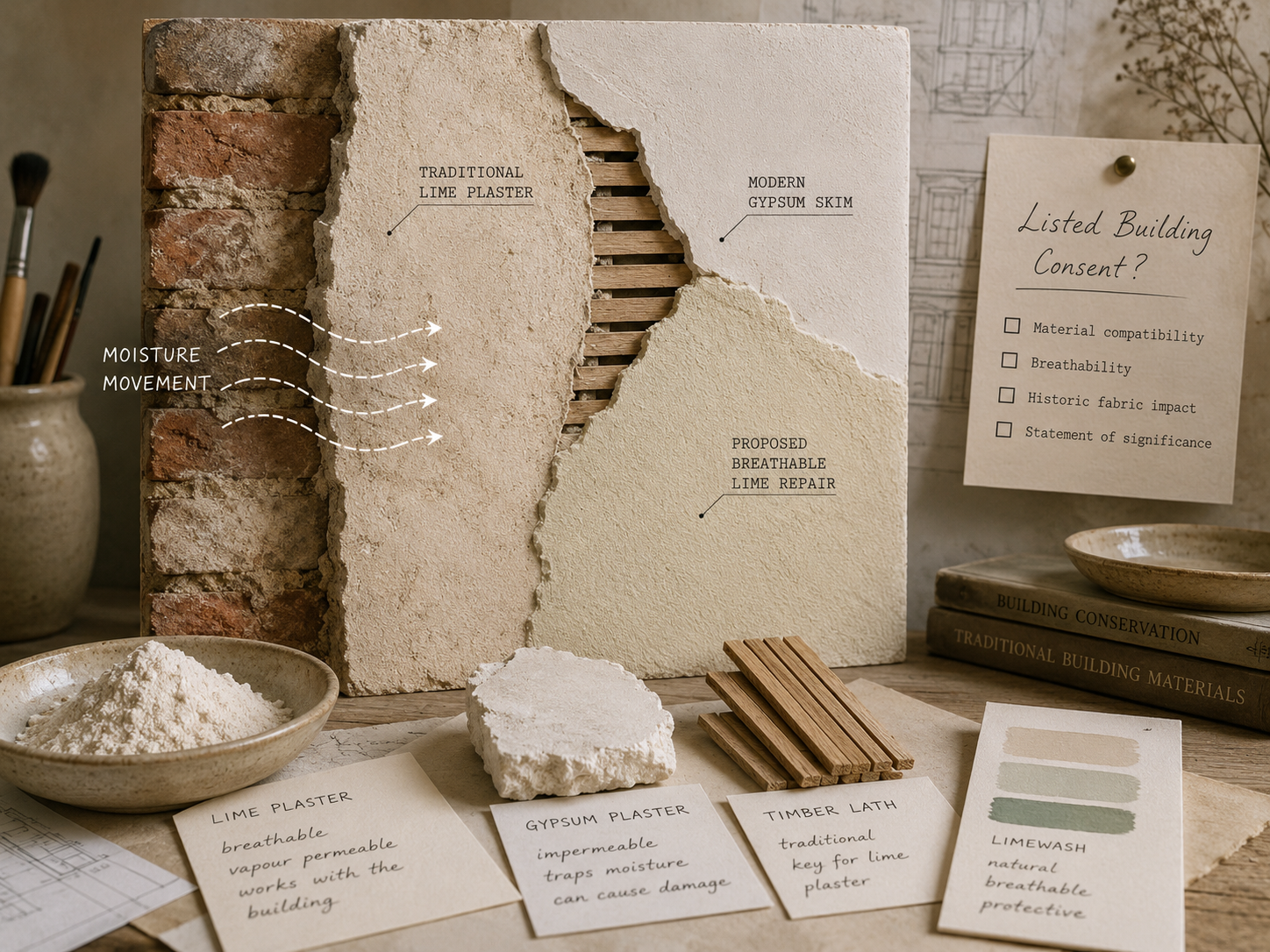
Gypsum plaster can become a planning issue in a listed building when it affects the character, fabric or performance of the building.
The issue is not simply that gypsum is “bad” and lime is “good”. The issue is compatibility. Many older buildings were built with softer, more permeable materials that absorb, store and release moisture. If those materials are replaced or covered with dense, less compatible finishes, the building may stop drying properly. This can contribute to damp, salt movement, mould, timber decay or damage to historic surfaces.
In a listed building, that technical problem can also become a consent problem. If plaster removal, replastering, damp treatment or replacement finishes affect historic fabric or the building’s special interest, listed building consent may be required. GOV.UK confirms that listed building consent and planning permission are separate regimes, and that internal works may need listed building consent even where ordinary planning permission is not required.
What does “breathable” mean in historic buildings?
“Breathable” is a shorthand term. It does not mean that walls literally breathe. It means that building materials can transmit and release moisture.
SPAB explains that, in the context of old and historic buildings, breathable materials are able to transmit moisture and allow absorbed or surface moisture to evaporate during drying conditions. SPAB also warns that moisture needs to leave the material quickly enough to avoid accumulation, deterioration, mould, infestation or decay.
Traditional breathable behaviour can involve:
- vapour permeability;
- moisture buffering;
- capillary movement;
- evaporation through lime plaster, lime mortar or limewash;
- drying through wall thickness and surface finishes.
This matters because many older buildings were not designed with modern damp proof membranes, cavity walls or sealed construction. They often manage moisture by allowing it to move and evaporate.
Why traditional buildings behave differently
Modern construction often tries to keep moisture out with barriers, membranes, cavities and impermeable layers.
Traditional buildings usually work differently. Solid masonry, timber frame, wattle and daub, lime plaster, lime mortar and limewash often form part of a more permeable system. Historic England explains that traditional buildings can absorb, store, transport and release moisture in vapour and liquid form. It also notes that modern methods that resist water vapour or liquid water are not usually appropriate for traditionally constructed buildings because they can trap moisture in the fabric, increase decay and negatively affect occupants’ health.
This is why a plaster choice is not only a decorative decision. It can affect how the building deals with moisture.
Why lime plaster is often preferred
Lime was widely used in old British buildings. SPAB says lime was used in nearly all old buildings in Britain and that understanding it is fundamental to conservative repair and long-term protection. SPAB also explains that lime-based materials allow structures to “breathe” and move gently, which are essential properties in old buildings.
Lime plaster can be useful because it is usually:
- more vapour permeable than many modern dense finishes;
- softer and more compatible with old masonry;
- more flexible than hard modern materials;
- able to work with lime mortar and limewash as a system;
- easier to repair locally;
- visually compatible with historic surfaces.
This does not mean every old wall needs the same lime specification. The correct material depends on the building, substrate, exposure, damp condition, original fabric and proposed use.
Why gypsum plaster can cause concern
Gypsum plaster is common in modern construction. It is quick, smooth and familiar to many builders. But in older and listed buildings, it can raise concerns when it is used in the wrong place or over the wrong substrate.
Possible issues include:
- it may be less compatible with soft historic masonry;
- it may be part of a less permeable wall build-up;
- it may trap or redirect moisture;
- it may deteriorate where moisture and salts are present;
- it may hide historic plaster, timber, masonry or decorative features;
- its removal or replacement may damage historic fabric;
- it may create a visually flat, modern finish where an older texture is part of the building’s character.
SPAB notes that the widespread use of alternative materials, including Portland cement, gypsum plaster and plastic paints, followed because lime is slow and skilled work, but it also states that these modern alternatives can seriously harm historic fabric.
Is gypsum plaster always unacceptable in a listed building?
No. This is important.
Gypsum is not automatically forbidden in every listed building. Some buildings have later gypsum finishes that may now form part of their history. Some small areas of modern plaster may be acceptable where they do not affect historic significance, moisture movement or important fabric. Some historic plaster traditions also included gypsum in particular regions or building types.
The question is not “is this gypsum?” in isolation.
The better questions are:
- What is the age and significance of the existing plaster?
- What is the wall made of?
- Is the wall damp or salt-contaminated?
- Is the plaster part of a breathable system?
- Is historic fabric being removed?
- Would gypsum change the appearance or texture of the interior?
- Would the new finish trap moisture?
- Would lime be more compatible?
- Does the work affect the listed building’s character?
A conservation officer is unlikely to object to a material simply because of its name. They are more likely to object if the material is technically inappropriate, visually harmful, damaging to historic fabric or unsupported by evidence.
Why this can become a listed building consent issue
Listed building consent is needed where works alter or extend a listed building in a way that affects its character as a building of special architectural or historic interest. GOV.UK confirms that this applies irrespective of whether planning permission is also required, and that listing normally covers the whole building, inside and outside, unless the list entry says otherwise.
This means plaster works can become a consent issue where they involve:
- removing historic lime plaster;
- replacing traditional plaster with gypsum;
- covering historic surfaces;
- removing lath and plaster ceilings;
- changing cornices, mouldings or decorative details;
- applying tanking or waterproof membranes;
- using cementitious backing coats;
- changing the appearance of historic rooms;
- altering damp behaviour in historic walls;
- affecting timber frame, masonry or internal finishes.
For ordinary modern buildings, replastering is often seen as maintenance. In a listed building, it may be an alteration to protected fabric.
Planning permission vs listed building consent
This topic is often described as a “planning issue”, but the most relevant approval is often listed building consent.
Planning permission controls development. Listed building consent controls works that affect the character of a listed building. GOV.UK explains that internal works to a listed building may not require planning permission because they may not constitute development, but listed building consent may still be required if they affect the building’s character.
So a homeowner or contractor may say, “It is only internal plastering, so it does not need planning.” That may be true for ordinary planning permission, but it does not answer the listed building consent question.
Why damp treatment is a common trigger
Gypsum plaster often becomes an issue when someone is trying to solve damp.
A typical sequence might be:
- A wall looks damp.
- A contractor recommends stripping plaster.
- A waterproof render, tanking slurry or gypsum system is proposed.
- The wall becomes less able to dry.
- Salts, staining or decay reappear.
- The conservation officer questions the method.
Historic England says damp is a significant problem because it causes decay of building fabric, creates unhealthy conditions for occupants and makes buildings more expensive to heat. It also says that dealing correctly with damp in old buildings has become more important as we reduce energy consumption and adapt to climate change.
The key word is “correctly”. In older buildings, the correct answer is often not to seal the wall. It is to understand the source of moisture and repair the building fabric in a compatible way.
Find the source of moisture first
Before choosing plaster, it is important to understand why the wall is damp.
Possible causes include:
- leaking gutters;
- blocked rainwater pipes;
- defective flashing;
- high external ground levels;
- poor drainage;
- cement pointing trapping moisture;
- impermeable external paint;
- plumbing leaks;
- condensation;
- poor ventilation;
- salts in masonry;
- previous tanking or waterproof coatings;
- bridging of damp proof levels;
- failed historic repairs.
Historic England advises that, before installing insulation, the source of moisture ingress must be addressed and a building that has been wet for a long time may need time to dry. Although this guidance is written in the context of insulation, the principle is relevant to plaster repairs: do not cover the problem before understanding the moisture behaviour.
Why modern “damp proofing” can make things worse
Many historic walls are solid, porous and designed to dry through their surfaces.
If a wall is covered internally with a dense backing coat, tanking slurry, waterproof render, vinyl paint or gypsum finish, moisture may not disappear. It may move elsewhere. It can be pushed into adjacent walls, timber, floors, skirtings or decorative features.
Historic England explains that unsuitable interventions can hinder natural drying and cause moisture to accumulate within the building fabric. It also notes that incompatible materials may force moisture inward, increasing internal humidity and mould risk.
This is why conservation officers can be cautious about modern plaster systems in listed buildings.
Why cement and gypsum are often discussed together
Gypsum plaster and cement-based materials are not the same, but they are often discussed together in conservation because both can form part of an incompatible modern repair approach.
Common problematic combinations include:
- cement pointing outside with gypsum plaster inside;
- impermeable masonry paint outside with gypsum plaster inside;
- waterproof tanking internally with trapped moisture behind;
- hard cement render over soft masonry;
- modern skim over historic lime plaster;
- gypsum plasterboard fixed over damp solid walls.
Historic England gives the example of hard cement pointing damaging soft permeable bricks because moisture could not easily evaporate through the mortar joints. It also describes inappropriate cement-based render trapping moisture in building fabric and increasing decay.
The wider point is compatibility. A historic wall should be understood as a system, not as isolated layers.
What a conservation officer may want to see
If you are applying for listed building consent and plaster or damp repairs are involved, the council may want more than a note saying “replaster walls”.
They may ask for:
- existing photographs;
- existing wall build-up information;
- areas of historic plaster to be retained;
- areas of damaged plaster to be removed;
- justification for removal;
- lime plaster specification;
- proposed finish and paint type;
- damp investigation;
- evidence of moisture sources;
- method statement;
- sample panels;
- heritage statement;
- repair schedule;
- details of how decorative features will be protected.
This is where clear drawings and written specifications matter. They help show that the proposal is repair-led, not a blanket modernisation.
What should a good repair strategy include?
A good repair strategy should usually start with minimum intervention.
It may include:
- inspect and record the existing fabric;
- identify original or significant plaster;
- retain sound historic plaster where possible;
- remove only loose, failed or harmful modern material;
- repair moisture sources before replastering;
- allow drying time where needed;
- use compatible lime-based materials where appropriate;
- avoid impermeable paints and dense modern finishes;
- protect cornices, skirtings, panelling and joinery;
- use breathable decoration such as limewash or suitable mineral paint where appropriate;
- document the works for future owners.
The aim is to preserve historic fabric and allow the building to manage moisture properly.
When might gypsum be acceptable?
Gypsum might be acceptable in some limited situations, for example:
- where the wall is modern and not significant;
- where the existing finish is already modern and dry;
- where the area does not affect historic character;
- where Building Control or fire performance requires a specific board system and the heritage impact is managed;
- where a conservation officer agrees the specification;
- where the gypsum is isolated from damp historic masonry and does not compromise moisture movement.
Even then, it should be considered carefully. In listed buildings, the default should not be “use standard modern plaster everywhere”. The default should be “understand the fabric first”.
When is lime plaster likely to be the better choice?
Lime plaster is often the better starting point where:
- the wall is traditional solid masonry;
- the building has no modern damp proof system;
- the existing plaster is lime;
- the wall has moisture or salt issues;
- historic texture and breathability matter;
- the building is listed or in a conservation setting;
- the room has retained historic features;
- the work is part of a heritage repair strategy.
SPAB says non-hydraulic lime’s slow set and workability make it ideal for internal plasterwork, while the correct lime choice depends on the job and the required balance of strength, permeability and flexibility.
Why plaster texture matters
In a listed building, character is not only about big features such as staircases and windows. It can also be about surface texture.
Older plaster often has subtle unevenness, softer edges and a different relationship with light. A perfectly flat gypsum skim can change the feeling of a historic interior, especially in older rooms with hand-finished walls, uneven masonry, timber beams or traditional joinery.
This is why a conservation-led specification may refer not only to material, but also to finish:
- lime plaster on laths;
- lime plaster on masonry;
- haired base coat;
- fine lime finish;
- breathable paint;
- retained undulations;
- no modern beading where inappropriate;
- repair rather than replacement.
A technically compatible repair can still be visually wrong if it removes the character of the room.
What if gypsum has already been used?
If gypsum plaster has already been applied in a listed building, do not panic and do not start stripping it immediately.
First, establish:
- when it was applied;
- what it covers;
- whether historic plaster survives underneath;
- whether the wall is damp;
- whether salts are present;
- whether timber or masonry is affected;
- whether listed building consent was required or granted;
- whether removal would cause more harm than retention.
Sometimes the right answer is careful removal and lime repair. Sometimes the right answer is monitoring. Sometimes a localised repair is enough. Sometimes the council may ask for a more formal regularisation or remedial strategy.
What if a builder recommends gypsum plaster?
Many builders are used to modern materials. That does not mean their advice is wrong, but listed buildings need a different level of care.
Before agreeing, ask:
- Is the existing plaster lime?
- Is the wall damp?
- Is the wall solid masonry?
- Is the building listed?
- Has the conservation officer approved this?
- Is listed building consent needed?
- What paint finish will be used?
- Will the repair remain breathable?
- How will historic fabric be protected?
- Is there a written specification?
A clear specification protects everyone: owner, builder, architect and the building itself.
What should be submitted with listed building consent?
For plaster and breathable material issues, a listed building consent application may include:
- existing drawings;
- proposed drawings;
- room-by-room schedule;
- photographic survey;
- plaster condition assessment;
- heritage statement;
- damp investigation summary;
- repair method statement;
- lime plaster specification;
- paint specification;
- details of any removal;
- details of any retained historic plaster;
- sample area proposal;
- construction sequence.
The aim is to show the council that the approach is informed, proportionate and compatible.
Common mistakes
Common mistakes include:
- stripping historic plaster without recording it;
- assuming internal works do not need consent;
- using gypsum because it is quicker;
- using tanking before solving moisture sources;
- applying impermeable paint over lime;
- mixing lime repairs with modern hard finishes;
- ignoring salts and damp;
- treating symptoms rather than causes;
- failing to distinguish between modern plaster and historic plaster;
- submitting vague notes instead of a clear repair specification.
These mistakes can create both technical and planning problems.
How Gartwork Architecture can help
Gartwork Architecture can help owners approach listed building repairs in a careful and evidence-led way.
This may include reviewing the existing fabric, identifying likely historic plaster, preparing drawings, developing a breathable repair strategy, coordinating with specialists, preparing a heritage statement, specifying suitable materials and supporting a listed building consent application.
For damp or previous inappropriate repairs, the aim is not simply to replace one material with another. The aim is to understand why the building is behaving as it is and propose a repair that protects the building’s significance.
Final takeaway
In a listed building, plaster is not just a finish. It can be part of the building’s historic fabric and moisture-management system.
Gypsum plaster can become a planning issue where it replaces or damages historic lime plaster, traps moisture, changes the character of a room or forms part of an inappropriate damp treatment. Breathable materials such as lime plaster are often more compatible, but the right answer depends on the building and should be supported by evidence.
Before replastering a listed building, check the existing fabric, understand the moisture problem, confirm whether listed building consent is needed and prepare a clear conservation-led repair strategy.
Categories
Listed Building Consent
Breathable Materials
Lime Plaster
Gypsum Plaster
Historic Buildings
Damp in Listed Buildings
Heritage Repairs
Conservation Officer
Historic Fabric
Lime Mortar
Limewash
Building Conservation
Period Property
Planning Permission
Architecture