Do I Need Planning Permission for an HMO in Merton?
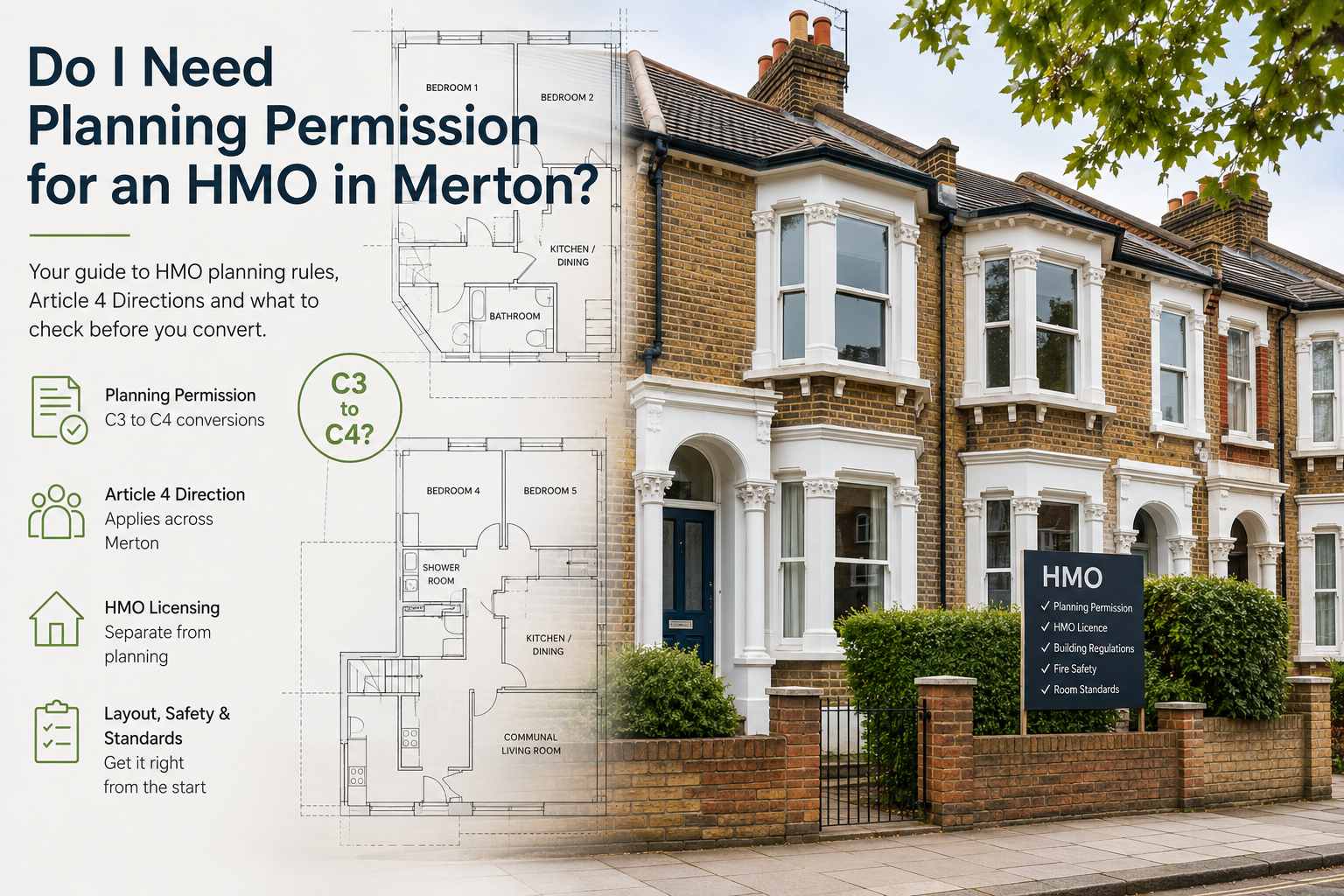
If you are thinking about converting a house or flat into an HMO in Merton, the safest starting point is simple: you should assume that planning permission may be required before you make changes or let the property as shared accommodation. Merton Council has removed permitted development rights across the borough for converting homes from Use Class C3 to small HMOs in Use Class C4, which means many HMO projects now need a planning application before they can go ahead.
The short answer
Yes. In Merton, if you are converting a normal home into an HMO, you are likely to need planning permission.
Merton Council states that permitted development rights have been removed across the whole borough for converting homes, Use Class C3, into small houses in multiple occupation, Use Class C4. The council says this means the conversion of homes to an HMO of any size anywhere in Merton will require planning permission.
This is especially important for landlords, homeowners and property investors in areas such as Wimbledon, Raynes Park, Morden, Colliers Wood, Mitcham, South Wimbledon, Merton Park, Cannon Hill, Ravensbury and the wider borough.
What is an HMO in planning terms?
In planning, a normal house or flat used by one household is usually Use Class C3. A small HMO is usually Use Class C4. The Planning Portal describes C4 HMOs as small shared houses occupied by between three and six unrelated individuals as their only or main residence, sharing basic amenities such as a kitchen or bathroom.
If an HMO has more than six residents, it normally falls outside Use Class C4 and is treated as “sui generis”, meaning it is in a class of its own. The Planning Portal explains that C4 is limited to houses with no more than six residents, so HMOs with more than six residents become sui generis.
In practical terms:
- A family home is usually C3.
- A shared house for 3 to 6 unrelated occupiers is usually C4.
- A larger HMO with more than 6 occupiers is usually sui generis and will normally need planning permission.
What is Article 4 and why does it matter in Merton?
In many parts of England, changing a house from C3 to a small C4 HMO can sometimes be permitted development. That means a full planning application may not always be needed.
However, councils can use an Article 4 Direction to remove those permitted development rights in specific areas. Merton has done this for HMOs.
Merton first introduced an Article 4 Direction for seven wards: Colliers Wood, Cricket Green, Figge’s Marsh, Graveney, Lavender Fields, Longthornton and Pollards Hill. This started on 17 November 2022 and was later confirmed. Merton then introduced a further Article 4 Direction covering the remaining 13 wards from 24 March 2026, meaning the HMO planning restriction now applies across the whole borough.
So, if you are planning a new HMO in Merton, do not rely on general national permitted development rules. Check the Merton-specific position first.
Planning permission and HMO licensing are not the same thing
One common mistake is confusing planning permission with an HMO licence. They are separate.
Planning permission deals with whether the use of the property is acceptable in planning terms. The council may consider issues such as the concentration of HMOs, impact on neighbours, refuse storage, outlook, parking, cycle storage, noise, amenity and whether the layout is suitable.
HMO licensing deals with housing standards and property management. Merton Council makes clear that HMO licensing is separate from planning permission.
For example, Merton says a mandatory HMO licence is needed where five or more people live in an HMO, forming more than one household, unless an exemption applies.
Merton also has additional HMO licensing for some smaller HMOs. At the time of writing, Merton says an additional HMO licence is needed where 3 or 4 people live in an HMO, forming more than one household, in the wards of Colliers Wood, Cricket Green, Figge’s Marsh, Graveney, Lavender Fields, Longthornton or Pollards Hill, unless an exemption applies.
This means a property may need:
- planning permission;
- an HMO licence;
- building regulations approval;
- fire safety upgrades;
- suitable waste arrangements;
- proper room sizes and shared facilities.
These should be checked together, not one by one after the design is already fixed.
What should you check before buying or converting a property into an HMO in Merton?
Before you invest in a property or start works, it is worth checking the following.
First, check the existing lawful use. Is the property currently a normal C3 dwelling, an existing HMO, a flat, a mixed-use property or something else? This matters because the planning route depends on the current lawful use.
Second, check the proposed number of occupiers. A 3 to 6 person shared house is treated differently from a larger HMO with more than six residents.
Third, check whether the layout can work properly. A good HMO is not just about adding bedrooms. The council and licensing team may look at room sizes, shared facilities, circulation, natural light, outlook, kitchen provision, bathrooms, fire safety, storage and waste.
Fourth, check the impact on neighbours. Even a well-designed HMO can raise planning concerns if the proposal creates noise, overlooking, poor waste storage or an overconcentration of HMOs nearby.
Fifth, check building regulations and fire safety early. Depending on the works, you may need upgrades to fire doors, escape routes, alarms, partitions, sound insulation, ventilation and other safety measures.
Finally, check licensing requirements. Merton’s licence application process asks for information such as room sizes, number of occupants, bathrooms, kitchens, sinks, wash basins, toilets, a sketch plan, safety certificates and waste arrangements.
Do you need drawings for an HMO planning application?
Usually, yes. A planning application for an HMO conversion will normally need clear existing and proposed drawings. These may include:
- existing floor plans;
- proposed floor plans;
- site plan and location plan;
- proposed layout and room uses;
- waste and recycling storage;
- cycle storage;
- amenity space, where relevant;
- supporting planning statement, where useful.
For more complex properties, such as mixed-use buildings, flats above shops, loft conversions, extensions or buildings in sensitive locations, the planning package may need more detailed information.
This is where early design work can save time. A layout that looks profitable on paper may fail if bedrooms are too small, circulation is awkward, fire safety is difficult, or the refuse arrangement creates planning objections.
Can an existing HMO continue without a new planning application?
Possibly, but this depends on the facts and evidence. If a property was already lawfully operating as an HMO before the relevant Article 4 Direction came into force, it may not need a new planning application simply because of the Article 4 Direction. However, you may need evidence of the lawful use, and a Lawful Development Certificate may be worth considering.
This is a situation where professional advice is particularly important, because the answer depends on dates, evidence, occupation history and the exact use of the property.
How Gartwork Architecture can help
Gartwork Architecture can help you look at the property before you commit to a design or planning route. This can include reviewing the existing layout, exploring HMO layout options, preparing planning drawings, advising on likely planning issues, coordinating with other consultants where needed, and submitting the planning application on your behalf.
For HMO projects, good design is not only about creating more rooms. It is about making the property safe, functional, compliant and more likely to be accepted by the council.
If you are considering an HMO conversion in Merton or South West London, it is best to check the planning position before starting works or advertising the property as shared accommodation.
Categories
HMO
Planning Permission
Merton
South West London
Property Conversion
Landlords
Shared Housing
Architecture
Planning Application