Do Internal Doors Need to Be Fire-Rated?
Not every internal door in a home needs to be fire-rated. In a simple house with no loft conversion, no integral garage, no flats, no HMO use and no protected escape route, many internal doors may be ordinary doors. However, once a door forms part of a fire strategy, the answer changes. Fire-rated doors may be needed to protect stairs, corridors, flat entrances, commercial escape routes, garage connections or compartment lines. The safest way to decide is to look at the whole layout, not the door in isolation. Approved Document B is the main fire safety guidance for Building Regulations in England, with separate volumes for dwellings and buildings other than dwellings.
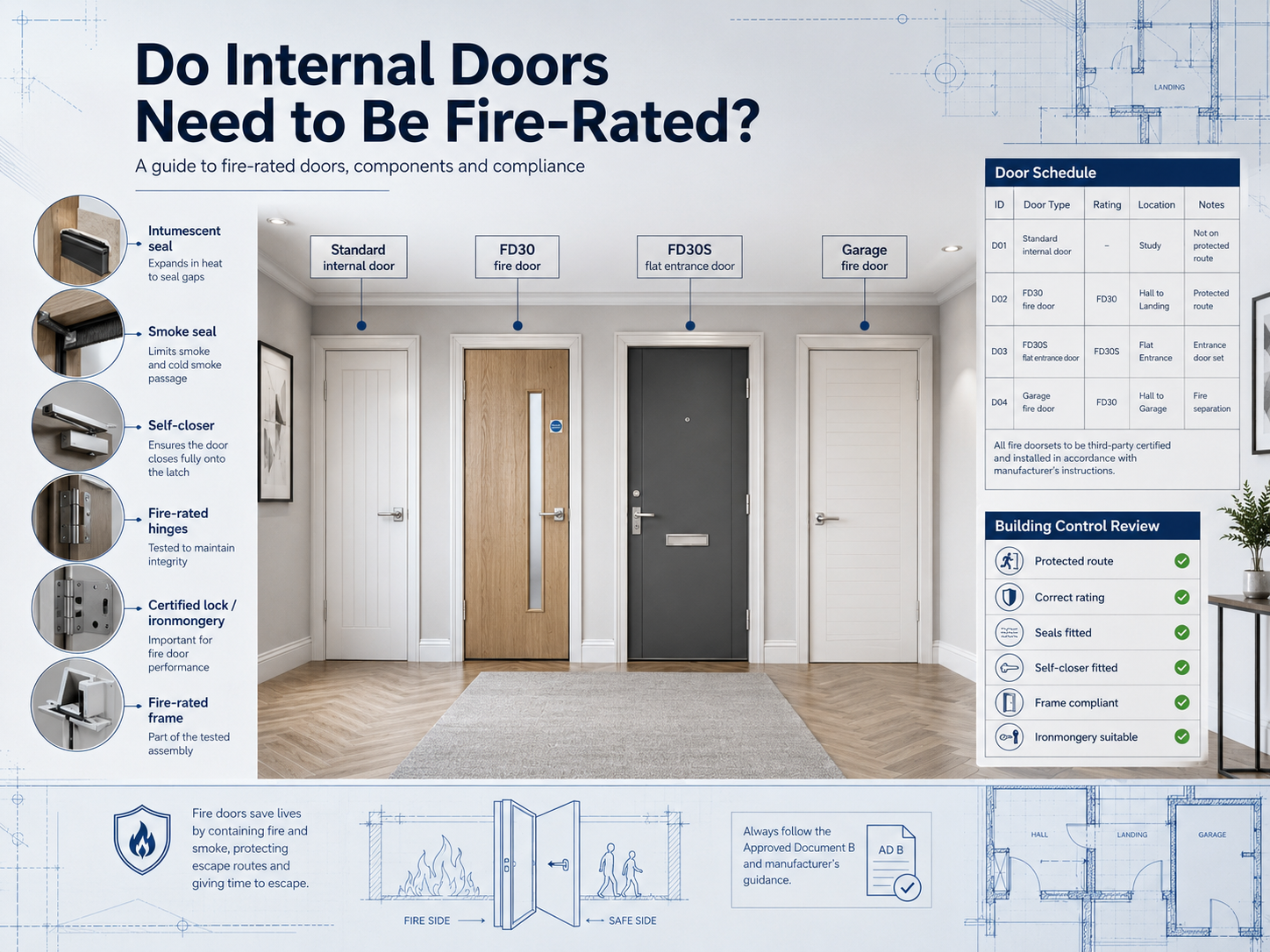
The short answer
Internal doors need to be fire-rated when they form part of the required fire safety strategy.
They do not need to be fire-rated simply because they are internal doors. They may need to be fire-rated because of where they are, what they protect, and what would happen if smoke or fire spread through that opening.
Common examples include:
- doors opening onto a protected stair;
- doors to flats from a communal corridor or stair;
- doors between a house and an integral garage;
- doors in HMOs or shared houses;
- doors in converted buildings;
- doors between residential and commercial parts of a building;
- doors protecting a basement escape route;
- doors to plant rooms, electrical cupboards or higher-risk spaces;
- doors forming part of a compartment wall or fire-resisting enclosure.
This is why a door schedule should not only say “new internal door”. It should identify which doors are standard doors and which doors are fire doors.
Why fire-rated doors matter
A fire door is not just a heavier door. It is part of a fire safety system.
Its purpose may be to:
- slow the spread of fire;
- reduce smoke spread;
- protect an escape route;
- protect a stair;
- separate one flat from another area;
- protect sleeping occupants;
- separate a higher-risk room;
- support compartmentation;
- give people more time to escape.
A standard internal door may provide some resistance for a short time, but it is not tested or installed as a fire-resisting doorset. Where Building Regulations or a fire strategy require a fire door, a normal door is not a substitute.
Planning permission and Building Regulations are separate
Fire doors are usually a Building Regulations issue, not a planning issue.
A project can receive planning permission and still need fire-rated doors at the Building Control stage. GOV.UK confirms that Building Regulations approval is different from planning permission and that homeowners may need both.
This is common in:
- loft conversions;
- extensions;
- flat refurbishments;
- conversions from one flat to two flats;
- HMOs;
- flats above shops;
- commercial-to-residential conversions;
- internal structural alterations;
- works to mixed-use buildings.
Planning drawings may show the layout. Building Control drawings need to show how the layout works safely.
When standard internal doors are usually enough
In a typical two-storey private house, many internal doors may not need to be fire-rated.
For example, ordinary bedroom, bathroom, living room or kitchen doors may be standard internal doors if they are not part of a protected escape route, compartment line, garage separation or special fire strategy.
However, this changes if the project includes:
- a loft conversion;
- an open-plan arrangement affecting escape;
- a third storey;
- a basement;
- an integral garage;
- a rental use;
- an HMO;
- flats;
- commercial use;
- a protected stair;
- a Building Control requirement.
The important point is context. The same style of door might be acceptable in one room but not in another.
Loft conversions: why fire doors often appear
Loft conversions are one of the most common situations where homeowners first encounter fire doors.
When a loft becomes a habitable room, the escape route from the new upper floor becomes more important. Building Control may require the stair to be protected, which often means upgrading doors to rooms that open onto the stair or escape route.
In practice, this may mean fire-rated doors to bedrooms, living rooms or other habitable rooms opening onto the stair. Bathrooms and cupboards may be treated differently, depending on the layout and risk, but this should be confirmed with Building Control.
A common mistake is spending money on the loft structure, stairs and finishes, then discovering late that many existing doors also need upgrading.
Integral garages
A door between a house and an integral garage is often required to be fire-resisting because the garage presents a higher fire risk.
This is not just because of cars. Garages may contain fuel, tools, batteries, chargers, paints, stored materials and appliances. The door between the garage and house may also need a self-closing device and smoke seals, depending on the accepted Building Control strategy.
This door should not usually be treated as a normal internal door.
Flats and flat entrance doors
Flat entrance doors are particularly important because they often protect a communal corridor, lobby or stair.
In a block of flats, the flat entrance door is usually not just “the front door to the flat”. It is part of the fire separation between the private dwelling and the shared escape route.
The Fire Safety (England) Regulations 2022 introduced duties for responsible persons in buildings containing two or more domestic premises. GOV.UK says the regulations introduced new duties under the Fire Safety Order for building owners or managers, known as responsible persons.
This is why replacing or altering a flat entrance door should be treated carefully. Changing the door leaf, removing a closer, changing ironmongery, cutting in a letterbox or replacing the frame can all affect fire performance.
HMOs and shared houses
HMOs often need more careful fire protection than ordinary single-family houses.
This is because occupants may be unrelated, may not know each other’s routines, may sleep in separate locked rooms, and may be less familiar with the building. The layout, number of occupants, storeys, escape route, kitchen position and licensing requirements can all affect the door specification.
Fire-rated doors may be needed to bedrooms, kitchens, escape routes and communal areas, depending on the HMO type and local requirements.
For HMO projects, it is better to check the fire strategy, licensing requirements and Building Control expectations before ordering doors.
Flats above shops and mixed-use buildings
Internal doors become especially important in mixed-use buildings.
For example, a building may have a shop, clinic or office at ground floor and flats above. In that situation, doors may be needed to protect:
- residential stairs;
- commercial escape routes;
- lobbies;
- plant rooms;
- storage rooms;
- basement routes;
- service cupboards;
- compartment lines between uses.
Approved Document B includes fire safety guidance for dwellings and buildings other than dwellings, which is relevant because mixed-use buildings may involve both residential and commercial parts.
A door in this type of building should not be chosen only for appearance. It needs to be checked against the fire strategy.
Commercial premises and fire risk assessments
For commercial premises, fire-rated doors may also be part of the ongoing fire risk assessment.
GOV.UK says the responsible person must carry out and regularly review a fire risk assessment of the premises. It also says the assessment should consider emergency routes and exits, fire detection and warning systems, firefighting equipment, evacuation plans and people at risk.
This matters for shops, clinics, offices, salons, restaurants and other commercial spaces. A door that looks like an ordinary internal door may actually protect a route, separate a risk area or form part of a managed fire strategy.
What does FD30 mean?
FD30 usually means a fire door designed to provide 30 minutes of fire resistance when properly tested, specified and installed.
FD60 means 60 minutes.
The number is not only about the door leaf. A fire door only works if the whole assembly is compatible. That can include:
- door leaf;
- frame;
- stops;
- hinges;
- latch;
- closer;
- intumescent seals;
- smoke seals, where required;
- glazing, where included;
- letterbox or viewer, where included;
- threshold details;
- installation method.
This is why replacing only the door leaf may not be enough.
What does FD30S mean?
FD30S usually means a 30-minute fire door with smoke control.
The “S” matters because smoke can be dangerous before flames reach the door. Smoke seals help restrict smoke spread around the edges of the door.
FD30S doors are often used where smoke protection is important, such as flat entrance doors, protected corridors, protected stairs or certain commercial escape routes.
The exact rating should be confirmed by the Building Control body, fire strategy or fire risk assessor.
Fire door leaf vs fire doorset
A common mistake is buying a fire-rated door leaf and hanging it in a standard frame.
That may not be acceptable.
A fire door should be treated as a tested system. The frame, seals, hinges, latch, closer and installation all affect performance. If the door leaf is fire-rated but the frame is unsuitable, the gaps are too large, the wrong hinges are used or the intumescent seals are missing, the door may fail to perform as intended.
For this reason, the specification should not simply say “fire door”. It should set out the required rating and compatible components.
Door frames matter
The frame is not a decorative extra. It is part of the fire door assembly.
If a project needs fire doors, the frame may need to be:
- suitable for the fire rating;
- installed plumb and square;
- fixed correctly;
- compatible with the door manufacturer’s evidence;
- fitted with suitable stops;
- sealed to the surrounding wall;
- coordinated with intumescent strips and smoke seals.
In refurbishments, existing frames are often a weak point. They may be thin, damaged, twisted, over-trimmed, badly fixed or unsuitable for the new fire door leaf.
A new fire door in a poor existing frame may not satisfy Building Control.
Ironmongery matters
Fire door ironmongery is not just about style.
The hinges, latch, handles, closer and any locks need to be compatible with the fire door. If the wrong hinges are used, if the latch does not hold the door closed, or if the closer does not close the door properly, the door may not perform.
For fire doors, check:
- number and type of hinges;
- fire-rated hinge pads, where required;
- latch compatibility;
- closer type;
- handle and lock specification;
- intumescent protection around ironmongery;
- fire-rated letterbox, viewer or glazing, where relevant;
- manufacturer’s instructions.
This is why door procurement should be coordinated with the technical drawings, not left until the builder is ordering joinery.
Self-closers: are they always needed?
Not always, but often.
Some fire doors need self-closing devices because a fire door only works when it is closed. A fire-rated door wedged open may provide little protection.
Self-closers are commonly required on flat entrance doors, doors to integral garages, commercial escape routes and other doors identified in the fire strategy.
In some domestic situations, such as certain internal doors in houses, Building Control may not require closers to every door, but this depends on the accepted design route. The safest approach is to confirm the requirement before ordering.
Smoke seals and intumescent strips
Intumescent strips expand when exposed to heat, helping to seal the gap around the door.
Smoke seals are designed to restrict cold smoke passing around the door.
Some doors need intumescent strips only. Some need combined intumescent and smoke seals. Some need threshold seals or drop seals. The requirement depends on the door location and fire strategy.
These details should be shown in the specification. They should not be guessed on site.
Glazed fire doors
Glazed fire doors can be used, but the glazing must be part of the tested fire-rated system.
A standard glass panel cut into a fire door is not acceptable unless the glass, beads, seals and installation are suitable for the required fire rating.
This is important where clients want feature doors, glazed kitchen doors or doors that match a particular interior style. It may still be possible, but the design needs to be checked against the fire rating.
Can fire doors be attractive?
Yes.
Fire-rated doors do not have to look institutional. There are many styles, including:
- flush contemporary doors;
- traditional panelled doors;
- painted timber doors;
- veneer doors;
- glazed fire doors;
- feature doors;
- bespoke doors, where tested and certified.
However, appearance cannot be separated from performance. A beautiful door that is not tested, correctly framed or properly fitted may not work as a fire door.
For high-end interiors, the best approach is to identify early which doors must be fire-rated, then source suitable fire-rated options rather than designing the look first and checking compliance later.
Do all doors in a project need to match?
Not necessarily.
Some clients worry that if one door needs to be fire-rated, all doors must be fire-rated. That is not always true.
A project may include:
- standard internal doors in low-risk areas;
- fire-rated doors on escape routes;
- FD30 or FD30S flat entrance doors;
- a special fire-rated door to a garage;
- feature non-fire doors in rooms where fire rating is not required.
The key is to produce a clear door schedule. This avoids over-specifying expensive fire doors everywhere or under-specifying doors where they are essential.
What often gets missed
The most common mistake is asking, “Does this door need to be fire-rated?” too late.
Other common mistakes include:
- ordering doors before Building Control comments;
- assuming a solid core door is automatically a fire door;
- using a fire-rated leaf in a standard frame;
- forgetting smoke seals;
- using the wrong hinges;
- trimming too much from the door;
- removing self-closers;
- fitting non-rated glazing;
- choosing feature doors before checking certification;
- not showing fire doors on drawings;
- not coordinating door swings with escape routes;
- forgetting fire doors to service cupboards or plant rooms;
- failing to keep certificates and installation records.
Fire door issues are much easier to solve on drawings than after manufacture.
What should be shown on Building Control drawings?
For Building Control, the drawings and door schedule should usually identify:
- which doors are standard internal doors;
- which doors are fire-rated;
- required rating, such as FD30 or FD30S;
- self-closing requirements;
- smoke seal requirements;
- door swings;
- protected routes;
- flat entrance doors;
- doors to higher-risk rooms;
- fire-resisting walls or compartment lines;
- notes on frames, seals and ironmongery;
- any glazed fire doors;
- manufacturer or certification requirements.
The drawing note should be specific enough for the builder to price and install correctly.
Fire doors and existing buildings
Existing buildings can be tricky.
Older houses and flats often have:
- original panelled doors;
- non-standard door sizes;
- thin frames;
- uneven openings;
- decorative architraves;
- listed building constraints;
- leaseholder restrictions;
- previous alterations;
- narrow corridors;
- unusual stair layouts.
Sometimes Building Control may accept an upgrade strategy rather than full replacement, but this depends on the project, risk and accepted guidance. In listed buildings, replacing historic doors can also raise heritage issues.
This is why the door strategy should be coordinated early with Building Control and, where relevant, the conservation officer or managing agent.
Fire doors in listed buildings and conservation projects
In listed buildings, internal doors may be part of the building’s significance.
This can create a conflict between fire safety and heritage conservation. Removing historic doors may harm the building’s character, but leaving them unchanged may not meet fire safety expectations.
Possible approaches may include:
- upgrading existing doors where acceptable;
- adding discreet intumescent seals;
- using specialist heritage fire-door upgrade systems;
- retaining important doors and adding other compensatory measures;
- installing new fire-rated doors in less sensitive locations;
- agreeing a project-specific strategy with Building Control and conservation officers.
This should be handled carefully. Fire safety and heritage should not be treated as separate conversations.
Fire doors in flats and leasehold properties
For flats, especially in managed buildings, door changes may also need freeholder or managing agent approval.
A flat owner may think they are only changing their own front door, but the entrance door may form part of the building’s fire strategy and common escape route.
Before changing a flat entrance door, check:
- the lease;
- managing agent requirements;
- fire risk assessment;
- building fire strategy;
- Building Control requirements;
- required rating;
- closer and smoke seal requirements;
- permitted appearance;
- certification documents.
This is particularly important where the door opens onto a communal corridor or stair.
A practical checklist before ordering internal doors
Before ordering doors, ask:
- Is this a normal house, flat, HMO, commercial unit or mixed-use building?
- Is there a loft conversion, basement or integral garage?
- Does the door open onto a protected stair or corridor?
- Is the door a flat entrance door?
- Is the door on a compartment line?
- Does it protect a higher-risk room or cupboard?
- Has Building Control reviewed the layout?
- Is a fire strategy required?
- What rating is needed: standard, FD30, FD30S, FD60 or another rating?
- Does the frame need replacing?
- Are smoke seals required?
- Is a self-closer required?
- Is the glazing fire-rated?
- Is the ironmongery compatible?
- Will certificates and installation records be kept?
How Gartwork Architecture can help
Gartwork Architecture can help identify which internal doors need to be fire-rated and coordinate the information needed for Building Control, contractors and suppliers.
This may include reviewing the layout, preparing Building Control drawings, marking protected routes, preparing a door schedule, coordinating fire door ratings, checking frames and ironmongery requirements, and responding to Building Control comments.
For projects involving flats, HMOs, loft conversions, listed buildings or mixed-use properties, this coordination can prevent costly mistakes and avoid ordering the wrong doors.
Final takeaway
Internal doors do not automatically need to be fire-rated. They need to be fire-rated when they are part of the fire strategy.
The important question is not “is it an internal door?” but “what does this door need to protect?”
If the door protects an escape route, stair, flat entrance, garage connection, compartment line or higher-risk area, it may need to be a certified fire door with the correct frame, seals, closer and ironmongery. The safest approach is to check the layout with Building Control before ordering, then document the door specification clearly on the drawings and door schedule.
Categories
Fire Doors
Internal Doors
Fire-Rated Doors
FD30
Building Regulations
Approved Document B
Building Control
Loft Conversion
Flat Entrance Door
Protected Stair
Fire Door Frames
Fire Door Ironmongery
Fire Strategy
Door Schedule
Architecture
FD30S