Fire Strategy for Flats Above Shops: What Often Gets Missed
Flats above shops are common on high streets, but they can be surprisingly complex from a fire strategy point of view. The building may look simple: commercial use below, residential use above. In practice, there may be shared structure, hidden service voids, old staircases, altered shopfronts, basement ducts, rear escape routes, leasehold boundaries and previous undocumented works. Fire strategy needs to be considered early, because Building Regulations approval is separate from planning permission and may be needed for many alteration projects. GOV.UK confirms that Building Regulations approval is different from planning permission and that you may need both.
The short answer
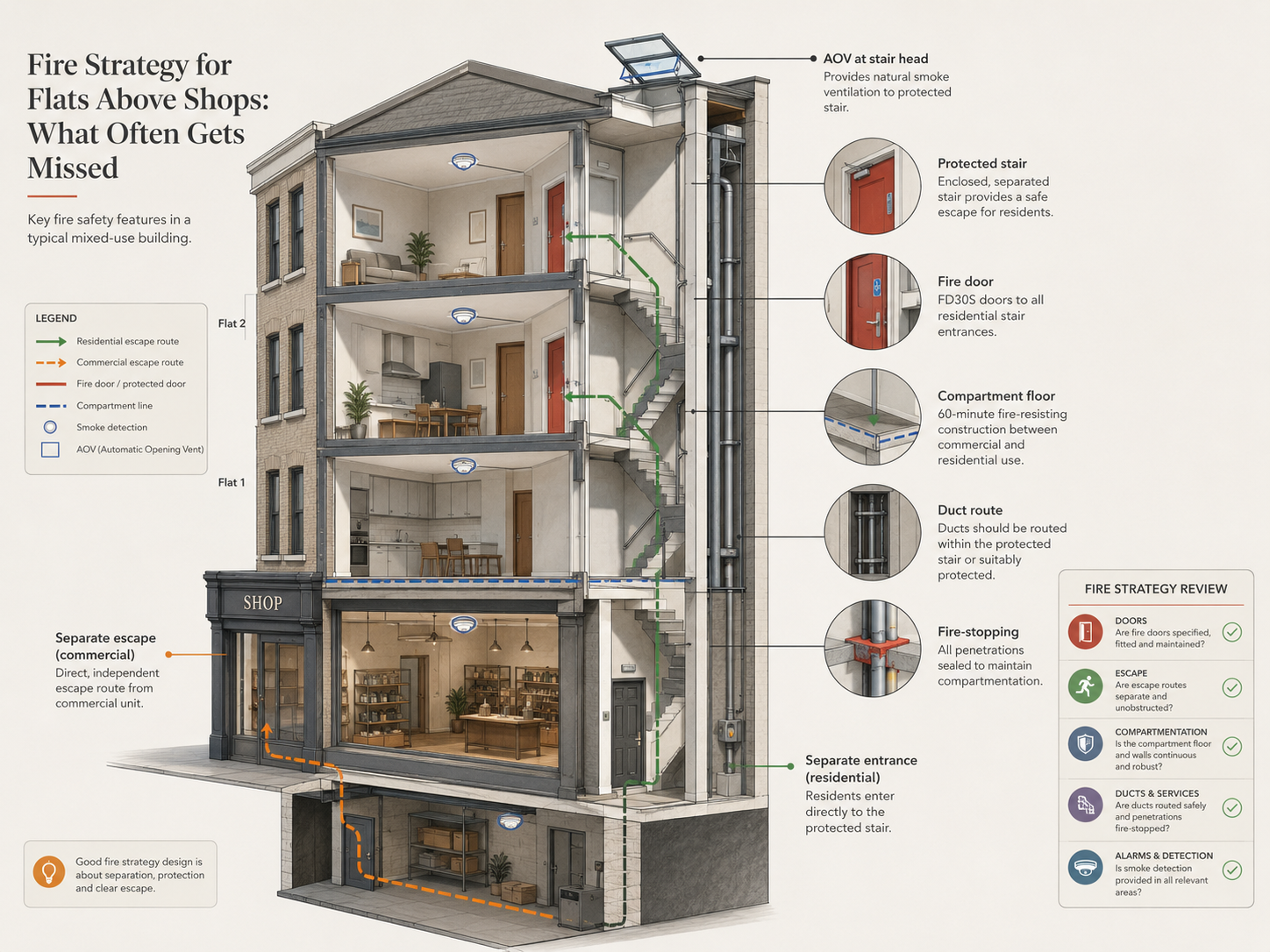
A fire strategy for flats above shops needs to show how the residential and commercial parts of the building are separated, how people escape safely, how fire and smoke are detected, how services are fire-stopped, and how firefighters can access the building.
What often gets missed is not one single item. It is usually the coordination between several things:
- the shop or commercial use;
- the flats above or behind;
- the staircases;
- fire doors;
- service penetrations;
- ductwork;
- ceilings and voids;
- structural alterations;
- alarm systems;
- escape routes;
- Building Control comments;
- fire risk assessment responsibilities;
- leasehold and management responsibilities.
Approved Document B is the main statutory guidance for fire safety matters within and around buildings in England. The GOV.UK page for Approved Document B confirms that it includes Volume 1 for dwellings and Volume 2 for buildings other than dwellings, which is important for mixed-use projects where residential and commercial parts need to be considered together.
Why flats above shops are different
A normal house usually has one main use: residential.
A flat above a shop is different because the building often contains two different risk profiles:
- people sleeping in the residential part;
- staff, customers, stock, equipment or treatment rooms in the commercial part.
The commercial premises may have different opening hours, different fire loads, different management arrangements and different services. A shop, restaurant, clinic, office or salon below a flat can each create a different fire strategy problem.
This is why the design should not simply assume that the flat is “separate enough” because it has a different front door. The construction, escape routes and services need to be checked.
What does a fire strategy need to explain?
A good fire strategy should explain the basic logic of the building.
For a mixed-use building with flats above shops, this often means answering:
- Where are the flats?
- Where is the commercial unit?
- Are the entrances separate?
- Are the escape routes separate?
- Is the residential stair protected?
- Is there a shared lobby or corridor?
- What separates the shop from the flats?
- Are the floors, walls and ceilings fire-resisting?
- Are the flat entrance doors fire doors?
- Are commercial doors on escape routes fire doors?
- How is smoke controlled?
- Where are alarms and detectors located?
- How do ducts and services pass through the building?
- Are penetrations fire-stopped?
- Can firefighters access the building?
- Who manages the common parts?
If the drawings do not answer these questions, Building Control may ask for further information.
What often gets missed: the separation between the shop and the flats
The biggest issue is often compartmentation.
The commercial unit and the flats should usually be separated so that a fire in one part of the building does not quickly spread into the other. This means looking at floors, walls, ceilings, voids, risers, ducts, stair enclosures and service penetrations.
It is not enough to say “the flat is above the shop”. The technical package should show how the separation is achieved.
For example, the design may need to identify:
- fire-resisting floors between commercial and residential areas;
- fire-resisting ceilings below flats;
- protected stair enclosures;
- fire-stopped service penetrations;
- fire-rated access panels;
- cavity barriers;
- protected service risers;
- fire-resisting ductwork or dampers where needed.
Approved Document B covers fire safety in and around buildings, while GOV.UK’s purpose-built flats guidance explains fire safety risk management in blocks of flats. Both are relevant reference points when considering residential fire safety and fire separation in multi-occupied buildings.
What often gets missed: ducts and service voids
Ducts are a common hidden problem.
A duct may look harmless on a drawing, but if it passes through a fire-resisting wall, floor or ceiling, it can compromise fire separation unless properly designed. The same applies to extract routes, ventilation ducts, soil pipes, cable routes, pipework, recessed lights and access panels.
In mixed-use buildings, ducts often run through awkward spaces because the commercial unit needs ventilation, extract or servicing, while the flats need protection from fire and smoke.
Common questions include:
- Does the duct pass through a compartment wall?
- Does it pass through a compartment floor?
- Does it connect different fire compartments?
- Is it enclosed in fire-resisting construction?
- Are fire dampers required?
- Is fire-resisting ductwork required?
- Are grilles and access panels fire-rated?
- Is there evidence from a specialist designer or manufacturer?
- Is the duct route shown clearly on the drawings?
A vague note saying “all penetrations to be fire-stopped” may not be enough if the ductwork is central to the strategy.
What often gets missed: the flat entrance doors
Flat entrance doors matter because they are often part of the fire separation between the flat and common escape route.
If there is a shared stair or lobby, the door to each flat is not just a normal internal door. It may need to provide fire and smoke resistance, have suitable self-closing arrangements and be coordinated with the wider fire strategy.
The Fire Safety (England) Regulations 2022 introduced duties for responsible persons in blocks of flats. GOV.UK states that, for multi-occupied residential buildings over 11 metres, responsible persons must carry out quarterly checks on communal fire doors and annual checks on flat entrance doors. It also states that, in all multi-occupied residential buildings, residents must be given relevant fire safety instructions and information about the importance of fire doors.
Even where a smaller building is outside some of the height-specific duties, the principle remains important: doors are part of the fire strategy, not a decorative afterthought.
What often gets missed: the residential stair
The stair serving the flats is often the most sensitive part of the scheme.
In older mixed-use buildings, the stair may be narrow, steep, altered, shared, partly enclosed or affected by structural beams. Sometimes a layout that works on a planning drawing becomes difficult at the technical stage because the stair needs proper protection, headroom, door openings and smoke control.
Issues to check include:
- Is the stair for the flats separate from the shop?
- Is it enclosed in fire-resisting construction?
- Are doors onto the stair fire doors?
- Is there smoke detection?
- Is smoke ventilation needed?
- Is the final exit clear and direct?
- Are door widths and swings workable?
- Are there structural obstructions?
- Does the stair connect to any commercial space?
- Are cupboards, meters or services opening into the stair?
A staircase should be reviewed as part of the fire strategy before layouts are fixed.
What often gets missed: basements
Basements can add complexity.
A shop or clinic may use a basement for treatment rooms, storage, staff facilities or plant. Basements can raise fire safety concerns because escape may involve travelling upwards, and smoke behaviour can be more challenging.
In a mixed-use building, the basement may also contain ducts, service voids or plant serving the commercial space. If the basement sits below flats or below a protected residential route, the fire strategy needs to be especially clear.
The drawings should explain:
- how people escape from the basement;
- whether the basement route is protected;
- whether the basement connects to the residential route;
- where detection and alarm coverage is provided;
- how service penetrations are protected;
- whether any plant, battery, electrical or storage risks exist;
- whether fire-resisting construction is needed around ducts or voids.
What often gets missed: the commercial fire risk assessment
Building Regulations deal with building work. They are not the same as the ongoing fire safety management duties for a commercial premises.
GOV.UK says that, as the responsible person, you must carry out and regularly review a fire risk assessment of the premises, and that this identifies what needs to be done to prevent fire and keep people safe. It says the assessment should consider emergency routes and exits, fire detection and warning systems, firefighting equipment, dangerous substances, evacuation plans, vulnerable people, information to employees and staff fire safety training.
For flats above shops, this matters because the commercial risk assessment can affect the residential occupants above. For example, stock storage, locked doors, blocked exits, cooking equipment, treatment rooms, plant, batteries or chemicals may change the risk profile.
What often gets missed: different alarm systems
A commercial unit and residential flats may need different alarm arrangements.
The commercial part may need a fire detection and alarm system appropriate to its use, occupancy and fire risk assessment. The flats may need domestic detection and alarms appropriate to residential guidance.
The mistake is assuming that one alarm system automatically solves both.
Questions to ask include:
- Is the alarm system for the commercial unit separate from the flats?
- Should there be any interface between systems?
- Will a fire in the shop alert occupants of the flats if required by the strategy?
- Will alarms cause unwanted disturbance or confusion?
- Is the system designed to the correct British Standard?
- Are detector locations shown on the drawings?
- Has the responsible person for the commercial premises been considered?
The answer depends on the layout and the adopted fire strategy.
What often gets missed: service penetrations
Service penetrations are easy to miss because they are small on drawings.
They include holes for:
- pipes;
- cables;
- ducts;
- waste pipes;
- ventilation routes;
- sprinkler or mist pipework;
- heating pipework;
- electrical containment;
- telecoms;
- extract grilles;
- recessed lighting.
If these pass through fire-resisting construction, they need proper fire-stopping. A single poorly sealed penetration can compromise a protected route or compartment line.
A good technical package should show the important compartment lines and include clear notes on fire-stopping, access panels, service routes and contractor responsibility.
What often gets missed: shopfront changes
Shopfront design can affect fire strategy.
A new shopfront may change:
- the final exit arrangement;
- the commercial escape route;
- fire service access;
- smoke ventilation possibilities;
- door widths;
- glazing performance;
- shutters or security grilles;
- the relationship between residential and commercial entrances;
- signage and wayfinding.
Planning approval for a shopfront does not automatically mean the fire strategy is resolved. If the shopfront changes during technical design, the fire strategy and Building Control package should be reviewed.
What often gets missed: ownership and lease boundaries
Flats above shops often have complex ownership.
The freeholder may own the whole building. The shop may be leased separately. The flat may be on a long lease. There may be a managing agent, landlord, tenant and commercial operator.
This matters because fire safety responsibilities may sit with different people for different parts of the building.
Questions include:
- Who controls the common parts?
- Who controls the residential entrance?
- Who controls the shop?
- Who maintains the fire doors?
- Who maintains alarms?
- Who keeps fire risk assessments?
- Who manages fire-stopping after future works?
- Who can authorise works to shared structure or services?
- Is a Licence to Alter needed?
These questions should not be left until the end.
What often gets missed: drawings that are too general
Planning drawings usually do not contain enough fire information.
For Building Control, the technical drawings may need to show:
- fire-resisting walls;
- fire-resisting floors and ceilings;
- protected escape routes;
- flat entrance doors;
- commercial fire doors;
- alarm and detector positions;
- emergency lighting where relevant;
- smoke ventilation;
- service risers;
- duct routes;
- fire-stopping notes;
- fire-rated access panels;
- compartment lines;
- final exits;
- fire service access.
GOV.UK confirms that Building Regulations approval may be needed for many alteration projects and warns that, without approval where required, you may not have compliance certificates needed when selling the property.
What often gets missed: Building Control comments
Building Control comments should be treated as design coordination, not admin.
If Building Control asks for clarification on ductwork, escape routes, fire-stopping, ventilation, structural changes or door openings, it usually means the strategy is not yet clear enough.
A good response may need:
- revised drawings;
- a short fire strategy note;
- marked-up compartment lines;
- duct routes;
- manufacturer details;
- structural engineer comments;
- fire-stopping specification;
- contractor confirmation;
- alarm layout;
- updated sections.
Trying to answer complex fire queries in email only, without updating drawings, can lead to confusion on site.
What often gets missed: construction sequencing
A fire strategy is not just a drawing for approval. It has to be buildable.
For example, a strategy may rely on fire-rated ceilings around a service void. But if the ductwork is already installed, access panels are not rated, or the contractor cannot reach the void without opening finished ceilings, the strategy may become difficult to implement.
Before works start, the team should check:
- who installs fire-stopping;
- who inspects fire-stopping;
- who supplies fire door certificates;
- who confirms ductwork fire performance;
- how access panels are rated;
- how hidden works will be photographed;
- how Building Control inspections will be arranged;
- how changes on site will be approved.
This is especially important in older buildings where site discoveries are common.
What often gets missed: fire service access
Fire service access is sometimes assumed because the building is on a high street.
But the strategy should still consider how firefighters reach the building, which entrance they use, whether the residential entrance is clear, whether there are rear routes, and whether any gates, shutters, alleys or locked doors affect access.
Approved Document B includes fire safety matters within and around buildings and Volume 1 is the relevant reference for dwellings, including flats.
For a small high-street building, the solution may be straightforward. But it still needs to be shown clearly enough for Building Control.
What often gets missed: existing buildings are not blank slates
Older mixed-use buildings often contain surprises:
- hidden steel beams;
- altered stairs;
- old service routes;
- blocked-up openings;
- undocumented ducts;
- non-compliant doors;
- shared risers;
- weak compartmentation;
- historic shopfront alterations;
- old basement works;
- incomplete as-built information.
This is why a measured survey and opening-up investigations can be important. A fire strategy based only on assumed construction may need revision once the site is opened.
Fire strategy and planning are different
Planning permission may deal with change of use, shopfront alterations, external works, refuse, amenity, access and design.
Fire strategy is mainly a Building Regulations and fire safety matter. It may not be fully assessed at planning stage.
This means a project can receive planning approval and still need significant fire strategy work before construction. GOV.UK confirms that Building Regulations approval and planning permission are separate and that both may be needed.
Fire strategy and fire risk assessment are also different
A fire strategy explains the design approach for the building works.
A fire risk assessment deals with how the premises are used and managed. GOV.UK says the responsible person must carry out and regularly review a fire risk assessment of the premises, identify hazards and people at risk, evaluate and reduce risks, record findings, prepare an emergency plan and review the assessment regularly.
For a flat above a shop, both may matter:
- the building design must be safe and compliant;
- the commercial premises must be properly managed;
- the common parts must be maintained;
- residents must understand relevant fire safety information.
A practical checklist for flats above shops
Before starting works, check:
- Is the residential entrance separate from the shop?
- Is the residential escape route protected?
- Are the flats separated from the commercial unit by fire-resisting construction?
- Are the flat entrance doors suitable fire doors?
- Are commercial fire doors shown where needed?
- Are alarms and detectors shown clearly?
- Is smoke ventilation needed to the residential stair?
- Are service routes and penetrations shown?
- Are ducts fire-resisting, fire-stopped or fitted with dampers where required?
- Are access panels fire-rated where they penetrate fire-resisting construction?
- Is the basement included in the strategy?
- Has the shopfront change affected escape or access?
- Has Building Control reviewed the strategy?
- Is a commercial fire risk assessment needed or updated?
- Are leaseholder, freeholder or managing agent approvals needed?
- Are hidden works inspected and recorded during construction?
When do you need a fire engineer?
Not every flat above a shop needs a fire engineer.
For some smaller projects, a competent architect, Building Control body and specialist contractors may be able to coordinate the strategy using Approved Document B guidance. However, a fire engineer may be useful where the project involves:
- complex escape routes;
- basement commercial use;
- unusual layouts;
- shared routes between uses;
- listed or constrained buildings;
- difficult compartmentation;
- long travel distances;
- smoke control issues;
- disagreement with Building Control;
- performance-based design;
- compensatory measures;
- multiple commercial units;
- high occupancy or higher-risk activities.
If the strategy relies on assumptions that are not clearly covered by standard guidance, specialist advice should be considered.
How Gartwork Architecture can help
Gartwork Architecture can help review the building layout, prepare technical drawings, coordinate fire strategy information and respond to Building Control comments.
For flats above shops and mixed-use buildings, this may include existing and proposed drawings, protected escape route plans, fire strategy drawings, fire door notes, service penetration notes, duct route coordination, sections showing compartmentation, and coordination with structural engineers, Building Control, contractors and specialist consultants.
The aim is to make the fire strategy clear before the site team starts work, not to discover problems after ceilings, ducts and doors have already been installed.
Final takeaway
Fire strategy for flats above shops is often about coordination.
The common problems are not always dramatic. They are often small missing details: an unprotected stair, an unclear compartment line, a duct through a fire-rated ceiling, a non-rated access panel, a shopfront change, a basement escape route, a missing fire door note or an ownership issue that affects who maintains what.
A good fire strategy should be clear, buildable and coordinated with the real building. The earlier it is considered, the easier it is to avoid Building Control delays, redesigns and costly site changes.
Categories
Fire Strategy
Flats Above Shops
Mixed-Use Buildings
Building Control
Approved Document B
Fire Separation
Compartmentation
Means of Escape
Fire Doors
Fire Stopping
Ductwork
Commercial Unit
Residential Flats
Shopfront
Basement
Technical Drawings
Architecture