HMO Licensing vs Planning Permission: What Landlords Often Confuse
HMO licensing and planning permission are not the same thing. This is one of the most common misunderstandings landlords have when converting a property into shared accommodation. A property can need an HMO licence but still lack planning permission. It can also have planning permission but still fail licensing, fire safety, space standard or building regulation requirements. Getting this wrong can delay a project, create enforcement risk and make an otherwise promising HMO layout unworkable.
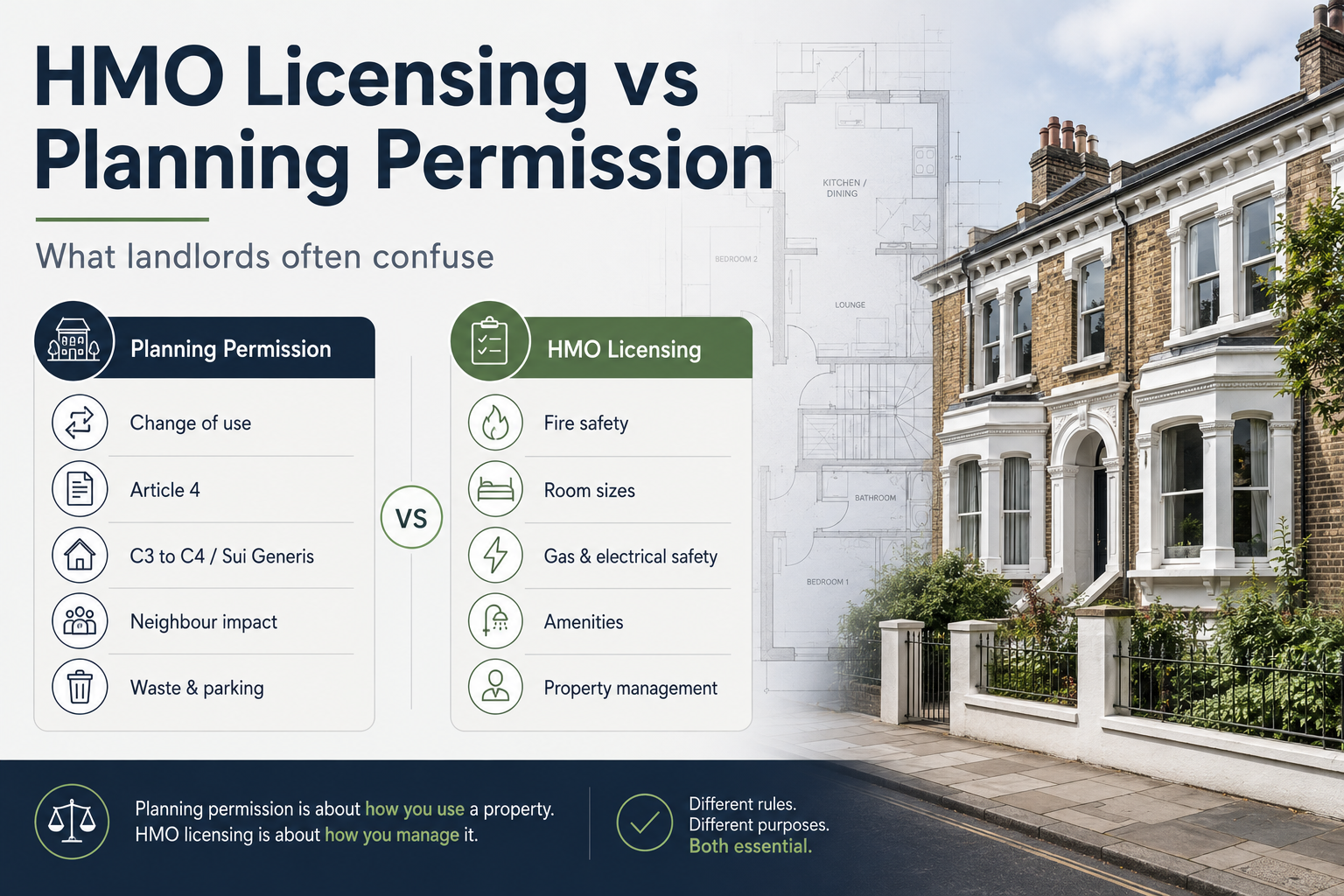
The short answer
HMO licensing is about whether a property is suitable and properly managed as shared rented accommodation.
Planning permission is about whether the use or physical changes to the property are acceptable in planning terms.
They are separate approvals, usually handled by different parts of the council, and one does not automatically grant the other. Merton Council, for example, states that HMO licensing is separate from planning permission.
For landlords, the key point is simple: do not assume that obtaining an HMO licence means the planning position is resolved.
What does HMO licensing deal with?
HMO licensing is mainly concerned with housing standards, safety and management. GOV.UK explains that an HMO is a property rented by at least three people who are not from one household and who share facilities such as a bathroom or kitchen. It also says landlords must contact the council to check whether a licence is needed.
A large HMO normally needs a mandatory licence if it is rented to five or more people forming more than one household, where tenants share facilities and at least one tenant pays rent.
Licensing can look at issues such as:
- whether the house is suitable for the number of occupants;
- whether the landlord or manager is a fit and proper person;
- gas safety certificates;
- smoke alarms;
- electrical safety;
- fire safety;
- room sizes;
- kitchen and bathroom provision;
- waste management;
- general property management.
GOV.UK also notes that smaller HMOs may still need a licence depending on the area, so landlords should not assume that licensing only applies from five occupants upwards.
In Merton, for example, a mandatory HMO licence is needed where five or more people live in an HMO, forming more than one household, unless an exemption applies. Merton also has additional HMO licensing for certain smaller HMOs with three or four people in specified wards.
What does planning permission deal with?
Planning permission deals with the lawful use of the property and the planning impact of the proposal. For HMO projects, this often means asking whether a normal house or flat can lawfully be used as shared accommodation.
In planning terms, a normal dwellinghouse is usually Use Class C3. A small HMO is usually Use Class C4. The Planning Portal explains that Class C4 covers small shared houses occupied by between three and six unrelated individuals as their only or main residence, sharing basic amenities such as a kitchen or bathroom.
Larger HMOs are different. The Planning Portal explains that C4 is limited to houses with no more than six residents, so HMOs with more than six residents become sui generis, meaning they are in a class of their own.
Planning may consider issues such as:
- change of use from C3 to C4 or sui generis;
- whether an Article 4 Direction removes permitted development rights;
- the concentration of HMOs in the area;
- impact on neighbours;
- noise and disturbance;
- parking and cycle storage;
- refuse and recycling storage;
- amenity space;
- external changes such as extensions, dormers or new entrances;
- whether the proposed layout supports a reasonable standard of accommodation.
This is why a layout that seems acceptable for licensing may still raise planning concerns.
The common mistake: “I only need a licence”
Many landlords start by asking whether they need an HMO licence. That is important, but it is not the whole question.
A better first question is:
“Can this property lawfully be used as an HMO, and if so, what permissions, licences and approvals are needed?”
This matters because the order of decisions can affect the whole project. For example, a landlord may spend money on a layout, fire doors, kitchens and bathrooms, only to discover later that the change of use needs planning permission and may be resisted by the council.
In some areas, converting a C3 dwellinghouse to a small C4 HMO may be permitted development. In other areas, an Article 4 Direction may remove that right, meaning a planning application is required. Merton is a clear example: permitted development rights have been removed across the whole borough for converting homes from Use Class C3 to small HMOs in Use Class C4, so the conversion of homes to an HMO of any size in Merton requires planning permission.
The opposite mistake: “I have planning permission, so I can let it”
Planning permission is not the final step either.
Even if planning permission is granted, the property may still need:
- an HMO licence;
- building regulations approval;
- fire safety upgrades;
- electrical and gas safety certificates;
- suitable management arrangements;
- compliance with minimum room sizes and amenity standards.
GOV.UK says a licence is valid for a maximum of five years, must be renewed before it runs out, and a separate licence is needed for each HMO. It also explains that councils can add licence conditions, including improvements to the standard of facilities.
So planning permission may answer the question “Can this use happen here?” but licensing asks “Is this property suitable and safe to operate as an HMO?”
Why architects get involved before the licence application
A good HMO design is not just about adding as many bedrooms as possible. The layout needs to work across several overlapping areas:
- planning use class;
- room sizes;
- circulation;
- escape routes;
- fire doors;
- kitchen provision;
- bathroom provision;
- ventilation;
- refuse storage;
- cycle storage;
- natural light and outlook;
- building regulations;
- licensing standards.
This is where early architectural input can help. Before a landlord commits to building work, the property should be reviewed as a whole. The existing layout, proposed layout, use class, number of occupiers and likely council requirements should be checked together.
This is especially important for properties with mixed uses, flats above commercial premises, loft conversions, extensions, internal reconfiguration or previous unauthorised changes.
A simple way to remember the difference
Think of it like this:
Planning permission asks: “Is this HMO use acceptable in this location and in this building?”
HMO licensing asks: “Is this property safe, suitable and properly managed for the number of people living there?”
Building regulations ask: “Do the physical works meet the required technical standards?”
Landlords often need to deal with all three.
What should landlords check before converting a property into an HMO?
Before buying, converting or letting a property as an HMO, landlords should check:
- The current lawful use of the property.
- The proposed number of occupiers.
- Whether the proposal is C4 or sui generis in planning terms.
- Whether an Article 4 Direction applies.
- Whether planning permission is needed.
- Whether mandatory, additional or selective licensing applies.
- Whether the layout meets room size and amenity expectations.
- Whether building regulations approval is needed.
- Whether the fire strategy is suitable.
- Whether refuse, cycle storage and neighbour impact have been considered.
Doing these checks early can prevent expensive redesigns.
Final takeaway
HMO licensing and planning permission are connected, but they are not interchangeable.
A licence does not prove that the HMO use is lawful in planning terms. Planning permission does not prove that the property meets licensing standards. Building regulations approval does not replace either of them.
For landlords, the safest approach is to check the planning route, licensing requirements and technical standards before starting work or signing tenancy agreements. A clear early review can save time, reduce risk and make the final HMO more practical, compliant and attractive to tenants.
Categories
HMO
Planning Permission
Landlords
Property Conversion
Shared Housing
Building Regulations
Fire Safety
Merton
South West London
Architecture
Planning Application