Listed Building Consent: What If Previous Owners Carried Out Unauthorised Works?
Discovering possible unauthorised works to a listed building can be worrying, especially if they were carried out by previous owners years before you bought the property. The issue often appears during a sale, remortgage, survey, window replacement, refurbishment or when the council reviews a new application. The important point is that listed building control is not the same as ordinary planning control. Works that affect the character of a listed building need listed building consent, and GOV.UK confirms that this applies to the whole building, including internal and external fabric, unless the list entry says otherwise.
The short answer
If previous owners carried out unauthorised works to a listed building, the issue does not necessarily disappear just because time has passed.
GOV.UK guidance says there are no time limits for issuing listed building enforcement notices, although the length of time since the apparent breach may be relevant when the council decides whether enforcement action is expedient. It also states that carrying out works without the necessary listed building consent, where those works materially affect the building’s historic or architectural significance, is an offence.
So the safest approach is to investigate the position carefully, gather evidence, understand what was changed, and take professional advice before approaching the council or carrying out further works.
Why listed buildings are different
A listed building is protected because it has special architectural or historic interest. This does not only mean the front elevation or the most decorative parts of the property.
GOV.UK states that listed building consent is required for any works to demolish, alter or extend a listed building in a way that affects its character as a building of special architectural or historic interest. It also confirms that, unless the list entry says otherwise, listing covers the whole building, internal and external, and may also cover fixed objects and curtilage buildings or structures.
This means consent may be needed for changes such as:
- replacing windows or doors;
- removing internal walls;
- altering staircases;
- changing fireplaces;
- removing cornices, skirtings, shutters or panelling;
- changing roof structure;
- inserting new services;
- changing shopfronts;
- removing historic fabric;
- changing floor levels;
- forming new openings;
- changing external materials;
- changing boundary walls, railings or gates within the listed building’s curtilage.
Some repairs or like-for-like works may not need consent, but this depends on the building, the feature, the method and whether the works affect special interest.
“The previous owner did it” does not make the problem disappear
It is understandable to think: “I did not do the works, so surely this is not my problem.”
Unfortunately, it is not that simple.
The person who carried out or caused the unauthorised works may be the person exposed to criminal liability. However, the building itself can still have an unresolved heritage problem. The council may still consider enforcement action, a buyer’s solicitor may raise questions, and future applications may be affected by what has already been changed.
GOV.UK’s enforcement guidance says there are no time limits for issuing listed building enforcement notices. It also says listed building consent and planning permission for relevant demolition are not granted retrospectively in the ordinary planning sense.
In practice, this means a current owner may still need to deal with the consequences of works carried out before they owned the property.
Does unauthorised listed building work become lawful after four or ten years?
Usually, no.
Ordinary planning breaches can sometimes become immune from enforcement after time limits, depending on the type of breach and when it happened. GOV.UK’s planning enforcement guidance explains the general enforcement time limits for ordinary planning control.
Listed building enforcement is different. GOV.UK specifically says there are no time limits for issuing listed building enforcement notices.
This is one of the most important things for owners and buyers to understand. An unauthorised alteration to a listed building is not necessarily safe simply because it is old.
Is there such a thing as retrospective listed building consent?
People often use the phrase “retrospective listed building consent”, but it should be treated carefully.
For ordinary planning permission, there is a recognised route for retrospective planning applications. For listed buildings, GOV.UK says listed building consent is not granted retrospectively.
However, in practice, owners may still make an application relating to works already carried out, often to regularise the position or to seek consent for remedial works. The outcome depends on the facts. The council may accept the works, require changes, ask for restoration, or refuse the application.
A later consent may help resolve the practical position, but it does not necessarily erase the fact that the works were carried out without consent in the first place. For this reason, legal advice may be needed where enforcement or prosecution risk is a concern.
What should you do first?
The first step is not to start ripping things out or replacing features.
The first step is to understand what happened.
You should try to establish:
- what the building looked like historically;
- what has changed;
- when the works were carried out;
- who carried them out, if known;
- whether listed building consent was granted;
- whether planning permission was granted;
- whether Building Control records exist;
- whether the works affected historic fabric;
- whether the current condition causes harm;
- whether the works can be justified, improved or reversed.
This is a documentation exercise before it is a design exercise.
Check the listing description, but do not rely on it alone
The listing description is a useful starting point, but it may not describe every protected feature.
Older list entries can be short and may only mention the most obvious elements. That does not mean other parts of the building are not protected.
GOV.UK explains that the listing status normally covers the entire building, internal and external, unless the list entry indicates otherwise.
So if the listing description mentions the front elevation but not the staircase, that does not automatically mean the staircase can be altered without consent.
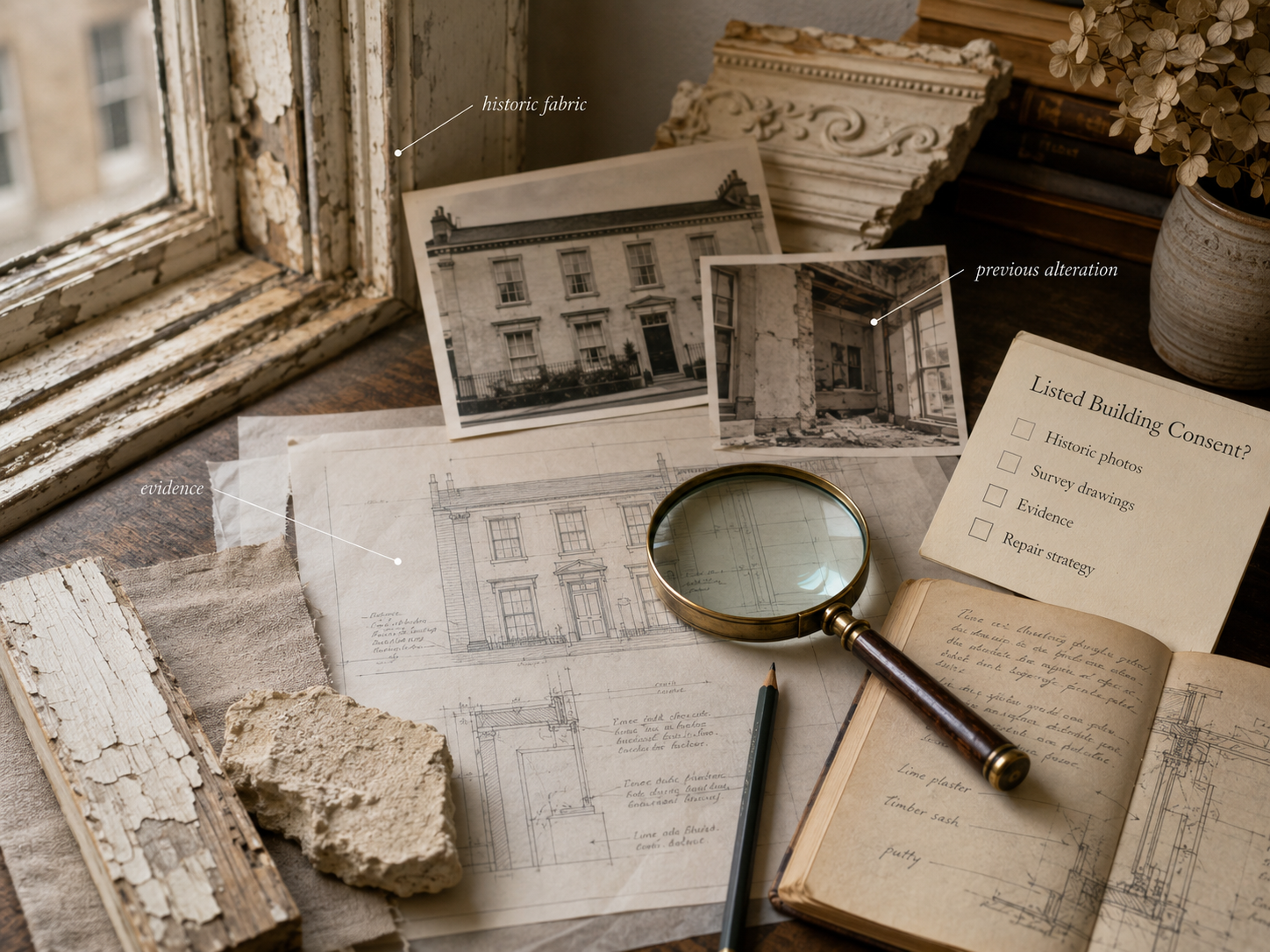
Gather evidence before approaching the council
Evidence can make a big difference.
Useful evidence may include:
- listing description;
- old estate agent photos;
- historic photographs;
- previous planning applications;
- previous listed building consent applications;
- Building Control records;
- survey reports;
- leasehold records;
- old sales particulars;
- dated contractor invoices;
- dated photographs from previous owners;
- archive drawings;
- title documents;
- conservation area appraisals;
- neighbouring property evidence;
- physical evidence on site.
The aim is to understand whether the works were genuinely unauthorised, whether they affected significance, and whether there is a reasonable heritage solution.
Why drawings are important
For a listed building consent or regularisation strategy, clear drawings are often essential.
A useful drawing package may include:
- existing plans;
- existing elevations;
- existing sections;
- historic layout evidence, where available;
- drawings showing unauthorised changes;
- proposed remedial drawings;
- joinery details;
- window or door details;
- material specifications;
- photographs keyed to drawings.
Drawings help the conservation officer understand exactly what has changed and what is proposed. They also help separate serious heritage issues from minor or reversible changes.
The role of a heritage statement
A heritage statement is often needed where works affect a listed building.
GOV.UK says applicants are expected to describe the significance of affected heritage assets, including the contribution made by their setting, and that the level of detail should be proportionate to the asset’s importance and sufficient to understand the potential impact of the proposal.
For unauthorised previous works, a heritage statement may need to explain:
- the building’s significance;
- which features are important;
- what appears to have changed;
- whether the works harmed significance;
- whether the harm can be mitigated;
- whether restoration is practical;
- whether retention is justified;
- what remedial works are proposed;
- how the proposal would preserve or enhance the listed building.
This should be written carefully. The tone should be factual, not defensive.
Should you contact the conservation officer?
Often, yes, but timing matters.
If the situation is sensitive, it may be better to prepare a clear evidence pack before making contact. A vague email saying “previous owners did unauthorised works, what should we do?” may lead to uncertainty or alarm without giving the officer enough information to respond properly.
A better approach is usually to gather evidence first, prepare drawings or photographs, identify the possible unauthorised elements, and then seek advice or submit an application with a clear proposal.
GOV.UK encourages owners and developers to discuss works with the local planning authority where there is doubt about whether listed building consent is required.
What if the works improved the building?
Sometimes previous works may have improved a listed building, or at least not harmed its significance.
For example, a poor modern feature may have been replaced with something more sympathetic, but without consent. In that case, the lack of consent is still a problem, but the heritage argument may be more manageable.
The question is not simply whether the works are old or new. The question is whether they affect the building’s special architectural or historic interest.
A careful application may be able to explain why the current condition is acceptable, or why a small adjustment would make it acceptable.
What if the works harmed the building?
If previous works harmed the building, the council may expect some form of remediation.
This could include:
- reinstating missing details;
- replacing inappropriate windows;
- removing modern materials;
- repairing damaged historic fabric;
- exposing covered features;
- changing inappropriate finishes;
- restoring traditional details;
- using more suitable materials;
- reversing layout changes, where possible.
The best solution depends on the building and the degree of harm. Full restoration is not always practical or proportionate, but doing nothing may not be acceptable either.
Common examples of previous unauthorised works
Common issues include:
- uPVC windows installed in place of timber sash windows;
- inappropriate double-glazed units;
- loss of glazing bars;
- modern doors replacing historic doors;
- removed fireplaces;
- removed chimney breasts;
- removed cornices or ceiling roses;
- suspended ceilings hiding historic features;
- modern plasterboard covering historic walls;
- cement render or pointing on older masonry;
- inappropriate external paint;
- altered staircases;
- removed internal partitions;
- modern shopfronts;
- new services cut through historic fabric;
- rooflights inserted without consent.
Some of these may be serious. Others may be resolvable with a proportionate repair strategy.
What if you are buying a listed building?
If you are buying a listed building, ask questions early.
Before exchange, check:
- the listing entry;
- planning and listed building consent history;
- Building Control history;
- whether alterations have consent;
- whether warranties or certificates exist;
- whether the seller can explain changes;
- whether the surveyor has flagged unauthorised works;
- whether the solicitor has reviewed heritage consents;
- whether indemnity insurance is being suggested;
- whether professional heritage advice is needed.
Do not assume that a clean-looking renovation is properly authorised.
What if you are selling a listed building?
If you are selling and discover a possible issue, it is better to understand it before a buyer’s solicitor does.
You may need to:
- locate old consents;
- prepare a chronology of works;
- find old photographs;
- check council records;
- obtain professional advice;
- consider a listed building consent application;
- prepare an explanation for buyers;
- speak to your solicitor before contacting the council.
The strategy depends on the seriousness of the works, whether they are visible, whether they affected significance, and whether there is a realistic route to resolving the issue.
Should you remove the unauthorised works immediately?
Not without advice.
Removing unauthorised works can itself affect the listed building and may require consent. For example, taking out a modern ceiling may reveal historic fabric, but it may also damage it. Removing modern plaster, windows, partitions or services without a plan can create more harm.
The safer route is to assess first, then propose a controlled repair or reinstatement strategy.
Listed building consent vs planning permission
Listed building consent and planning permission are separate.
Some works may need both. Some internal works may not need planning permission but still need listed building consent. GOV.UK states that planning permission may not be required where works are internal only and would not constitute development, but listed building consent may still be required if the works affect the building’s character.
This is a common source of confusion. A previous owner may say “we did not need planning permission”, but that does not answer the listed building consent question.
Listed building consent vs Building Control
Building Control approval does not replace listed building consent.
A builder, contractor or building inspector may have been involved in previous works, but that does not mean the heritage consent position was resolved. Building Regulations are concerned with technical standards such as structure, fire safety, insulation and drainage. Listed building consent is concerned with the building’s special architectural or historic interest.
Both can be needed.
Can minor works be exempt?
Some works may not need listed building consent if they do not affect the character of the listed building as a building of special architectural or historic interest.
GOV.UK explains that a Certificate of Lawfulness of Proposed Works can confirm that proposed works do not require listed building consent because they do not affect character. However, it also states that this certificate is only available for proposed works and cannot be obtained retrospectively.
For works already carried out by previous owners, the focus is therefore usually evidence, heritage assessment and, where needed, a consent or remedial strategy.
Why this often comes up during new works
Unauthorised previous works often come to light when a new owner wants to make fresh improvements.
For example, a new window application may reveal that earlier window replacements were unauthorised. A kitchen refurbishment may reveal that walls were removed. A roof repair may reveal modern changes to historic structure. A conservation officer reviewing a new application may ask about past works before supporting future works.
This is why it is useful to review the building as a whole before submitting a new listed building consent application.
A practical action plan
If you discover possible unauthorised previous works, the following approach is sensible:
- Stop and avoid further works until the position is understood.
- Check the listing entry.
- Search the council’s planning and listed building consent records.
- Gather old photographs and documents.
- Identify what appears to have changed.
- Prepare existing drawings and photographs.
- Assess whether the changes affect significance.
- Speak to a heritage architect, planning consultant or solicitor as needed.
- Decide whether to seek informal advice or submit an application.
- Prepare a clear heritage statement and remedial proposal if needed.
- Keep a complete record for future sale or refinancing.
How Gartwork Architecture can help
Gartwork Architecture can help owners understand what has changed and what the safest next step may be.
This may include reviewing the property, preparing existing drawings, comparing current and historic layouts, identifying possible unauthorised works, preparing a heritage statement, developing a sensitive repair or regularisation strategy, liaising with consultants and preparing a listed building consent application.
The aim is not only to “get consent”. The aim is to understand the building properly, reduce risk and find a proportionate way to preserve its character while allowing it to remain useful.
Final takeaway
If previous owners carried out unauthorised works to a listed building, do not assume the issue has expired. Listed building control is strict, and GOV.UK confirms that there are no time limits for listed building enforcement notices.
The best response is calm and evidence-led: understand the building, identify the works, assess heritage impact, and prepare a careful strategy before contacting the council or starting further works.
Categories
Listed Building Consent
Unauthorised Works
Previous Owners
Listed Building Enforcement
Heritage Statement
Conservation Officer
Retrospective Consent
Regularisation
Historic Buildings
Listed Building Alterations
Conservation Area
Heritage Architecture
Planning Permission
Building Control
Property Sale