Planning Approved: What Happens Next?
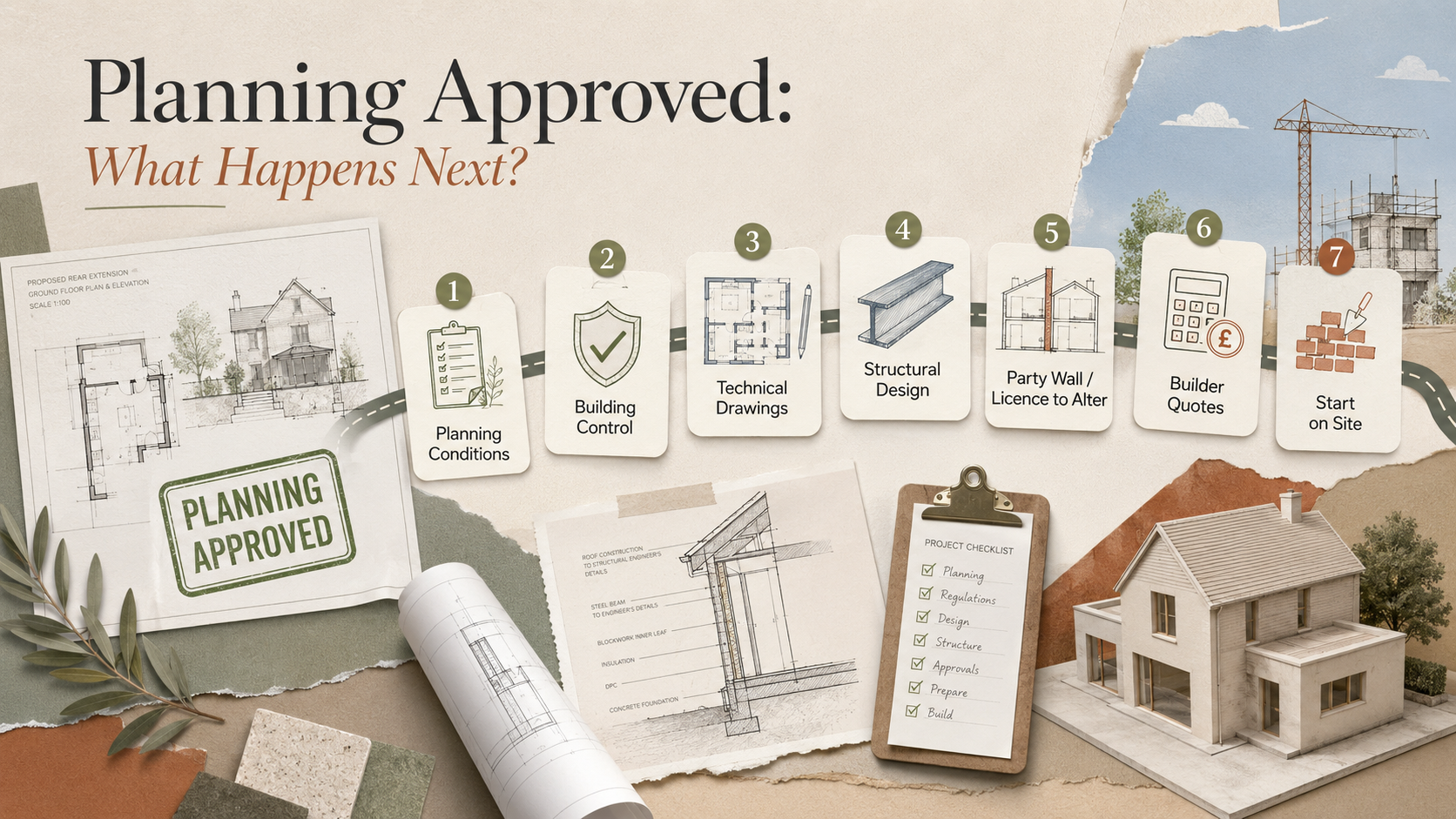
Getting planning approval is exciting, but it does not usually mean you can start building the next morning. Planning permission confirms that the proposal is acceptable in planning terms, subject to any conditions attached to the decision. Before construction begins, most projects still need technical design, Building Control approval, structural coordination, contractor information and sometimes other consents such as party wall notices, freeholder consent or a Licence to Alter. GOV.UK guidance makes clear that planning permission may still be subject to planning conditions and that other consents may be required.
The short answer
After planning approval, the next step is to move from planning design to construction preparation.
That normally means checking the decision notice, dealing with any planning conditions, preparing Building Control drawings, appointing any required consultants, coordinating structural calculations, agreeing the scope of works, speaking to builders and checking whether any separate consents are needed before work starts.
Planning approval answers one question: “Is this development acceptable in planning terms?”
It does not automatically answer: “How exactly will it be built?” or “Is it ready for construction?”
Step 1: Read the decision notice carefully
The first thing to do is read the planning decision notice from start to finish.
Do not only look for the word “approved”. The important details are usually in the conditions and informatives. The decision notice may tell you:
- when the permission expires;
- which drawings are approved;
- whether materials must match or be approved;
- whether details must be submitted before work starts;
- whether landscaping, windows, drainage or boundary treatments are controlled;
- whether construction hours or neighbour protection measures are mentioned;
- whether any additional consents may be required.
A common mistake is assuming that planning approval is unconditional. In reality, many approvals come with conditions that must be followed.
Step 2: Check whether any conditions need to be discharged
Some planning conditions simply tell you how the work must be carried out. Others require information to be submitted and approved before a certain stage.
The most important are pre-commencement conditions. These must normally be dealt with before work starts. Starting work without discharging a pre-commencement condition can create problems later, especially if the council considers that the development has not been lawfully implemented.
Conditions may ask for details such as:
- external materials;
- window or door details;
- rooflight details;
- landscaping;
- boundary treatment;
- drainage;
- tree protection;
- construction management;
- cycle storage;
- refuse storage;
- noise or ventilation details.
Government planning guidance lists discharge of conditions as a separate type of planning application, and also notes that non-planning consents can be needed alongside or after planning permission.
Step 3: Check the approved drawings
The approved drawings are the drawings listed on the decision notice. These are the drawings the council has approved.
Before moving forward, compare the approved drawings with what you now want to build. Sometimes clients want small changes after planning approval, especially once they speak to builders, structural engineers or suppliers.
Examples include:
- changing a window size;
- moving a rooflight;
- changing external materials;
- altering a door position;
- adjusting the internal layout;
- changing the roof design;
- making a structural solution more practical;
- revising drainage or services.
Some small changes may be dealt with through an amendment route, but some changes may need a new planning application. GOV.UK guidance identifies applications for amending proposals that already have planning permission as a separate application type.
The safest approach is to check before building something different from the approved drawings.
Step 4: Prepare Building Control drawings
Planning drawings are usually not detailed enough for construction.
After planning approval, the project normally needs a technical package for Building Control. GOV.UK states that Building Regulations approval is different from planning permission and that you might need both.
Building Control drawings usually explain how the project will be built. They may cover:
- foundations;
- floor, wall and roof build-ups;
- insulation;
- fire safety;
- structure;
- ventilation;
- drainage;
- stairs and guarding;
- glazing;
- electrics;
- heating;
- plumbing;
- damp proofing;
- sound insulation;
- construction details.
This is the stage where the project moves from “what will it look like?” to “how will it actually work?”
Step 5: Appoint or coordinate a structural engineer
If the project involves removing walls, forming new openings, installing beams, altering roofs, adding loft structure, changing floors or building an extension, a structural engineer will often be needed.
The structural engineer may prepare:
- beam calculations;
- structural drawings;
- padstone details;
- foundation design;
- roof structure;
- temporary works assumptions;
- sequencing advice.
The architect’s Building Control drawings should then be coordinated with the structural engineer’s design, so the builder is not working from disconnected information.
Step 6: Check if Building Regulations approval is needed
Many domestic projects need Building Regulations approval, even if planning permission has already been granted.
GOV.UK lists examples of work that may need approval, including extensions, alterations, replacing windows and doors, replacing roof coverings, installing bathrooms involving plumbing, replacing heating systems, adding radiators and electrical works such as replacing fuse boxes or changing electrics near a bath or shower.
This can apply to projects such as:
- rear extensions;
- loft conversions;
- garage conversions;
- internal structural alterations;
- flat refurbishments;
- new bathrooms;
- major rewiring;
- new heating systems;
- window replacement;
- roof replacement;
- changes to drainage.
Without Building Regulations approval where it is required, GOV.UK warns that the relevant building control body could require faulty work to be fixed and that you may not have compliance certificates needed when selling the home.
Step 7: Check party wall requirements
Planning approval does not remove your duties under the Party Wall etc. Act.
If you are building near a boundary, excavating near a neighbour’s foundations, cutting into a party wall, inserting beams into a shared wall or doing works to a party structure, you may need to serve party wall notices.
GOV.UK states that you must tell neighbours if you want to carry out building work near or on a shared property boundary or party wall in England and Wales. It also explains that party wall agreements are different from planning permission and Building Regulations approval.
This is a common reason why a project cannot start immediately after planning approval.
Step 8: Check freeholder, leaseholder or Licence to Alter requirements
If the property is leasehold, or if the works affect a flat, maisonette or building with shared ownership arrangements, planning approval may not be enough.
You may also need consent from:
- the freeholder;
- the landlord;
- the managing agent;
- the management company;
- the building surveyor;
- the insurer.
For leasehold flats, this is often dealt with through a Licence to Alter. The information requested may include architectural drawings, structural calculations, specification of works, contractor insurance, professional insurance, a programme of works and evidence of statutory approvals.
This should be checked early because a Licence to Alter can run in parallel with Building Control, but it can also take time.
Step 9: Prepare a clear scope of works
Before asking builders for quotations, it is helpful to prepare a clear scope of works.
This may include:
- what is being demolished;
- what is being retained;
- what is being built;
- what finishes are included;
- whether ceilings, floors and walls are being replaced or repaired;
- whether plumbing is moving;
- whether radiators, boilers or cylinders are being changed;
- whether electrics are being upgraded;
- what doors, windows and rooflights are proposed;
- what works are excluded;
- which items are provisional or to be confirmed.
A clear scope helps builders price the same thing. It also reduces misunderstandings later.
Step 10: Get contractor quotations based on the technical information
It is tempting to get builder quotes immediately after planning approval. However, builders can only price accurately if they know what they are pricing.
Planning drawings may not show enough detail for a reliable construction price. If the technical design is incomplete, the quote may include many assumptions. This can lead to extras later.
A better process is usually:
- Review the planning approval and conditions.
- Prepare Building Control drawings.
- Coordinate structural calculations.
- Clarify the scope of works.
- Issue the same information to builders.
- Compare quotations carefully.
- Agree exclusions, assumptions and provisional sums before appointing.
Step 11: Check whether specialist consultants are needed
Depending on the project, you may need input from other specialists.
This could include:
- structural engineer;
- energy assessor;
- SAP assessor;
- drainage specialist;
- party wall surveyor;
- building control body;
- heritage consultant;
- fire consultant;
- M&E consultant;
- arboricultural consultant;
- contractor or temporary works designer.
Not every project needs all of these. The point is to identify the missing technical information before work starts, not once the site is open.
Step 12: Check planning conditions again before starting
Before construction starts, check the planning conditions one more time.
You should confirm:
- which conditions must be discharged before commencement;
- which conditions apply before a specific stage;
- which conditions control materials or workmanship;
- whether the approved drawings match the construction drawings;
- whether any planning amendments are needed;
- whether the permission is still valid.
This is especially important where the builder or structural engineer has suggested changes after planning approval.
Step 13: Notify Building Control before work starts
Building Control will usually need to be notified at the correct stage, depending on the application route and building control body.
The inspection process may include stages such as:
- commencement;
- excavations;
- foundations;
- damp proof course;
- drainage;
- structural elements;
- insulation;
- fire safety;
- completion.
The exact inspection stages depend on the project. The main point is that Building Control should not be treated as paperwork at the end. It is part of the construction process.
Step 14: Keep records during the build
Good records matter.
During construction, keep copies of:
- planning decision notice;
- approved planning drawings;
- discharged condition approvals;
- Building Control application;
- Building Control drawings;
- structural calculations;
- inspection records;
- completion certificate;
- product warranties;
- electrical certificates;
- gas safety documents;
- window and glazing certificates;
- photos of hidden works such as insulation, drainage and structure.
These records can be important when selling, refinancing or resolving future questions.
Step 15: Do not ignore changes on site
Changes often happen during construction. A beam may need to move, a window supplier may suggest a different size, drainage may be discovered in a different location, or a wall may be different from expected.
Some changes are minor. Others may affect planning, Building Control, structure, fire safety or leasehold consent.
If something changes, pause and check who needs to approve it. This may be the architect, structural engineer, Building Control, council planning officer, freeholder’s surveyor or contractor.
A practical checklist after planning approval
After planning approval, check the following before starting work:
- Read the decision notice.
- List all planning conditions.
- Identify pre-commencement conditions.
- Check the approved drawings.
- Decide if amendments are needed.
- Prepare Building Control drawings.
- Coordinate structural calculations.
- Check Building Regulations approval route.
- Check party wall requirements.
- Check freeholder or Licence to Alter requirements.
- Confirm whether specialist consultants are needed.
- Prepare a clear scope of works.
- Obtain comparable builder quotations.
- Agree the programme of works.
- Notify Building Control before work starts.
- Keep records throughout construction.
How Gartwork Architecture can help
Gartwork Architecture can help clients move from planning approval into the technical and construction preparation stage.
This may include reviewing the planning decision, identifying conditions, preparing Building Control drawings, coordinating with structural engineers, developing the scope of works, responding to Building Control comments, helping with Licence to Alter information and supporting the project before work starts.
The goal is to make the approved design buildable, coordinated and easier for contractors and consultants to follow.
Final takeaway
Planning approval is a major step, but it is not the final step.
Before starting work, you need to check conditions, prepare technical drawings, deal with Building Control, coordinate structure, confirm other consents and make sure the builder is pricing a clear and buildable package.
The best time to resolve these issues is before construction starts. That is when careful coordination can save time, reduce uncertainty and prevent avoidable problems on site.
Categories
Planning Approval
Planning Permission
Building Control
Building Regulations
Planning Conditions
Discharge of Conditions
Technical Drawings
Construction Drawings
Structural Calculations
Party Wall
Licence to Alter
Contractor Quotes
Home Extension
Loft Conversion
Flat Refurbishment
Architecture