Pre-Application Advice vs Full Planning Application: Which Route Should You Choose?
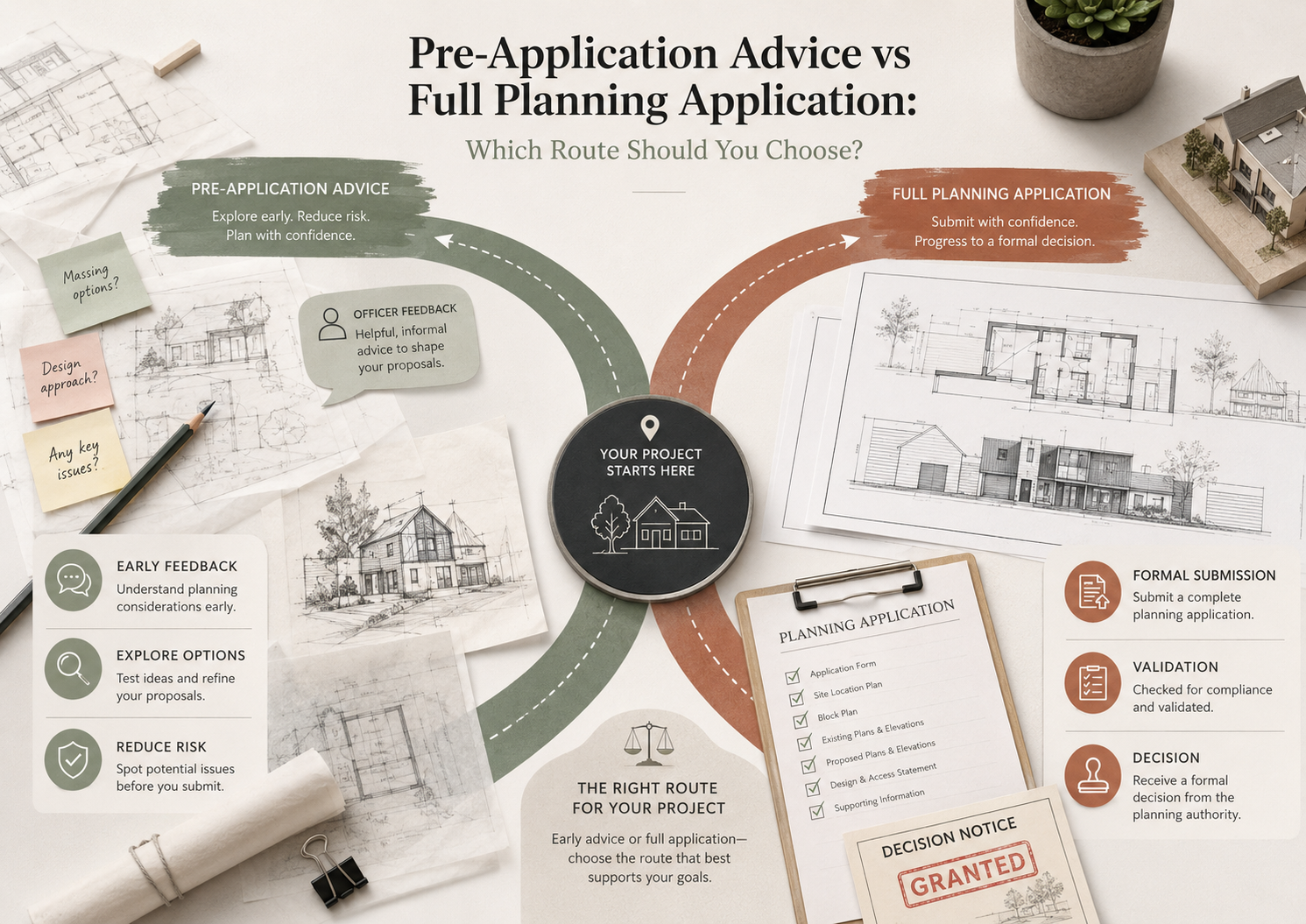
Choosing between pre-application advice and a full planning application is partly a planning decision and partly a strategy decision. Pre-application advice can be useful when the proposal is uncertain, sensitive or likely to raise policy questions. A full planning application may be better when the design is already clear, the planning risk is manageable and you need a formal decision. The right route depends on the project, the site, the local authority, the level of risk and how much time you have.
The short answer
Pre-application advice is useful when you want early feedback before committing to a full planning application.
A full planning application is useful when you are ready to ask the council for a formal decision.
Pre-application advice can reduce uncertainty, but it is not planning permission. A full planning application gives you a formal decision, but it usually requires a more complete submission package from the start. GOV.UK explains that applications for full planning permission result in a decision on the detailed proposals for how a site can be developed, subject to any planning conditions and any other consents that may still be required.
What is pre-application advice?
Pre-application advice, often called “pre-app”, is a way of asking the local planning authority for informal feedback before submitting a formal planning application.
It usually involves sending the council a short package of information, such as:
- site address;
- existing drawings;
- sketch proposals;
- photographs;
- planning statement or design summary;
- key questions for the planning officer;
- relevant planning history;
- heritage or conservation context, where relevant.
The aim is to understand how the council may view the principle, scale, design, layout, use, heritage impact, neighbour impact or policy position before a formal application is made.
Pre-app advice is particularly useful when the proposal is not straightforward. Recent planning commentary describes it as an optional step that can help applicants test feasibility, identify issues early and align a proposal with local planning expectations, but also notes that it does not guarantee planning permission.
What is a full planning application?
A full planning application asks the local planning authority to make a formal decision on a detailed proposal.
This usually requires a more complete package than pre-application advice. GOV.UK says a valid planning application requires a completed application form, compliance with national information requirements, the correct application fee and any local information requirements.
For a typical householder, residential or commercial project, a full planning application may include:
- application form;
- ownership certificate;
- planning fee;
- location plan;
- existing drawings;
- proposed drawings;
- site plan;
- design and access statement, where required;
- heritage statement, where required;
- planning statement, where helpful;
- specialist reports, where required by the local list.
GOV.UK states that, as a minimum, applicants need a location plan showing the application site in relation to the surrounding area, and that additional plans and drawings will usually be needed to describe the proposed development.
The main difference
The main difference is this:
Pre-application advice gives you feedback.
A full planning application gives you a decision.
Pre-app can help you decide whether to proceed, revise or rethink. A full planning application leads to approval, refusal or sometimes withdrawal before determination.
This means pre-app is usually a risk management tool. A full application is the route to permission.
When pre-application advice is worth considering
Pre-application advice is often worth considering where the proposal has planning uncertainty.
This may include:
- a listed building;
- a conservation area;
- a locally listed building;
- a sensitive street scene;
- major changes to the front elevation;
- a new dwelling;
- change of use;
- HMO conversion;
- unusual roof extensions;
- basement works;
- commercial signage;
- development affecting neighbours;
- a site with previous refusals;
- a proposal that conflicts with some policy but has planning arguments in its favour.
Pre-app can also be useful where you need a specific point clarified before deciding how much design work to commission.
For example, if the key question is whether the council would support a particular principle, it may be sensible to ask that question early rather than preparing a full planning package immediately.
When a full planning application may be the better route
A full planning application may be the better route where the proposal is already well developed and the planning position is reasonably clear.
This may apply where:
- the project is a standard house extension;
- similar approvals exist nearby;
- the proposal follows local design guidance;
- the planning risk is low;
- the client needs a formal decision quickly;
- pre-app timescales are long;
- the likely council feedback would not materially change the design;
- the project team is already confident about the route.
In these cases, pre-app can add time without adding much value.
Sometimes, the most efficient route is to prepare a strong full application from the start, with clear drawings, a focused statement and the right supporting documents.
Why pre-app is not a guarantee
Pre-application advice is not the same as approval.
It is normally informal officer advice. The final decision on a planning application may depend on consultation responses, neighbour comments, internal consultee responses, planning policy, committee procedures and the case officer’s full assessment.
This is why a positive pre-app response should not be treated as a promise of permission. Equally, a cautious or negative pre-app response does not always mean the project is impossible.
The value of pre-app is in understanding the likely issues. It does not remove the need for a properly prepared formal application.
Why full planning can still be risky
A full planning application gives you a formal decision, but it carries its own risks.
If the proposal is refused, the refusal becomes part of the planning history. That may affect the strategy for any future application or appeal.
A full application also usually requires more upfront work. If the design is likely to change significantly after officer feedback, the client may end up paying for drawings, reports and design work twice.
This is why jumping straight to a full application is not always the cheaper option, even if it avoids the pre-app fee.
How to decide between the two routes
A good way to decide is to ask four questions.
First, is the planning principle uncertain? If the answer is yes, pre-app may help.
Second, is the design likely to change depending on officer feedback? If yes, pre-app may save wasted design work.
Third, is the project sensitive? If the site is listed, in a conservation area, near heritage assets or likely to attract strong objections, pre-app may be useful.
Fourth, is speed more important than reducing risk? If yes, and the proposal is reasonably straightforward, a full planning application may be the better route.
What to ask in a pre-app request
A pre-app request is most useful when it asks clear questions.
Instead of only asking “is this acceptable?”, it is better to ask targeted questions such as:
- Is the principle of this development acceptable?
- Is the proposed scale likely to be supported?
- Are there concerns about design, massing or appearance?
- Are there heritage concerns?
- Are there neighbour amenity concerns?
- Would the council expect a heritage statement, transport note, daylight report or other specialist document?
- Are there any changes that would make the full application stronger?
The aim is to make the officer response useful, not vague.
What information should go into a pre-app package?
A pre-app package should usually be simpler than a full planning application, but still clear enough for meaningful feedback.
Depending on the project, it may include:
- location plan;
- existing plans;
- proposed sketch plans;
- proposed elevations, where relevant;
- site photographs;
- short planning statement;
- design summary;
- planning history summary;
- heritage summary, where relevant;
- specific questions for the officer.
If the information is too vague, the advice may also be vague. If the information is too detailed too early, the client may spend too much before knowing whether the principle is likely to be supported.
The balance is important.
What information is needed for a full planning application?
A full planning application usually needs a more complete and coordinated submission.
Depending on the project, this may include:
- location plan;
- existing drawings;
- proposed drawings;
- site plan;
- roof plan;
- sections;
- design and access statement;
- heritage statement;
- planning statement;
- materials details;
- application form;
- ownership certificate;
- planning fee;
- specialist reports required by the council’s local validation list.
GOV.UK explains that local planning authorities can request additional plans, drawings and local information requirements where it is reasonable to do so.
Pre-app or full planning for heritage projects
For listed buildings, conservation areas and sensitive period buildings, pre-app can be particularly valuable.
Heritage projects often involve judgement. The council may want to understand how the proposal affects historic fabric, character, appearance, setting, windows, doors, materials, roof form or internal features.
A pre-app can help identify whether the council is likely to support the principle of the change, what details they may require, and whether the design needs to be softened before a formal application.
However, if the design is already carefully researched and supported by a strong heritage statement, a full application may still be appropriate.
Pre-app or full planning for house extensions
For a simple rear extension, many homeowners may go straight to a householder planning application, especially if the proposal is similar to neighbouring approvals.
Pre-app may be more useful where the extension is larger, more visible, unusual in design, close to boundaries, in a conservation area, affects a listed building, or has already received neighbour resistance.
For straightforward householder projects, the main value is often in preparing a clear, well-considered application rather than adding an extra pre-app stage.
Pre-app or full planning for commercial projects
Commercial projects can benefit from pre-app where the proposal involves:
- change of use;
- new shopfront;
- signage;
- external plant;
- extraction;
- impact on residential neighbours;
- heritage or conservation constraints;
- operational issues such as servicing, hours or deliveries.
Pre-app can help identify whether the council is mainly concerned about design, noise, highways, heritage, amenity or policy.
For a small, low-risk commercial change, a full application may be more efficient.
Pre-app or full planning after a refusal
After a refusal, either route may be appropriate.
Pre-app can help test a revised proposal before resubmission. It can be useful where the refusal reasons are broad, unclear or involve design judgement.
A fresh full application may be better where the refusal reasons are clear and the design has been amended directly to address them.
Sometimes the best first step is to review the officer report, consultee comments and refusal reasons before deciding whether to appeal, resubmit or seek pre-app advice.
The practical problem with pre-app delays
Pre-app can be useful, but it can also take time.
Some councils respond quickly. Others take much longer. In some cases, the time spent waiting for pre-app advice may be similar to, or longer than, the time needed for a full planning application.
This creates a practical question: will the advice be valuable enough to justify the delay?
If the project is high risk, the answer may be yes. If the project is straightforward, the answer may be no.
Can you use both routes?
Yes. Many projects use pre-app first, then a full planning application.
This can be a good route where the project is sensitive or strategic. The process might look like this:
- initial feasibility review;
- pre-app drawings and planning note;
- council feedback;
- design revisions;
- full planning application;
- response to consultation comments;
- planning decision.
This can be more controlled than going straight to full planning, particularly where the design needs to be shaped around council feedback.
Common mistakes
One common mistake is submitting pre-app advice without clear questions. This often leads to general feedback that does not help the project move forward.
Another mistake is treating pre-app advice as approval. It is not.
A third mistake is going straight to a full application when the principle is uncertain and the design could have been improved before submission.
The opposite mistake is using pre-app for everything, even when the proposal is simple and the added stage does not justify the time.
How Gartwork Architecture can help
Gartwork Architecture can help review the project, identify the planning risks and recommend whether pre-application advice or a full planning application is the better route.
This may include reviewing the planning history, checking local policy, preparing early feasibility drawings, drafting a focused pre-app submission, preparing a full planning package, coordinating heritage or specialist information, and responding to council feedback.
The aim is to choose the route that best fits the project, rather than using the same process every time.
Final takeaway
Pre-application advice and full planning applications serve different purposes.
Pre-app is best understood as a way to reduce uncertainty before committing to a formal application. A full planning application is the route to a formal decision.
For simple, low-risk projects, going straight to a full application may be the most efficient option. For sensitive, complex or uncertain projects, pre-app advice can be a valuable step that helps shape a stronger application.
The right answer depends on the project, the site, the planning history, the council and the client’s appetite for risk.
Categories
Pre-Application Advice
Full Planning Application
Planning Permission
Planning Strategy
Planning Drawings
Planning Consultant
Householder Application
Heritage Planning
Conservation Area
Listed Building Consent
Planning Refusal
Planning Risk
Architecture
London Planning
Home Extension