Trickle Vents in Heritage Windows: Visible, Semi-Concealed or Concealed?
Trickle vents are often treated as a minor technical detail, but in heritage window projects they can become one of the most sensitive parts of the design. A visible external canopy or grille can change the appearance of a traditional sash window, especially in a listed building or conservation area. At the same time, Building Regulations require adequate ventilation, and replacement windows should not make the building’s ventilation worse. The best solution is usually to resolve the ventilation approach early, so the architect, window manufacturer, Building Control body and, where relevant, conservation officer are all working from the same details. GOV.UK’s Approved Document F guidance covers ventilation requirements under Part F of the Building Regulations, while heritage and planning controls may also apply depending on the building.
The short answer
For heritage windows, concealed trickle vents are usually the most visually sensitive option if they can meet the ventilation requirement and be properly detailed.
Semi-concealed trickle vents may be acceptable where a fully concealed option is not practical, but the external appearance still needs careful checking.
Visible trickle vents are usually the highest risk in listed buildings and sensitive conservation areas because they can introduce modern-looking grilles, slots or canopies into traditional window details.
The right answer depends on the building, the existing ventilation, the window design, the planning status, the Building Regulations strategy and the manufacturer’s ability to provide clear technical details.
Why trickle vents matter
A trickle vent is a small background ventilator that allows controlled airflow when the window is closed. It is usually installed through or around the window frame.
In modern buildings, this may be a routine detail. In heritage buildings, it can affect:
- the external appearance of the window;
- the internal appearance of the frame;
- the proportions of the head, meeting rail or sash;
- the profile of the timber section;
- the way the window sits in the reveal;
- the heritage acceptability of the proposal;
- Building Regulations compliance;
- comfort, condensation and mould risk.
The problem is that planning and heritage officers often look at how the window appears, while Building Control looks at whether the building will have adequate ventilation. A good heritage window design needs to satisfy both.
Why this becomes a heritage issue
Historic England explains that windows add character through their design, materials and workmanship, and that older windows can often be repaired and adapted rather than replaced. It also says that repair is often preferable because it preserves character and historic fabric, while complete replacement should normally be a last resort.
That same logic applies to ventilation details. A sash window can be beautifully proportioned, but a bulky plastic vent on the outside can undermine the heritage argument. Conservation officers may be concerned if a new vent:
- interrupts the traditional head detail;
- creates a visible modern slot;
- projects from the frame;
- appears on a prominent elevation;
- affects a matching terrace;
- changes the appearance of a listed façade;
- looks like an afterthought rather than part of the design.
In listed buildings, even small external and internal details can matter because the listing normally covers the whole building, unless the list entry says otherwise. GOV.UK also defines conservation areas as areas of special architectural or historic interest where character or appearance should be preserved or enhanced.
Why this becomes a Building Regulations issue
The Building Regulations position cannot simply be ignored.
GOV.UK’s Approved Document F FAQ explains that ventilation can be provided by any appropriate means, including a background ventilator through a wall, provided it gives the required equivalent area. It also says that if an existing wall ventilator already meets the relevant requirements, further background ventilation may not need to be added when replacing windows.
The same GOV.UK FAQ also makes two important points. A window locked slightly open on a night-latch is not an appropriate background ventilation solution, and a homeowner cannot simply sign a disclaimer saying they do not want background ventilators or will install them later. Work must comply with the Building Regulations.
This means the design team needs a real ventilation solution, not just a planning-friendly drawing.
Visible trickle vents
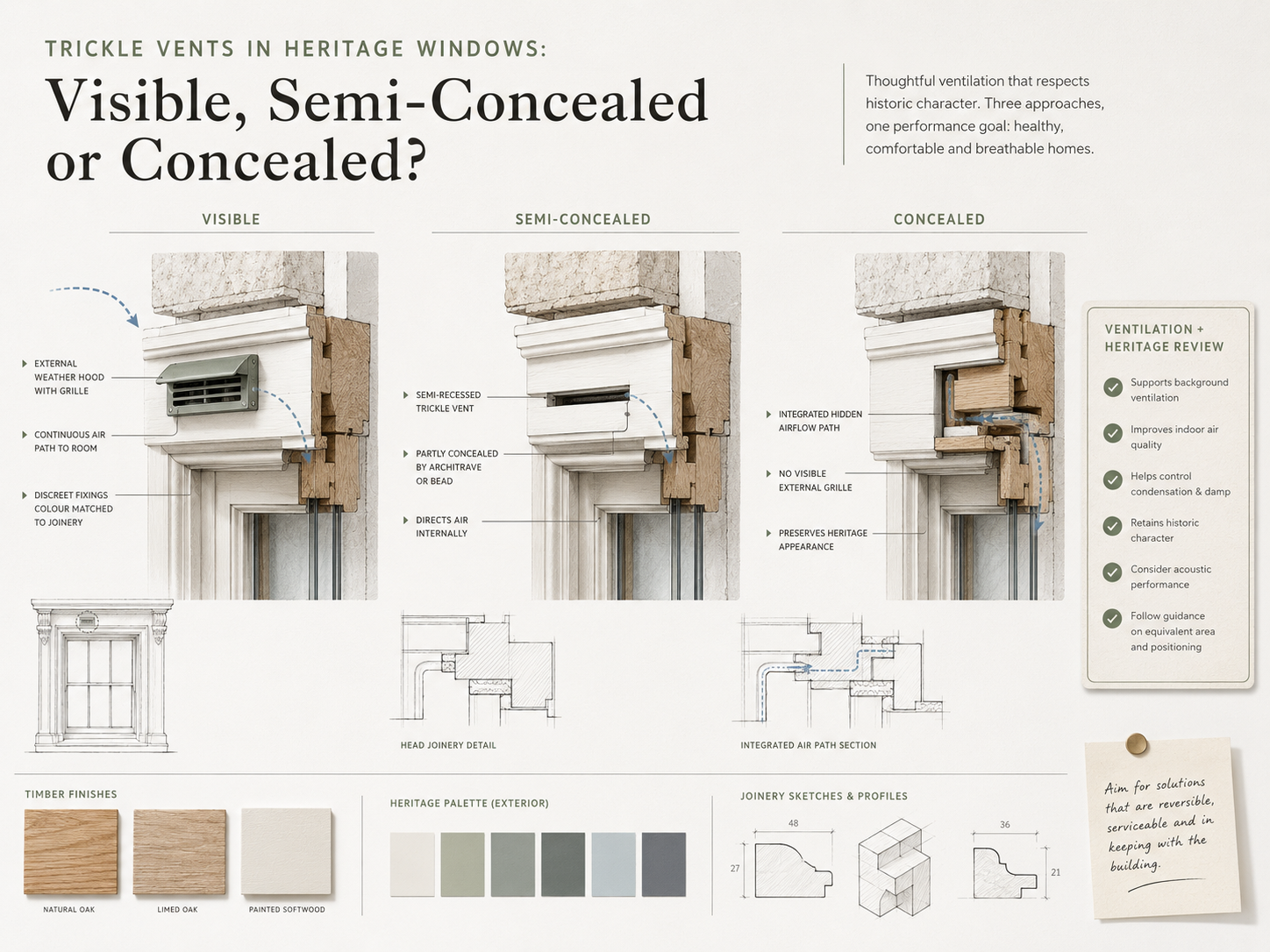
Visible trickle vents are the most obvious type. They usually have an external canopy, grille or slot visible on the outside of the window frame.
They may be suitable for:
- modern windows;
- less sensitive elevations;
- rear elevations with limited visibility;
- buildings without heritage constraints;
- situations where the local authority accepts them;
- cases where no better technical option is available.
However, they can be problematic for:
- listed buildings;
- conservation areas;
- front elevations;
- traditional sash windows;
- elegant timber window sections;
- symmetrical façades;
- terraces with consistent historic window patterns.
The main advantage is that they are simple and familiar. The main disadvantage is visual impact.
For a heritage application, a visible vent should not be shown only as a generic note. It should be drawn clearly, with the exact external grille or canopy, size, location, colour and relationship to the frame.
Semi-concealed trickle vents
Semi-concealed trickle vents try to reduce visibility while still using a window-based ventilation route. They may be partly recessed, placed within the head of the frame, colour-matched or positioned so the external component is less prominent.
They can be a useful compromise where:
- Building Control needs background ventilation;
- a fully concealed route is not technically possible;
- the manufacturer has a tested semi-concealed system;
- the vent can be aligned with the window head;
- the external canopy is small and discreet;
- the colour and finish can match the window.
However, “semi-concealed” does not always mean visually acceptable. Some systems still have a visible external projection or grille. In a sensitive heritage setting, even a small visible strip can be an issue if it appears on every window in a formal elevation.
For this reason, the detail should be tested visually before submission. A 1:5 or 1:2 section, a manufacturer’s CAD detail and a photograph of a comparable installed window can be very helpful.
Concealed trickle vents
Concealed trickle vents are designed so the ventilation route is integrated into the frame or surrounding detail and is not visible externally, or is only minimally visible.
They are often the preferred option for heritage windows because they can reduce the conflict between ventilation and appearance.
They may work well for:
- listed buildings;
- conservation areas;
- timber sash replacements;
- high-quality replica windows;
- front elevations;
- buildings with strong historic character;
- projects where the conservation officer is likely to scrutinise details.
The advantages are:
- less visual impact;
- stronger heritage argument;
- cleaner external appearance;
- better chance of preserving traditional proportions;
- fewer concerns about modern external grilles.
The disadvantages are:
- they may cost more;
- they require more careful joinery detailing;
- not every manufacturer can provide them;
- the equivalent area still needs to be checked;
- Building Control still needs to be satisfied;
- maintenance and airflow path need to be understood.
A concealed vent should not simply be described as “concealed” in a note. The drawings should show how it works.
Why manufacturer drawings matter
Manufacturer drawings can make or break a heritage window application.
For trickle vents, the application package should ideally show:
- where the vent is located;
- whether it is visible, semi-concealed or concealed;
- the internal appearance;
- the external appearance;
- the airflow path;
- equivalent area or performance information;
- head, jamb and sash sections;
- any external canopy or grille;
- paint or finish;
- how much of the frame is hidden in the reveal;
- how the detail relates to the existing opening.
A common problem is that the architectural elevation looks clean, but the manufacturer’s technical drawing later shows a visible grille or canopy. If that happens after consent, manufacture or installation, it can create delay, redesign or compliance issues.
The safer approach is to coordinate the manufacturer’s CAD details before submission.
Planning permission, listed building consent and Building Control are separate
This is where many homeowners and landlords get confused.
Planning permission deals with whether the external change is acceptable in planning terms. Listed building consent deals with whether works affect the special architectural or historic interest of a listed building. Building Regulations deal with technical compliance, including ventilation.
The Planning Portal says new windows and doors of similar appearance to those used in the construction of a house often do not need planning permission, but it also warns that Article 4 Directions, listed buildings, designated areas and leasehold restrictions can change the position. It also states that listed buildings need listed building consent for significant internal or external works.
So a window detail can pass one test and still fail another. A visible vent may satisfy Building Control but harm heritage appearance. A concealed vent may look excellent but still need proof that it provides adequate ventilation.
Why the issue should be resolved before submission
For heritage window applications, it is better to resolve trickle vents before the application is submitted, not during manufacture.
Early coordination helps avoid:
- planning drawings showing one thing and manufacturer drawings showing another;
- conservation officer objections;
- Building Control concerns;
- last-minute visible grilles;
- delays in ordering windows;
- rework to joinery details;
- conflict between the client, architect and manufacturer;
- uncertainty about whether consent covers the final product.
If the application says the vents are concealed, the final installed windows should match that statement.
What if there is already ventilation in the room?
Existing ventilation matters.
GOV.UK’s Approved Document F FAQ says that, where a room already has a wall ventilator that meets the relevant minimum equivalent areas, further background ventilation does not need to be added after replacing the windows. It also says ventilation can be provided through a wall rather than through window trickle ventilators if it provides the relevant equivalent area.
This can be useful in heritage projects. Sometimes the best way to avoid visible vents in sensitive windows is to use another compliant ventilation route.
Possible alternatives may include:
- existing wall ventilators;
- new discreet wall background ventilators;
- a whole-dwelling ventilation strategy;
- mechanical ventilation where appropriate;
- specialist acoustic ventilators in noisy locations;
- ventilation on a less sensitive elevation.
This needs to be checked properly. It should not be assumed.
What about noise and air pollution?
Trickle vents can raise concerns about traffic noise and outdoor pollution, especially on busy streets.
GOV.UK recognises this issue. The Approved Document F FAQ says trickle ventilators can be located on the less polluted side of the building to reduce outdoor air pollution ingress, and recommends noise-attenuating background ventilators where façades face noisy environments.
For heritage projects, this can overlap with planning and design. A front elevation may be the most sensitive visually and the noisiest environmentally. That may support looking at alternative ventilation routes, acoustic ventilators or concealed solutions.
Visible, semi-concealed or concealed: which should you choose?
For a listed building or sensitive conservation area, the usual order of preference is:
- No new visible window vent, if adequate background ventilation already exists or can be provided elsewhere.
- Concealed trickle vent, if the window manufacturer can provide a compliant and genuinely concealed detail.
- Semi-concealed trickle vent, if it is visually discreet and acceptable to the conservation officer.
- Visible trickle vent, only where the visual impact is acceptable or no better solution exists.
This is not a fixed legal hierarchy. It is a practical heritage-design approach.
What should the heritage statement say?
A heritage statement should not ignore trickle vents if they are part of the window proposal.
It may explain:
- whether the building is listed or in a conservation area;
- why the windows are significant;
- whether the existing windows have vents;
- what ventilation is proposed;
- why the chosen vent detail is visually appropriate;
- whether the vent is visible, semi-concealed or concealed;
- how the detail preserves the appearance of the window;
- how Building Regulations ventilation has been considered;
- whether alternative ventilation routes were explored.
For a listed building, this can help show that the design is not just technically compliant, but also heritage-led.
What drawings should be included?
For a heritage window project involving trickle vents, useful drawings may include:
- existing elevation;
- proposed elevation;
- existing window detail;
- proposed window detail;
- 1:5 or 1:2 head section;
- vertical section through the frame;
- horizontal section through the frame and reveal;
- manufacturer’s CAD detail;
- internal view of the vent;
- external view of the vent;
- schedule identifying vent type by window;
- note confirming whether vents are visible, semi-concealed or concealed;
- ventilation performance information.
If the proposal relies on concealed ventilation, the drawing should prove it.
Common mistakes
Common mistakes include:
- submitting clean elevations without showing vents;
- assuming “concealed” means the same thing for every manufacturer;
- leaving trickle vents to the window supplier after consent;
- ignoring Building Regulations until late in the project;
- using visible vents on a listed façade without checking acceptability;
- relying on night-latch opening as background ventilation;
- assuming a homeowner disclaimer solves the issue;
- omitting the external vent canopy from drawings;
- failing to coordinate ventilation with glazing bars, sash horns and head details;
- ordering windows before the consented detail is final.
These mistakes can turn a small technical item into a planning, heritage and construction problem.
A practical checklist before ordering heritage windows
Before ordering heritage windows, check:
- Is the building listed?
- Is it in a conservation area?
- Is there an Article 4 Direction?
- Are the existing windows historic or later replacements?
- Is repair or secondary glazing a better option?
- Is background ventilation already present?
- Can ventilation be provided through a wall or another route?
- Does the window need trickle vents?
- Are the vents visible, semi-concealed or concealed?
- Has Building Control accepted the ventilation approach?
- Has the conservation officer seen the detail, where relevant?
- Do the manufacturer’s drawings match the planning drawings?
- Is the external appearance fully shown?
- Is the internal appearance acceptable?
- Is the final detail included in the consent package?
How Gartwork Architecture can help
Gartwork Architecture can help coordinate the heritage, planning and technical sides of replacement window projects.
This may include reviewing the existing windows, checking the planning route, preparing existing and proposed drawings, coordinating manufacturer CAD details, reviewing visible or concealed vent options, preparing heritage statements, and making sure the submitted package shows the actual window detail intended for manufacture.
For sensitive sash windows, this early coordination can be the difference between a smooth consent process and a late-stage problem with visible vents.
Final takeaway
Trickle vents may be small, but in heritage windows they are not minor.
Visible vents can harm the appearance of traditional windows. Semi-concealed vents can be a useful compromise. Concealed vents are often the most heritage-sensitive option, but only if they genuinely work and can be properly documented.
The best approach is to resolve ventilation before submission, show the exact detail on the drawings, and make sure the final window design satisfies both heritage expectations and Building Regulations.
Categories
Trickle Vents
Heritage Windows
Concealed Trickle Vents
Semi-Concealed Trickle Vents
Visible Trickle Vents
Listed Building Consent
Conservation Area
Sash Windows
Timber Windows
Background Ventilation
Approved Document F
Building Regulations
Heritage Statement
Window Replacement
Architecture