What Drawings Do You Need for Building Control After Planning Approval?
Planning approval is an important milestone, but it does not usually mean you are ready to start building. Planning drawings are mainly prepared to show the design, appearance, layout and planning impact of a proposal. Building Control drawings go further. They explain how the project will be constructed, insulated, ventilated, drained and made safe. In many cases, you will need a separate Building Control application before work starts, because building regulations approval is different from planning permission and you may need both.
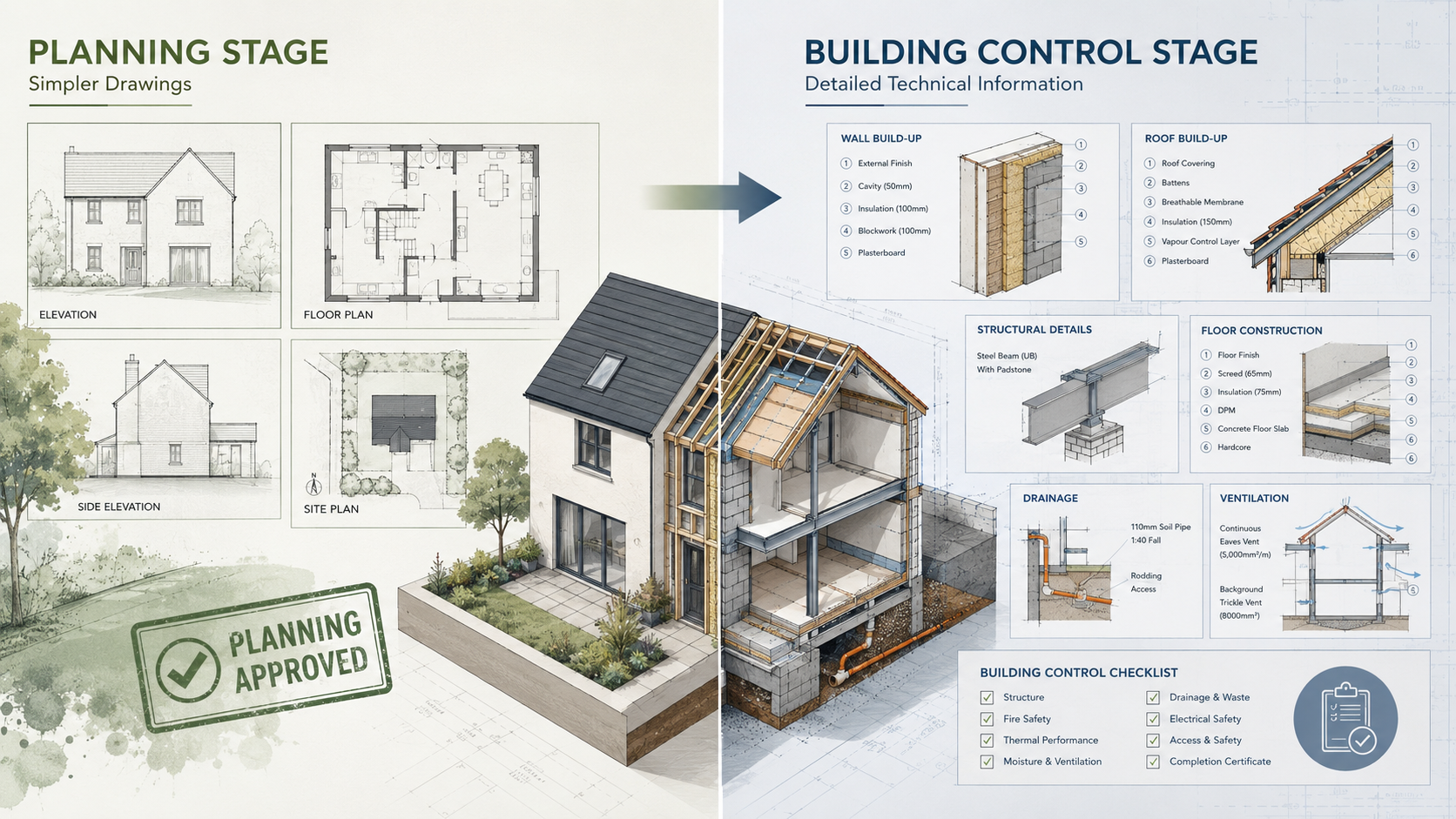
The short answer
After planning approval, you usually need a more detailed technical drawing package for Building Control.
For a typical residential extension, loft conversion, flat refurbishment or internal alteration, this may include:
- existing drawings;
- demolition drawings, where elements are removed;
- proposed plans;
- proposed elevations, where external changes are involved;
- proposed sections;
- construction details;
- structural engineer’s drawings and calculations;
- foundation and floor details;
- wall, roof and insulation details;
- drainage information;
- ventilation information;
- fire safety information;
- electrical, heating and plumbing notes where relevant;
- window, door and glazing information;
- U-value calculations or energy information;
- SAP calculations for some projects;
- specifications for materials, products and workmanship.
The exact list depends on the type of project, the building, the local authority or registered building control approver, and whether the work is being submitted as a Full Plans application, Building Notice or another route.
Why planning drawings are not enough
Planning drawings are normally prepared to help the council decide whether the proposal is acceptable in planning terms. They show the overall layout, scale, relationship to neighbours, external appearance and site context.
Building Control drawings answer a different question: will the work comply with the Building Regulations?
GOV.UK explains that the Building Regulations 2010 cover the construction and extension of buildings. They can also apply to many alteration projects, including replacing fuse boxes and connected electrics, installing bathrooms involving plumbing, changing electrics near a bath or shower, replacing windows and doors, installing or replacing heating systems, and adding extra radiators to a heating system.
This is why drawings that were sufficient for planning are often too general for Building Control.
What Building Control usually wants to understand
Building Control needs to understand how the building work will comply technically.
That means the drawings and supporting documents should usually explain:
- how the structure is supported;
- what is being demolished;
- what is new;
- what is retained;
- how walls, floors and roofs are built up;
- how the works meet fire safety requirements;
- how insulation and thermal performance are achieved;
- how ventilation is provided;
- how drainage works;
- how damp, weathering and condensation are addressed;
- how stairs, guarding and access are designed;
- how glazing, doors and windows meet relevant standards;
- how heating, plumbing and electrics are dealt with;
- how the works coordinate with the existing building.
In practical terms, a Building Control package should give the plan checker and inspector enough information to review the proposal before and during construction.
Existing drawings
Existing drawings show the building as it is before work starts.
These may include:
- existing floor plans;
- existing elevations;
- existing sections;
- roof plans where relevant;
- notes identifying existing walls, openings, floors, stairs, ceilings, drainage and structure.
For Building Control, existing drawings are not just background information. They help explain what is being changed and how the new works connect to the old building.
Demolition drawings
Demolition drawings are useful where walls, chimneys, ceilings, floors, roof elements, windows, doors or structural elements are being removed.
They can show:
- walls to be removed;
- openings to be formed;
- ceilings or floors to be taken down;
- existing finishes to be stripped;
- structural elements to be altered;
- areas where temporary support may be needed;
- elements to be retained and protected.
This is particularly important for internal refurbishments, flat alterations and structural changes. A simple proposed plan may not clearly show what needs to happen first.
Proposed plans
Proposed plans show the new layout.
For Building Control, they should normally include more technical notes than planning drawings. For example, the proposed plans may identify:
- room names and uses;
- new walls and retained walls;
- fire doors;
- escape routes;
- new structural openings;
- beams and posts;
- stairs;
- kitchen and bathroom layouts;
- sanitaryware;
- radiators;
- boilers or hot water cylinders;
- extract fans;
- background ventilation;
- smoke and heat alarms;
- drainage points;
- floor finishes;
- changes in level.
The aim is to make the proposed works clear enough for technical review and construction coordination.
Sections
Sections are often one of the most important parts of the Building Control drawing package.
They can show:
- foundation depths;
- floor build-ups;
- wall build-ups;
- roof build-ups;
- ceiling build-ups;
- insulation positions;
- structural zones;
- drainage routes;
- damp proof courses;
- cavity trays;
- ventilation paths;
- headroom over stairs;
- relationship between old and new construction.
For extensions, loft conversions and structural alterations, sections often explain the project more clearly than plans alone.
Construction details
Construction details show how specific junctions are built.
These may include:
- foundation to wall junctions;
- floor to wall junctions;
- roof to wall junctions;
- parapets;
- rooflights;
- dormer cheeks;
- eaves and verges;
- openings through external walls;
- lintels and beams;
- cavity trays and damp proofing;
- insulation continuity;
- thermal bridge reduction;
- fire stopping;
- sound insulation details;
- waterproofing in wet areas.
Good construction details help reduce ambiguity on site. They also help Building Control check whether the proposed construction is realistic and compliant.
Structural drawings and calculations
If the project affects load-bearing walls, floors, roofs, chimneys, foundations or structural openings, a structural engineer will usually be needed.
Structural information may include:
- beam layouts;
- steel beam sizes;
- padstones;
- posts;
- connection details;
- foundation design;
- roof structure;
- floor strengthening;
- calculations;
- temporary works considerations, where relevant.
In many projects, the architect prepares the Building Control drawings and coordinates them with the structural engineer’s design. The engineer’s information is then submitted alongside the architectural package.
Fire safety information
Building Control will need to understand how the project deals with fire safety.
Depending on the type of work, the drawings may need to show:
- escape routes;
- protected stairways;
- fire doors;
- smoke alarms;
- heat alarms;
- fire resisting walls, floors and ceilings;
- cavity barriers;
- fire stopping;
- egress windows;
- separation between dwellings;
- fire safety upgrades in loft conversions;
- special requirements for flats or buildings with common parts.
Fire safety is often one of the areas where planning drawings are least detailed, so it needs proper attention at the Building Control stage.
Insulation, U-values and energy information
Building Control drawings should explain the thermal performance of the works.
This may include:
- wall insulation;
- roof insulation;
- floor insulation;
- glazing performance;
- door performance;
- thermal bridging;
- air tightness principles;
- heating system information;
- low energy lighting;
- SAP calculations where required;
- U-value calculations or product information.
For extensions, the package may need to show how new walls, roofs, floors, windows and doors meet the required standards. For conversions or refurbishments, it may also need to address upgraded thermal elements where existing walls, floors or roofs are being renovated.
Ventilation information
Ventilation is often missed until late in the project, but it should be considered early.
The drawings may need to show:
- extract fans to bathrooms, shower rooms, WCs, utility rooms and kitchens;
- background ventilators or other whole-dwelling ventilation provisions;
- purge ventilation through openable windows or doors;
- trickle vents where required;
- ventilation to roof voids or concealed spaces;
- mechanical ventilation routes where applicable.
This is particularly important where windows are being replaced, rooms are being reconfigured, or the works affect the ventilation of the existing dwelling.
Drainage information
Building Control will often need to understand how foul water, rainwater and any new drainage connections will work.
Drainage information may include:
- existing drainage runs;
- new foul drainage;
- new rainwater drainage;
- inspection chambers;
- rodding access;
- soil vent pipes;
- waste pipe routes;
- falls;
- soakaways or sustainable drainage where relevant;
- relationship to existing sewers;
- protection of drains near foundations.
For extensions, drainage can affect the foundation design and layout. For internal works, drainage can affect whether kitchens, bathrooms or utility rooms can be moved easily.
Electrical, plumbing and heating notes
Not every electrical or plumbing item needs to be fully designed by the architect, but Building Control drawings often need enough information to identify the scope.
This may include:
- new consumer unit or fuse box;
- electrical works in bathrooms or near wet areas;
- new heating system;
- new boiler;
- hot water cylinder;
- radiators;
- underfloor heating;
- extract ventilation;
- bathroom and kitchen plumbing;
- incoming services affected by the works.
GOV.UK lists several alteration projects that may need building regulations approval, including connected electrics, bathrooms involving plumbing, electrics near a bath or shower, heating system replacement and extra radiators.
Windows, doors and glazing
Building Control may need information about:
- safety glazing;
- thermal performance;
- means of escape windows;
- ventilation;
- fire doors;
- door widths;
- external doors;
- window replacement;
- rooflights;
- guarding where windows are low or near level changes.
For listed buildings or conservation areas, planning, listed building consent and Building Control issues may overlap, but they are still separate approvals.
Specifications and notes
Building Control drawings usually include written notes and specifications.
These can cover:
- materials;
- workmanship;
- wall types;
- floor types;
- roof types;
- insulation;
- plasterboard;
- fire resistance;
- moisture resistance;
- waterproofing;
- ventilation rates;
- drainage standards;
- lintels;
- fixings;
- manufacturer’s requirements;
- relevant Building Regulation parts.
A clear specification reduces the risk of the plan checker asking for more information and helps the builder price and build the work more accurately.
Full Plans application or Building Notice?
For domestic projects, there are different Building Control routes. The right route depends on the project and advice from the building control body.
A Full Plans application usually involves submitting drawings, specifications and calculations for review before work starts. This is often sensible for extensions, loft conversions, structural works, flat refurbishments and projects where technical coordination matters.
A Building Notice route can be simpler, but it may give less certainty before construction starts. It is not suitable for every project.
Where the work is complex, structural, close to other properties, in a flat, or likely to involve several technical issues, a fuller drawing package is usually the safer approach.
What happens if Building Control asks for more information?
It is common for Building Control to ask for clarifications or further information.
They may ask for:
- more detailed construction sections;
- revised structural calculations;
- additional fire safety information;
- insulation or U-value details;
- SAP calculations;
- drainage clarification;
- ventilation details;
- product specifications;
- evidence from a specialist consultant.
This does not always mean the design is wrong. It often means the plan checker needs more information before the application can be accepted or approved.
Can you start work once planning is approved?
Not necessarily.
Before starting work, you should check whether Building Control approval is needed and whether any planning conditions need to be discharged. You should also check whether you need party wall notices, freeholder consent, a Licence to Alter, Thames Water build-over consent, a structural engineer’s design, specialist surveys or contractor method statements.
GOV.UK warns that without Building Regulations approval, where it is required, the relevant building control body could require faulty work to be fixed, and the owner may not have compliance certificates needed when selling the home.
Why this stage matters
The Building Control stage is where the design becomes buildable.
This is when the project moves from “what will it look like?” to “how exactly will it be built?”
A good Building Control package can help:
- reduce questions from Building Control;
- give the builder clearer information;
- identify missing technical issues early;
- coordinate the architect and structural engineer;
- reduce site delays;
- reduce unexpected costs;
- support future sale or remortgage records;
- make the construction phase safer and more predictable.
How Gartwork Architecture can help
Gartwork Architecture can help prepare Building Control drawings after planning approval and coordinate the technical package with the structural engineer, energy assessor, contractor and other consultants where needed.
For residential projects, this may include existing, demolition and proposed drawings, construction sections, technical details, specification notes, coordination with structural calculations, insulation and ventilation notes, drainage information and responses to Building Control comments.
The aim is to give Building Control and the builder a clear, coordinated package before work starts.
Final takeaway
Planning approval is not the end of the design process. It is the point where the project normally moves into technical design.
If you are planning an extension, loft conversion, refurbishment or structural alteration, you will usually need Building Control drawings that explain how the work will comply with Building Regulations.
The earlier this information is prepared, the easier it is to avoid delays, redesigns and surprises on site.
Categories
Building Control
Building Regulations
Planning Approval
Technical Drawings
Construction Drawings
Full Plans Application
Structural Calculations
U-Values
Drainage
Ventilation
Fire Safety
Residential Extensions
Loft Conversion
Flat Refurbishment
Architecture