What Information Should You Send an Architect Before a First Call?
A first call with an architect does not need to be complicated, but it is much more useful when the architect has the right information beforehand. You do not need to prepare a perfect brief or know exactly what is possible. The purpose of the call is often to explore the project, understand the property, identify risks and agree the next step. However, if you send the address, photos, existing plans, a short description of what you want to achieve, your budget range and any known constraints before the call, the architect can give you much more focused advice.
The short answer
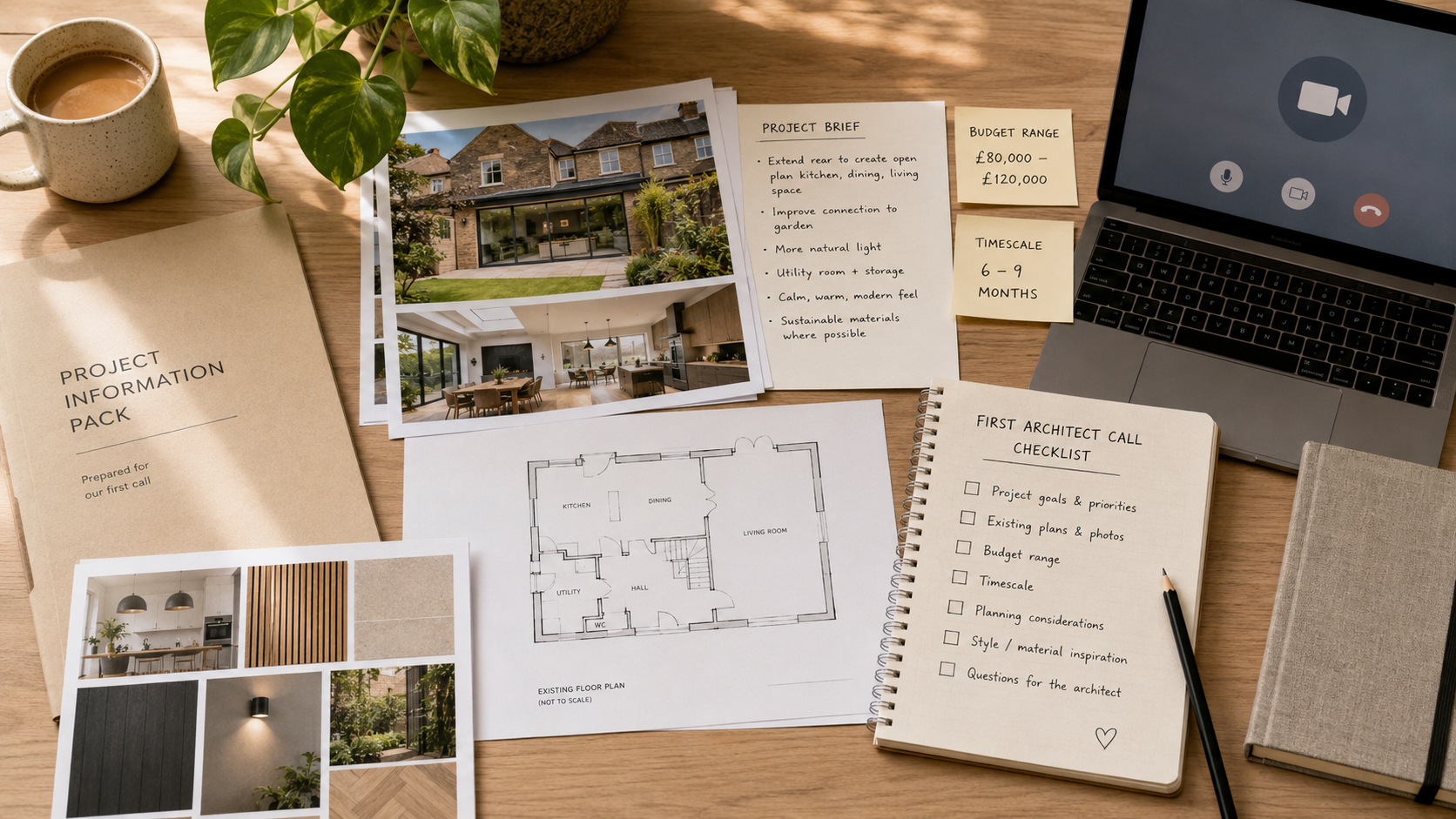
Before a first call with an architect, it is helpful to send:
- the property address;
- a short project summary;
- photos of the property;
- any existing plans or estate agent plans;
- any previous planning drawings or approvals;
- a list of what you want to change;
- your main priorities;
- your rough budget range;
- your ideal timescale;
- details of ownership or leasehold restrictions;
- whether the property is listed or in a conservation area, if known;
- any reports, surveys or contractor comments you already have;
- inspiration images, if they help explain the style or feeling you want.
You do not need to send everything. But the more relevant information you provide, the easier it is for the architect to understand the project quickly.
Why the first call matters
The first call is not only an introduction. It is usually the moment when the architect starts to understand the shape of the project.
A good first call can help clarify:
- whether the project sounds feasible;
- what information is missing;
- whether a measured survey is needed;
- whether planning permission may be required;
- whether Building Control will be relevant;
- whether other consultants may be needed;
- whether the budget and scope are aligned;
- what the next stage should be.
The call is much more useful if the architect can look at the property, not just hear a verbal description.
Start with the full property address
The address is one of the most useful things to send before the call.
With the address, the architect can usually check:
- the property type;
- street context;
- approximate size;
- conservation area status;
- listed building status;
- planning history;
- neighbouring extensions;
- roof form;
- garden relationship;
- likely constraints;
- local authority area.
This does not replace a proper planning review, but it helps the architect ask better questions during the call.
For example, a rear extension to an ordinary suburban house is a different conversation from a flat in a mansion block, a listed building, a shop with a flat above, or a property in a conservation area.
Send a short project summary
A short project summary is often more useful than a long email.
Try to explain the project in one or two paragraphs. For example:
- “We want to extend the kitchen and create a better connection to the garden.”
- “We have a flat and want to reconfigure the layout to create a second shower room.”
- “We want to convert the loft and understand whether planning permission is needed.”
- “We own a commercial unit with a flat above and want to understand the planning and Building Control route.”
- “We are thinking of replacing windows in a conservation area and need advice on drawings and consent.”
The aim is not to solve the project. The aim is to give the architect enough context to prepare for the call.
Explain the problem, not only the solution
Clients often start with a solution: “We want a rear extension,” “We want to remove this wall,” or “We want to add another bedroom.”
That is useful, but the architect also needs to understand the problem behind the solution.
For example:
- Is the kitchen too dark?
- Is the hallway awkward?
- Do you need more storage?
- Is the house too open-plan or not open enough?
- Are children’s things taking over the living space?
- Is there nowhere to work from home?
- Is the bathroom arrangement not working?
- Is the property being prepared for rental, sale or long-term family life?
Sometimes the best design response is not the one the client first imagined. Explaining the problem helps the architect explore better options.
Send photos of the property
Photos are extremely helpful before a first call.
Useful photos include:
- front elevation;
- rear elevation;
- garden;
- side access;
- neighbouring context;
- kitchen;
- living areas;
- bedrooms;
- bathrooms;
- hallway and stairs;
- roof space, if relevant;
- basement, if relevant;
- any areas you want to change;
- any cracks, damp, awkward details or previous alterations.
Photos do not need to be professional. Phone photos are fine. The most useful photos are clear, honest and wide enough to show the space.
If the project is about a specific issue, such as a window, wall, door, fireplace, ceiling or damp patch, include both close-up photos and wider photos showing where it sits in the room.
Send existing plans, even if they are not perfect
If you have any existing plans, send them.
These might include:
- estate agent floor plans;
- old planning drawings;
- lease plans;
- Land Registry title plan;
- previous architect drawings;
- builder sketches;
- measured survey drawings;
- structural drawings;
- Building Control drawings;
- kitchen or bathroom supplier plans.
Estate agent plans are often not accurate enough for design work, but they can still help before the first call. They allow the architect to understand the approximate layout and ask more focused questions.
The architect can then advise whether a proper measured survey is needed before design options are drawn.
Be clear if the plans are approximate
If the plans are from an estate agent, old sale brochure or previous owner, say so.
This matters because approximate plans should not normally be used as the final base for design, planning or construction drawings.
A measured building survey is often needed to prepare accurate existing drawings. Those drawings then become the base for proposed layouts, planning drawings and technical information.
Sending approximate plans is still useful for the first call, but everyone should understand their limitations.
Send planning history if you have it
If you have previous planning drawings, decision notices, pre-application advice, refusal letters or appeal decisions, send them before the call.
This is especially useful where:
- the property has already been extended;
- there was a previous refusal;
- there are planning conditions;
- the project involves a listed building;
- the property is in a conservation area;
- neighbours have similar extensions;
- a previous owner carried out works;
- you want to amend an approved scheme.
GOV.UK explains that full planning permission gives a decision on detailed proposals, but other consents may still be required. It also notes that applications can be made for matters such as discharge of conditions, amendments to proposals with planning permission and lawful development certificates.
This is why planning history can affect the advice you receive on the first call.
Say whether the property is listed or in a conservation area
If you know the property is listed, locally listed or in a conservation area, tell the architect before the call.
If you are not sure, send the address and the architect can usually check.
This matters because heritage constraints can affect:
- window replacement;
- doors;
- roof changes;
- extensions;
- internal alterations;
- materials;
- plaster;
- external finishes;
- demolition;
- shopfronts;
- signage;
- planning strategy;
- need for a heritage statement.
A project in a listed building or conservation area often needs a more careful approach from the beginning.
Explain what you want to keep
A good brief is not only about what you want to change. It should also explain what you want to keep.
For example:
- original doors;
- timber floors;
- cornices;
- fireplaces;
- staircase;
- sash windows;
- existing kitchen;
- garden wall;
- mature tree;
- built-in joinery;
- bathroom fittings;
- current room arrangement.
This helps the architect understand the emotional, practical and budget priorities of the project.
It also helps avoid drawings that accidentally remove something important.
Explain what you definitely dislike
It is useful to say what you dislike about the current property.
This could include:
- dark kitchen;
- poor storage;
- awkward corridor;
- too many small rooms;
- too much open-plan space;
- poor connection to garden;
- no utility space;
- bad bathroom layout;
- noise between rooms;
- lack of privacy;
- poor entrance sequence;
- unused dining room;
- cold or damp rooms;
- insufficient natural light.
This often gives the architect more useful information than a list of desired rooms.
Send your must-haves and nice-to-haves
Before the call, separate your requirements into must-haves and nice-to-haves.
For example:
Must-haves:
- larger kitchen;
- downstairs WC;
- utility space;
- one more bedroom;
- better natural light;
- separate work area.
Nice-to-haves:
- pantry;
- rooflights;
- window seat;
- larger boot room;
- pocket doors;
- bespoke joinery;
- guest shower room.
This helps the architect understand which ideas should drive the design and which can be tested if space and budget allow.
Share your rough budget range
Many clients feel uncomfortable sharing a budget early, but it is very useful.
The architect does not need a perfectly fixed figure before the first call. A rough range is enough.
For example:
- “We are trying to keep the works modest.”
- “We have a budget range of around £80,000 to £120,000.”
- “We are not sure what is realistic, but we do not want a high-end rebuild.”
- “We would prefer a phased approach.”
- “We want to understand whether the project is likely to be affordable before going too far.”
Budget affects design. It influences the size of the proposal, structural ambition, number of bathrooms, glazing, finishes, joinery and level of technical work required.
A realistic budget discussion early on can prevent disappointment later.
Explain your timescale
Tell the architect if there is a specific deadline.
For example:
- baby due date;
- school start date;
- rental deadline;
- mortgage or sale timing;
- planning submission target;
- contractor availability;
- holiday period;
- lease expiry;
- business opening date;
- grant or funding deadline.
The architect can then advise whether the timescale sounds realistic.
Some stages can take longer than clients expect, especially measured surveys, planning applications, Building Control, structural design, Licence to Alter, party wall matters and contractor pricing.
Mention whether you already have a builder
If you already have a builder, contractor, structural engineer, window supplier, kitchen designer or interior designer involved, mention this before the first call.
This affects the process.
For example:
- the architect may need to coordinate with the contractor;
- the contractor may have already made assumptions;
- the builder may need drawings for pricing;
- the engineer may already have structural comments;
- the supplier may need drawings checked before ordering;
- the client may need help comparing options.
It is also useful to say whether the builder has already visited and whether they raised any concerns.
Mention ownership and leasehold issues
If the property is a flat, maisonette, leasehold house, commercial unit or mixed-use building, say this before the call.
Leasehold and ownership issues can affect the project before design starts.
You may need:
- freeholder consent;
- managing agent consent;
- Licence to Alter;
- landlord approval;
- management company review;
- building surveyor review;
- contractor insurance documents;
- programme of works;
- Building Control information;
- structural calculations;
- evidence of approvals before works begin.
These requirements can affect both design and timing.
Tell the architect who makes decisions
If more than one person is involved, tell the architect who should attend the call.
This may include:
- both homeowners;
- a landlord and leaseholder;
- business owner and property owner;
- family members funding the project;
- contractor;
- interior designer;
- structural engineer;
- managing agent representative.
A first call is more useful when the key decision-makers are present or when the architect understands who else needs to approve the direction.
Otherwise, the same conversation may need to happen twice.
Send inspiration images
Inspiration images can be helpful, but they should be used carefully.
You can send images showing:
- style;
- atmosphere;
- materials;
- kitchen ideas;
- bathroom ideas;
- joinery;
- doors;
- windows;
- lighting;
- storage;
- garden connection;
- heritage details;
- modern extensions.
It is helpful to explain what you like about each image.
For example:
- “I like the calm feeling.”
- “I like the concealed storage.”
- “I like the timber and soft colours.”
- “I like the connection to the garden.”
- “I like the traditional sash window detail.”
- “I like the way the utility is hidden.”
The architect should not simply copy an image. They should understand the design intention behind it.
Send any reports or surveys
If you already have reports, send them.
Useful reports may include:
- structural survey;
- homebuyer report;
- damp report;
- drainage survey;
- asbestos survey;
- measured survey;
- party wall information;
- arboricultural report;
- heritage report;
- fire risk assessment;
- energy report;
- previous Building Control documents;
- contractor quotation.
Even if the report is not perfect, it can highlight early risks.
For example, a survey might mention cracks, damp, roof defects, movement, drainage issues, non-compliant alterations or asbestos risk. These can all affect the design process.
Mention known problems
If there are known problems, mention them before the call.
Examples include:
- damp;
- leaks;
- mould;
- cracks;
- uneven floors;
- low ceilings;
- poor insulation;
- noisy neighbours;
- drainage smells;
- blocked gutters;
- old electrics;
- boiler issues;
- difficult access;
- previous unauthorised works;
- neighbour disputes;
- planning enforcement concerns.
These issues may not stop the project, but they can affect the advice.
Explain whether you want advice, drawings or a full service
Different clients need different things at the first stage.
Some want a quick feasibility view. Some need planning drawings. Some need Building Control drawings. Some need help with a Licence to Alter. Some want a full design service from concept to construction.
Before the call, say what you think you need.
For example:
- “We want to understand if the idea is possible.”
- “We need drawings for a planning application.”
- “We already have planning approval and need technical drawings.”
- “We need help responding to Building Control comments.”
- “We need drawings for a freeholder.”
- “We want options before deciding what to do.”
- “We need help checking a builder’s proposal.”
The architect can then explain the right next step.
Understand that the first call is not a full design session
A first call can be very useful, but it is not the same as a measured survey, planning appraisal, design workshop or technical review.
The architect can often give an initial view, but they may need further information before giving reliable advice.
For example, they may need:
- measured survey;
- planning history review;
- site visit;
- structural engineer input;
- photographs of hidden areas;
- drainage information;
- freeholder requirements;
- Building Control advice;
- heritage review.
This is normal. A good first call should identify what needs to happen next.
Ask about the likely approval route
Before or during the first call, it is useful to ask what approvals may be needed.
Depending on the project, this may include:
- planning permission;
- lawful development certificate;
- pre-application advice;
- listed building consent;
- conservation area considerations;
- Building Control approval;
- party wall notices;
- Licence to Alter;
- landlord or freeholder consent;
- advertisement consent;
- HMO licensing;
- Thames Water or build-over consent;
- highways consent.
GOV.UK explains that non-planning consents may need to be obtained alongside or after planning permission in order to complete and operate a development lawfully.
This is why the first call should not focus only on drawings. It should also consider the route.
Building Regulations should not be left until the end
Even if the project is still at early stage, Building Regulations may affect the design.
GOV.UK states that Building Regulations approval is different from planning permission and that you might need both. It also lists examples of works that may need approval, including bathroom plumbing, electrical work, replacement windows and doors, heating systems and extra radiators.
This matters because clients often think about layout first, then technical compliance later. In reality, structure, drainage, fire safety, ventilation and insulation can all affect what layout makes sense.
What not to worry about before the first call
You do not need to have everything perfect.
You do not need:
- a professional brief;
- accurate drawings;
- a final budget;
- a fixed design;
- a chosen contractor;
- planning answers;
- supplier quotes;
- all finishes selected;
- full technical detail.
The architect can help organise the process. The aim is simply to send enough information for a productive first conversation.
A simple email structure
A helpful first email might include:
- property address;
- short project summary;
- what you want to achieve;
- what is not working now;
- any must-haves;
- rough budget range;
- ideal timescale;
- whether you have plans or photos;
- whether there are known constraints;
- what you want from the first call.
This does not need to be long. Clarity is more important than length.
Common mistakes
Common mistakes include:
- sending only a vague message such as “we want to renovate”;
- not sending the address;
- not mentioning that the property is a flat or leasehold;
- hiding the budget completely;
- sending inspiration images without explaining what you like;
- assuming estate agent plans are accurate;
- not mentioning previous planning refusals;
- not mentioning listed building or conservation area status;
- involving only one decision-maker when several people need to agree;
- asking for a fixed fee before the scope is clear;
- expecting detailed design advice without photos, plans or context.
These mistakes are easy to avoid.
A practical checklist before your first architect call
Before the first call, try to send:
- Property address.
- Your name and contact details.
- Short project summary.
- Photos of key areas.
- Existing plans, if available.
- Previous planning or Building Control documents, if available.
- Main problems with the current property.
- Must-haves and nice-to-haves.
- Approximate budget range.
- Ideal timescale.
- Ownership or leasehold information.
- Known planning or heritage constraints.
- Any survey reports.
- Contractor or consultant comments, if already available.
- Inspiration images, with notes on what you like.
If you only have three things, send the address, photos and a short description of what you want to do. That alone can make the first call much more useful.
How Gartwork Architecture can help
Gartwork Architecture can help clients make sense of early project information and identify the most sensible next step.
This may include reviewing the address and planning context, looking at photos and existing plans, clarifying the brief, advising whether a measured survey is needed, identifying likely approvals, preparing design options, submitting planning applications, preparing Building Control drawings or coordinating information for a Licence to Alter.
The first call is often the beginning of that process. The better the information sent beforehand, the more practical and specific the advice can be.
Final takeaway
You do not need a perfect brief before speaking to an architect.
The most useful information is simple: address, photos, existing plans, what you want to change, what is not working now, budget range, timescale and any known constraints.
A good first call should help turn a loose idea into a clear next step. It should identify what information is missing, what approvals may be needed and how the design process should begin.
Categories
Architect First Call
Architectural Brief
Home Renovation
House Extension
Measured Survey
Existing Plans
Planning Permission
Building Control
Design Options
Client Brief
Property Photos
Renovation Planning
Licence to Alter
Residential Architecture
Gartwork Architecture