What Is a Licence to Alter and When Does a Flat Owner Need One?
A Licence to Alter is one of the first things a flat owner should check before starting refurbishment works. Many leaseholders focus on builders, finishes and costs, but forget that their lease may restrict what they can change inside the flat. Even works that seem internal, such as removing a wall, replacing ceilings, changing plumbing routes or upgrading services, may need written consent from the freeholder, landlord or managing agent before work begins.
What is a Licence to Alter?
A Licence to Alter, often shortened to LTA, is formal written consent from the freeholder or landlord allowing a leaseholder to carry out specific alterations to a leasehold property.
It is usually needed because a lease is not the same as owning a freehold house. A flat owner normally owns a long lease of the flat, while the structure, common parts and wider building are controlled by the freeholder or landlord. The lease sets out what the leaseholder can and cannot do.
The exact rules depend on the wording of the lease. Some leases ban certain alterations completely. Others allow alterations only with the landlord’s consent. Legal commentary on residential leases explains that alteration covenants are often either absolute, meaning works may be prohibited, or qualified, meaning landlord consent is required and may not always be unreasonably withheld depending on the wording and law applying to the lease.
When does a flat owner usually need a Licence to Alter?
A flat owner may need a Licence to Alter when the proposed works go beyond simple decoration or like-for-like repairs.
Common examples include:
- removing or altering walls;
- forming new openings;
- installing steel beams or other structural supports;
- changing the internal layout;
- moving kitchens or bathrooms;
- altering plumbing or drainage routes;
- changing heating systems, boilers or hot water cylinders;
- installing new radiators or underfloor heating;
- replacing windows or external doors;
- changing floor finishes, especially hard floor finishes in flats;
- upgrading electrics or replacing a fuse box;
- installing recessed lighting in ceilings;
- changing ceilings, cornices or fire protection;
- works affecting communal services, risers, structure or fire safety.
Not every lease treats these works in the same way. The first step is always to read the lease and check the alteration clause.
Why internal works can still need consent
A common misunderstanding is that internal works are automatically private. In flats, this is often not true.
An internal wall may be structural. A floor finish may affect sound transmission to the flat below. A bathroom alteration may affect drainage, waterproofing or leaks. A ceiling alteration may affect fire separation. Electrical and plumbing changes may affect safety and insurance. This is why freeholders and managing agents often want to review the works before they start.
In practice, a Licence to Alter process is not only about appearance. It is about protecting the building, the neighbours, the freeholder, the leaseholder and future buyers.
Is a Licence to Alter the same as Building Control approval?
No. A Licence to Alter and Building Control approval are separate.
A Licence to Alter is private leasehold consent from the landlord or freeholder.
Building Control approval is a statutory process that checks whether building work complies with building regulations. GOV.UK states that building regulations approval is different from planning permission and that a homeowner might need both. The same principle applies to leasehold consent: private consent does not replace statutory approval.
GOV.UK lists many alteration projects that may require building regulations approval, including replacing fuse boxes and connected electrics, installing bathrooms involving plumbing, changing electrics near a bath or shower, replacing windows and doors, replacing heating systems and adding extra radiators.
For leasehold flat works, the practical position is often:
- the freeholder or managing agent wants enough technical information to assess the Licence to Alter request;
- Building Control may need to be submitted in parallel;
- evidence of statutory approvals may need to be provided before works start.
Is a Licence to Alter the same as planning permission?
No. Planning permission is also separate.
Many internal flat refurbishments do not need planning permission, but some projects might. For example, planning issues can arise if the property is listed, in a conservation area, involves external changes, changes windows, changes the use of the property, or affects the appearance of the building.
A Licence to Alter does not remove the need for planning permission, listed building consent or Building Control approval where those are required. Equally, planning permission does not remove the need for landlord consent under the lease.
This is why flat owners should check all approval routes before starting work.
What documents are usually needed for a Licence to Alter?
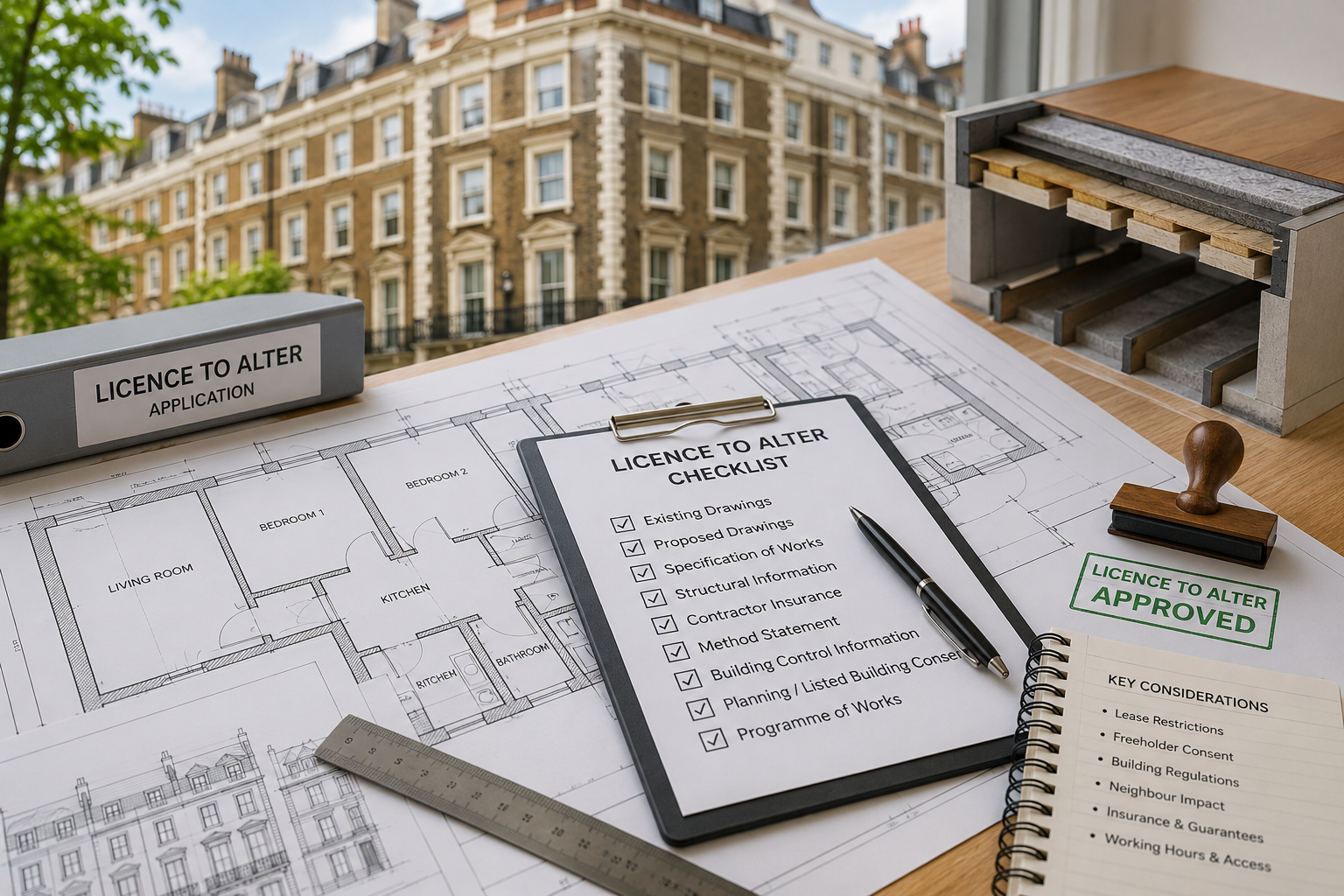
Each freeholder, landlord and managing agent has their own process, but a typical Licence to Alter package may include:
- existing drawings;
- demolition drawings, if anything is being removed;
- proposed drawings;
- a written specification or scope of works;
- structural engineer’s drawings and calculations, if structural works are proposed;
- contractor details;
- contractor insurance;
- professional indemnity insurance for consultants, where requested;
- proposed programme of works;
- method statements or temporary works details, where requested;
- Building Control information, where relevant;
- planning permission or listed building consent, where relevant;
- details of changes to plumbing, heating, electrics, floors, ceilings and fire safety.
For many flat refurbishments, it is useful to show the works clearly on drawings rather than relying only on a builder’s quotation. Drawings help the landlord’s surveyor understand what is changing, what is staying, and what needs technical review.
Why the scope of works matters
A vague application can delay the Licence to Alter process. Managing agents and surveyors usually need to know exactly what is proposed.
For example, it may not be enough to say “refurbish the flat”. The application may need to explain whether walls are being removed, whether ceilings are staying or being replaced, whether cornices are retained, whether new floor finishes are proposed, whether bathrooms are being retiled, whether radiators are being changed, and whether electrical or plumbing works are included.
The more clearly the scope is described, the easier it is for the landlord’s surveyor to review the proposal.
What happens if the works change during construction?
This is one of the most important practical questions.
Older flats often reveal surprises once works start. A ceiling may hide beams. A wall may turn out to be more complicated than expected. Existing plumbing may not be where the contractor expected. A structural opening may need a different temporary support method.
If this happens, the leaseholder should not assume they can simply carry on. The managing agent, landlord’s surveyor, architect, structural engineer, Building Control body or contractor may need to review the change.
A good Licence to Alter application should make the process clear: who is contacted if something changes, whether revised drawings are needed, and whether the surveyor must approve changes before work continues.
Can works start before the Licence to Alter is granted?
Usually, no.
Flat owners should not start works that require consent until the Licence to Alter has been granted and any pre-commencement conditions have been satisfied. Starting without consent can create legal, insurance, neighbour and resale problems.
GOV.UK also warns that without building regulations approval, where approval is required, the owner may lack certificates of compliance needed when selling the home, and the relevant building control body may require faulty work to be fixed.
From a resale point of view, missing consents can become a major issue. Buyers’ solicitors often ask for evidence of landlord consent, planning approvals, Building Control certificates and guarantees for alteration works.
Why a Licence to Alter can take longer than expected
A Licence to Alter is rarely just one email to the managing agent.
The process may involve:
- the managing agent;
- the freeholder or landlord;
- the landlord’s surveyor;
- the leaseholder’s architect;
- the structural engineer;
- the contractor;
- Building Control;
- sometimes a solicitor;
- sometimes neighbours, depending on the lease and the type of work.
Delays often happen when the application is missing drawings, contractor insurance, structural information, a programme of works or confirmation of statutory approvals.
For structural works, the freeholder’s surveyor may also ask for more detailed information before works proceed on site, especially where temporary support, propping or sequencing is important.
What flat owners should check before appointing a builder
Before committing to a start date, a flat owner should check:
- Does the lease require consent for the proposed works?
- Is the consent a simple written approval or a formal Licence to Alter?
- Does the managing agent have a specific application form or process?
- What drawings and specifications are required?
- Is a structural engineer needed?
- Is Building Control approval needed?
- Is planning permission or listed building consent needed?
- Are contractor insurance documents required?
- Does the freeholder need a programme of works?
- Are there restrictions on working hours, noisy works, access, skips, lifts or protection of common parts?
Doing this early can avoid a situation where the contractor is ready to start, but the legal and technical approvals are not in place.
How an architect can help with a Licence to Alter
An architect can help turn the intended works into a clear, reviewable package.
This may include preparing existing drawings, proposed drawings, demolition drawings, layout notes, finishes notes, coordination with the structural engineer, scope descriptions and responses to managing agent or surveyor queries.
For more complex refurbishments, the architect can also help coordinate the Licence to Alter package with Building Control, planning requirements, listed building considerations and contractor information.
The aim is not simply to produce drawings. The aim is to make the proposal understandable, coordinated and easier for the landlord’s team to review.
Final takeaway
A Licence to Alter is an important approval for many leasehold flat refurbishments. It is not the same as planning permission and it is not the same as Building Control approval.
Flat owners should check the lease, speak to the managing agent early, prepare clear drawings and confirm what technical documents are required before works begin.
The safest approach is to treat the Licence to Alter as part of the project planning stage, not as an afterthought once the builder is already booked.
Categories
Licence to Alter
Leasehold Alterations
Flat Refurbishment
Freeholder Consent
Managing Agent
Building Control
Structural Alterations
Leasehold Flat
Property Renovation
Architecture
London Flats
Planning Permission
Listed Building Consent