What Should Happen Before an Architect Starts Drawing Options?
Many clients expect the design process to begin with drawings. In reality, good drawings usually come after a careful pre-design stage. Before an architect starts drawing options, they need to understand the property, the client’s goals, the existing layout, the budget, planning risks, technical constraints and what decisions actually need to be tested. Without that groundwork, design options can look attractive but fail to answer the real problem. The best early design work is not just creative. It is informed, practical and based on reliable information.
The short answer
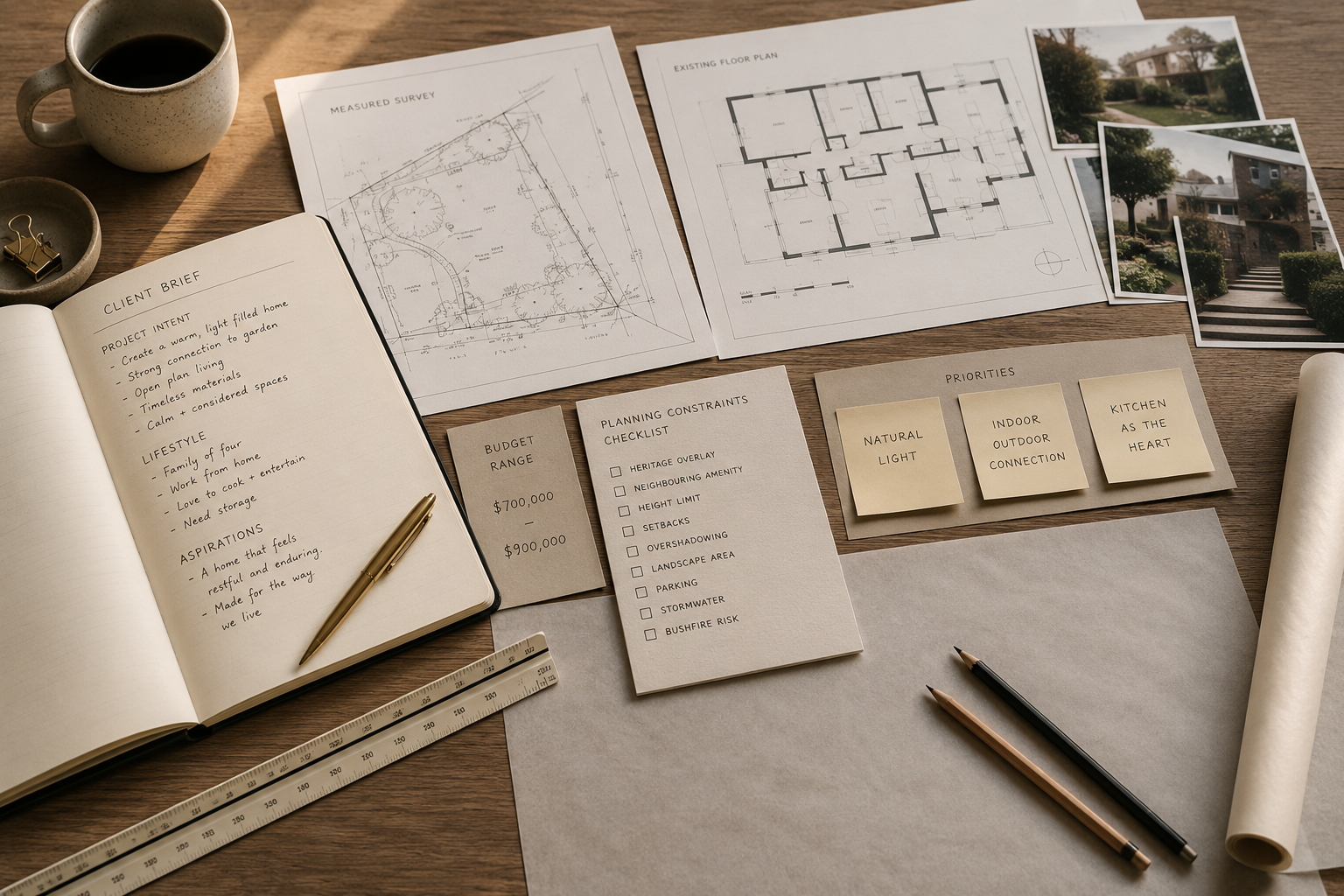
Before an architect starts drawing options, there should usually be a clear brief, reliable existing information, an initial understanding of constraints, and a shared view of what the design options are meant to test.
This usually includes:
- understanding the client’s goals;
- confirming the project priorities;
- reviewing the existing property;
- arranging or checking a measured survey;
- preparing accurate existing drawings;
- discussing budget expectations;
- identifying planning constraints;
- checking whether pre-application advice may be useful;
- considering Building Control and technical risks;
- identifying whether consultants are needed;
- clarifying what decisions the design options should help answer.
An architect can sketch ideas without all of this, but those sketches may be less useful. The earlier the project is grounded in reality, the better the design options are likely to be.
Why drawings should not be the first step
A drawing is only useful if it is responding to the right question.
For example, “Can we extend?” is not the same question as:
- Can we extend within budget?
- Can we get planning permission?
- Can we make the kitchen brighter?
- Can we add a bedroom without losing family space?
- Can we improve circulation?
- Can we keep the existing structure?
- Can we make the house work better for children?
- Can we avoid moving drainage?
- Can we phase the works?
- Can we make the property easier to sell later?
If these questions are not discussed first, the architect may draw options that look interesting but do not solve the client’s actual problem.
Start with the client’s brief
The brief is the foundation of the design process.
It should explain what the client wants to achieve, not only what they think should be built.
A useful brief may include:
- what is not working in the current property;
- which rooms feel too small, dark or disconnected;
- how the household uses the space day to day;
- whether the priority is more space, better light, storage, privacy or flow;
- whether the project is for long-term living or resale;
- which features are essential;
- which features are nice to have;
- what the client dislikes about the existing layout;
- what emotional or practical problem the project needs to solve.
For example, a client might say they want an extension, but the real issue may be poor circulation, lack of storage, a badly located utility area or an unused dining room. A good pre-design conversation helps separate the symptom from the cause.
Clarify priorities before drawing options
Most projects involve trade-offs.
A client may want a bigger kitchen, a separate utility, a play area, more storage, a larger bedroom, better daylight, a guest room and a lower budget. It may not be possible to maximise everything at once.
Before drawing options, it helps to rank priorities.
Questions to ask include:
- What is the main reason for doing the project?
- What must be included?
- What can be compromised?
- Which rooms matter most?
- Is storage more important than open space?
- Is a separate room more important than a large open-plan area?
- Is natural light more important than floor area?
- Is budget certainty more important than design ambition?
- Is speed more important than reducing planning risk?
This helps the architect draw options that test meaningful choices rather than random variations.
Understand the existing property
Before changing a building, the architect needs to understand it.
This means looking at:
- the existing layout;
- room sizes;
- ceiling heights;
- structure;
- stairs;
- windows and doors;
- drainage;
- services;
- existing extensions;
- previous alterations;
- orientation and daylight;
- relationship to neighbours;
- access;
- garden or external space;
- site levels;
- constraints such as trees, boundaries or shared walls.
The existing property often contains both opportunities and limitations. A good design starts by reading the building carefully.
Arrange a measured building survey
A measured building survey is often one of the most important first steps.
It records the existing dimensions, layout and condition of the property so the architect can prepare accurate existing drawings. These drawings become the base for proposed options.
Without accurate existing information, design options may be based on guesswork. This can cause problems later, such as:
- rooms not fitting as expected;
- door swings clashing;
- stairs being too tight;
- windows not aligning;
- extensions being drawn from incorrect wall positions;
- planning drawings needing to be redone;
- structural coordination becoming harder;
- builders pricing inaccurate information.
For small projects, a simple measured survey may be enough. For complex, old or irregular buildings, a more detailed survey may be needed.
Prepare accurate existing drawings
Before proposed options are drawn, the architect usually needs existing drawings.
These may include:
- existing floor plans;
- existing elevations;
- existing sections;
- roof plan, where relevant;
- site plan;
- basic room names and dimensions;
- levels, where relevant;
- notes on important existing features.
Existing drawings are not just paperwork. They are the map of the starting point.
They allow the architect to test options properly and help the client understand how the proposed changes compare with the current layout.
Check the planning position early
Before drawing options, it is sensible to understand the planning context.
Depending on the project, this may involve checking:
- whether the property is in a conservation area;
- whether the building is listed;
- whether there is an Article 4 Direction;
- whether permitted development rights apply;
- previous planning applications;
- local design guidance;
- neighbouring approvals;
- likely overlooking or daylight issues;
- size and scale limits;
- materials and appearance;
- whether pre-application advice may be useful.
This does not mean the architect needs to solve the full planning strategy before drawing anything. But they should know enough to avoid drawing options that are obviously unlikely to be acceptable.
Check whether pre-application advice may help
Pre-application advice can be useful where the project has planning uncertainty.
This may apply if the proposal involves:
- a large extension;
- a sensitive site;
- a listed building;
- a conservation area;
- a change of use;
- an unusual design;
- a previous refusal;
- a property with complex planning history;
- works that may affect neighbours;
- a proposal where council feedback could change the design.
Pre-application advice is not always necessary. For a straightforward project, it may add time without much value. But for sensitive or uncertain projects, it can help reduce risk before committing to a full planning application.
Discuss budget honestly
Budget should be discussed before drawing options.
This does not mean the architect can give a fixed construction price at the first meeting. But the client and architect should have an honest conversation about the likely scale of the project and whether the ambitions are realistic.
Budget affects:
- size of extension;
- structural complexity;
- number of bathrooms;
- kitchen scope;
- glazing;
- bespoke joinery;
- finishes;
- whether services are moved;
- whether works are phased;
- how much detail is needed before pricing;
- whether the proposal should be simplified.
A design option that ignores budget can create disappointment later. A better approach is to develop options that reflect different levels of ambition and cost risk.
Understand the client’s decision-making style
Some clients want several options. Others become overwhelmed by too many choices.
Before drawing, it helps to understand how the client wants to make decisions.
For example:
- Do they want two or three clear options?
- Do they prefer one recommended option with minor alternatives?
- Do they need visual references before they can comment?
- Do they make decisions quickly or need time to compare?
- Are several family members involved?
- Is one person focused on layout and another on budget?
- Is the project emotionally sensitive, such as a family home or inherited property?
The design process works better when the architect knows how the client thinks.
Collect visual references
Visual references can be helpful before drawing options, but they need to be used carefully.
Clients may share:
- Pinterest images;
- Instagram posts;
- magazine pages;
- photos of friends’ homes;
- examples of kitchens, doors, windows, materials or lighting;
- images showing a mood or atmosphere.
The architect should not copy these directly. Instead, they should identify what the client is responding to.
For example, a client may like an image because of:
- natural light;
- calm materials;
- warm timber;
- hidden storage;
- arched openings;
- traditional detailing;
- a clean contemporary look;
- connection to the garden;
- a feeling of openness.
The reason matters more than the image itself.
Identify technical risks early
Even at the options stage, some technical issues should be considered.
These may include:
- load-bearing walls;
- structural openings;
- drainage routes;
- boiler and hot water cylinder positions;
- ventilation;
- fire safety;
- headroom;
- stairs;
- floor build-ups;
- damp;
- insulation;
- roof structure;
- party walls;
- existing services;
- access for construction.
The architect does not need to fully design every technical detail before drawing options. But they should identify the obvious risks so the options do not become unrealistic.
Consider whether other consultants are needed
Some projects need other consultants before or during the early design stage.
This might include:
- measured surveyor;
- structural engineer;
- planning consultant;
- heritage consultant;
- party wall surveyor;
- drainage specialist;
- energy assessor;
- fire consultant;
- quantity surveyor;
- building control advisor;
- arboricultural consultant.
Not every project needs all of these. The point is to identify likely consultant input early, rather than discovering too late that the chosen design depends on information nobody has checked.
Check ownership and permissions
Before drawing options, it is also worth checking whether the client actually has the right to carry out the works.
This is especially important for:
- flats;
- leasehold properties;
- properties with managing agents;
- shared freeholds;
- commercial units;
- flats above shops;
- listed buildings;
- buildings with restrictive covenants;
- properties needing landlord consent.
A project may need a Licence to Alter, freeholder consent, management company approval, party wall notices or other permissions. These do not always stop the design process, but they can affect what is realistic.
Understand the approval route
Before design options are developed too far, the team should understand what approvals may be needed.
These may include:
- planning permission;
- permitted development confirmation;
- lawful development certificate;
- listed building consent;
- conservation area consent requirements;
- advertisement consent;
- Building Control approval;
- party wall process;
- Licence to Alter;
- landlord or freeholder consent;
- highways approval;
- Thames Water or build-over consent;
- HMO licensing or other property licensing.
A design option should not be judged only by whether it looks good. It should also be judged by how difficult it may be to approve and build.
Decide what the options are testing
Good design options are not just different drawings. They should test clear ideas.
For example, options might test:
- open-plan layout versus separate rooms;
- larger kitchen versus separate utility;
- side return extension versus rear extension;
- retaining existing structure versus larger structural opening;
- lower-cost layout versus more ambitious layout;
- planning-safe option versus higher-risk option;
- more storage versus more floor space;
- better daylight versus more privacy;
- keeping bedrooms as they are versus changing the upstairs layout;
- phasing the project versus doing everything at once.
When the purpose of each option is clear, the client can make better decisions.
Avoid drawing too many options
More options are not always better.
Too many options can slow the process and make decisions harder. It can also create the illusion that every possible layout can be tested without cost, time or consequences.
A better approach is often to develop a small number of strong options, each based on a clear strategy.
For example:
- Option 1: minimal intervention;
- Option 2: balanced layout improvement;
- Option 3: more ambitious transformation.
This gives the client a meaningful comparison without turning the design stage into endless rearrangement.
Agree the level of detail
Before drawing starts, the client should understand what kind of drawings will be produced.
Early design options may be simple plans or sketches. They may not include full structural details, drainage design, fire strategy, construction notes, supplier information or Building Control details.
This should be clear.
Otherwise, clients may assume that an early option is already buildable, priced and technically resolved. It usually is not. It is a design direction that still needs development, coordination and approval.
Confirm what information is missing
It is useful to list missing information before drawing options.
For example:
- survey not yet completed;
- drainage route unknown;
- structural wall assumptions not confirmed;
- budget not yet fixed;
- planning history still being checked;
- supplier information not available;
- client has not chosen between key priorities;
- freeholder requirements not yet known;
- services strategy not yet reviewed;
- site levels not confirmed.
Missing information does not always stop design work, but it should be acknowledged. This helps avoid false certainty.
Why this pre-design stage saves time
Clients sometimes worry that the pre-design stage delays the exciting part of the project.
In reality, it often saves time.
A good pre-design stage can reduce:
- unsuitable options;
- redesign;
- planning risk;
- cost surprises;
- consultant rework;
- client confusion;
- builder misunderstanding;
- late-stage changes;
- approval delays.
It also helps the architect draw fewer but better options.
What clients can prepare before meeting the architect
Before the first design meeting, clients can prepare:
- a list of problems with the current property;
- a list of must-haves and nice-to-haves;
- rough budget expectations;
- photos of the property;
- existing plans, if available;
- planning history, if known;
- lease or freeholder information, if relevant;
- examples of designs they like;
- examples of designs they dislike;
- family or household routines;
- intended timescale;
- future plans for the property.
This information helps the architect understand both the building and the people using it.
What the architect should do before drawing
Before drawing options, the architect should usually:
- listen carefully to the client’s aims;
- ask questions about lifestyle and priorities;
- review existing information;
- identify missing information;
- arrange or review a measured survey;
- prepare existing drawings;
- check planning and site constraints;
- flag likely technical issues;
- discuss budget and scope;
- advise whether pre-application advice may be useful;
- explain the design process;
- agree what the options should test.
This is the part of the project where good thinking matters more than fast drawing.
Common mistakes
Common mistakes include:
- drawing before the brief is clear;
- using estate agent plans instead of a measured survey;
- ignoring budget until after the design is developed;
- not checking planning constraints;
- producing too many options without a clear purpose;
- designing around assumptions that should have been checked;
- ignoring drainage, structure or services;
- not asking who will use the space day to day;
- missing leasehold or freeholder constraints;
- treating client inspiration images too literally;
- assuming early options are ready for construction.
These mistakes can create avoidable redesign later.
A practical checklist before drawing options
Before the architect starts drawing options, check:
- Has the client brief been discussed properly?
- Are the client’s priorities ranked?
- Is there a measured survey?
- Are existing drawings prepared or being prepared?
- Has the planning context been checked?
- Is the property listed or in a conservation area?
- Are there leasehold or freeholder constraints?
- Is the approximate budget understood?
- Are technical risks identified?
- Is consultant input needed?
- Are key client decisions still missing?
- Is the approval route understood?
- Is pre-application advice worth considering?
- Is the purpose of each design option clear?
- Has the client understood the level of detail at this stage?
How Gartwork Architecture can help
Gartwork Architecture can help clients move from early ideas to useful design options by first clarifying the brief, reviewing the property, arranging survey information, preparing existing drawings and identifying the main planning and technical constraints.
This early work allows the design options to be more focused, realistic and helpful. Instead of drawing layouts that only look different, the options can test the decisions that matter: space, light, budget, structure, planning risk, storage, family life and future value.
Final takeaway
An architect should not usually start by drawing random options.
The best design options come after a clear brief, accurate existing information, early constraint checks and an honest discussion about budget, priorities and approvals. This does not remove creativity. It gives creativity a useful direction.
Before the architect draws, the project needs a good question. Once the question is clear, the drawings can become much more valuable. They can help the client compare real possibilities, not just attractive ideas.
Categories
Architectural Design
Design Options
Client Brief
Measured Survey
Existing Drawings
Home Renovation
House Extension
Planning Constraints
Feasibility Study
Pre-Application Advice
Building Control
Project Brief
Interior Layout
Architecture Process
Residential Architecture