Why Technical Drawings Change After Work Starts
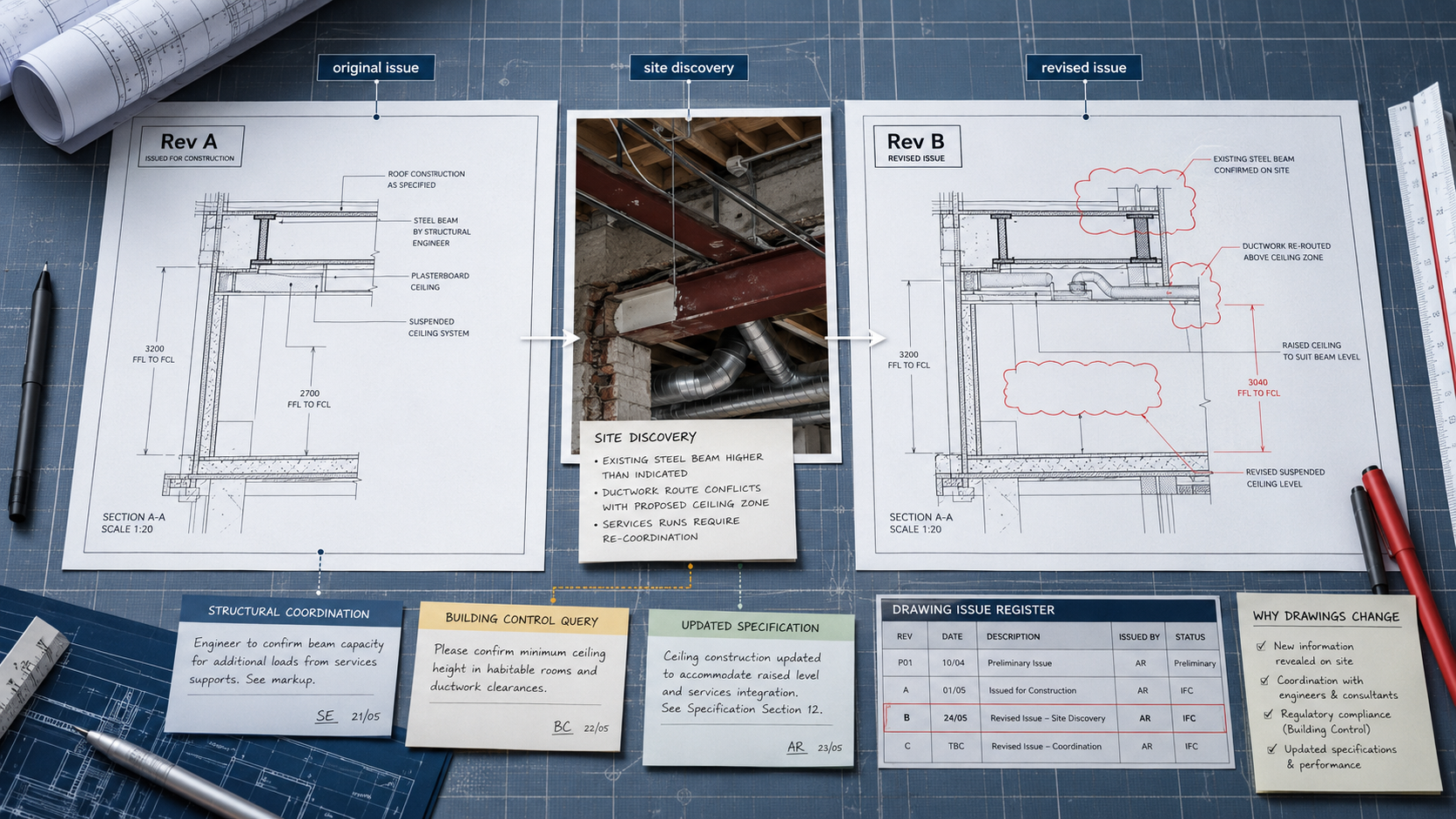
Technical drawings often change after work starts, especially in refurbishments, flats, older buildings, extensions and mixed-use properties. This does not always mean something has gone wrong. Drawings are prepared using surveys, visible information, assumptions, client decisions and consultant input available at the time. Once walls, ceilings, floors or old finishes are opened up, the building can reveal information that was not visible before. Building Control may also ask for more detail, contractors may discover practical constraints, and clients may refine finishes or layouts. The important thing is not to pretend drawings never change. The important thing is to control the changes properly.
The short answer
Technical drawings change after work starts because building projects move from design information to real site conditions.
Before construction, the architect, engineer and contractor may not be able to see every beam, pipe, duct, void, floor build-up, wall thickness, previous alteration or hidden defect. Once work starts, assumptions can be tested. Some are confirmed. Others need to be revised.
Common reasons for drawing changes include:
- hidden beams or structural elements being discovered;
- walls, floors or ceilings being different from the survey assumptions;
- Building Control asking for more information;
- fire strategy needing clarification;
- ducts or services needing a different route;
- temporary works or propping needing to be considered;
- material or product choices being confirmed;
- client decisions changing;
- contractor buildability comments;
- leaseholder, freeholder or Licence to Alter requirements;
- planning or listed building consent constraints;
- supplier drawings needing coordination.
Good technical drawings are not static. They should be updated when the project information changes.
Planning drawings are not the same as technical drawings
Planning drawings are usually prepared to show the council what is proposed in planning terms. They explain the design, scale, appearance, layout and relationship to the site.
Technical drawings go further. They explain how the project will be built, coordinated and reviewed under Building Regulations.
GOV.UK confirms that Building Regulations approval is different from planning permission, and that a project may need both. It also explains that Building Regulations can apply to construction, extensions and many alteration projects, including replacement windows and doors, bathrooms involving plumbing, electrical works, heating systems and roof coverings.
This is why a project can have planning approval and still need substantial drawing updates before or during construction.
Why drawings change when walls and ceilings are opened
In refurbishment work, the existing building is often the biggest unknown.
A measured survey can record what is visible, but it cannot always confirm what is inside walls, ceilings, floors or service voids. Once work starts, the contractor may discover:
- steel beams not shown on older drawings;
- timber joists running in a different direction;
- chimney breasts or structural nibs hidden by finishes;
- pipework inside a wall;
- drainage routes in unexpected positions;
- old openings that were blocked up;
- weak or damaged structure;
- non-compliant previous works;
- ceilings lower than expected;
- ducts or risers that cannot be moved easily;
- damp, rot or defective plaster;
- services shared with other parts of the building.
When this happens, the drawings may need to be updated so everyone is working from the real condition, not the original assumption.
Why this is common in older buildings
Older buildings are rarely perfect records of themselves.
Over decades, they may have been extended, altered, repaired, divided, modernised or patched. Previous owners or contractors may have removed walls, added beams, rerouted services, lowered ceilings, built over drains or changed layouts without leaving clear as-built drawings.
This is why technical drawings for older properties often include assumptions. Those assumptions are reasonable at design stage, but they may need to be checked once work starts.
A drawing revision is often the project team saying: “Now that we have more accurate information, the design needs to be adjusted.”
Structural discoveries
Structural discoveries are one of the most common reasons for revised drawings.
For example, the contractor may open up a ceiling and find that beams, joists or walls are not where expected. A proposed opening may need a different beam size. A stair may need to shift because of existing structure. A chimney, wall or nib may be more important than originally assumed.
The structural engineer may then need to revise:
- beam calculations;
- steel sizes;
- padstone details;
- connection details;
- propping assumptions;
- temporary works advice;
- structural drawings;
- sequencing notes.
The architect’s technical drawings may also need to be updated so that plans, sections, details and specifications match the engineer’s revised design.
Temporary works and propping
Permanent works and temporary works are different.
A structural engineer may design the permanent beam, opening or support. The contractor may still need a temporary works or propping method to hold the building safely while the permanent works are installed.
This often becomes clearer once the contractor has reviewed access, site constraints, existing construction and sequencing.
Technical drawings may therefore change to clarify:
- what is being demolished;
- what is retained;
- where new steelwork goes;
- whether propping is needed;
- what information is contractor-designed;
- what needs specialist temporary works design;
- what needs surveyor or Building Control review before works proceed.
This is especially important in flats, structural refurbishments and buildings where works are subject to a Licence to Alter.
Building Control comments
Building Control comments are another common reason for revisions.
Building Control may ask for more information about:
- structure;
- fire safety;
- escape routes;
- ventilation;
- drainage;
- insulation;
- sound separation;
- glazing;
- stairs;
- fire doors;
- service penetrations;
- roof build-ups;
- damp proofing;
- accessibility.
GOV.UK warns that without Building Regulations approval, where it is required, the relevant building control body could require faulty work to be fixed and the owner may not have compliance certificates needed when selling the home.
So, if Building Control asks for clarification, it should be treated as part of the technical design process, not as an admin inconvenience.
Fire strategy changes
Fire strategy can change during construction when the real building is better understood.
For example, updated drawings may be needed if:
- a stair layout changes;
- a door opening is narrower than expected;
- a protected route needs adjustment;
- a duct route changes;
- service penetrations pass through fire-rated construction;
- access panels need to be fire-rated;
- smoke detection or alarm positions need updating;
- compartment lines need to be shown more clearly;
- Building Control asks for a compliance note.
Approved Document B is the statutory guidance covering fire safety matters within and around buildings in England. GOV.UK lists separate volumes for dwellings and buildings other than dwellings, which can both become relevant in mixed-use or flat projects.
Fire strategy revisions are particularly common where flats, commercial premises, basements, service voids or protected stairs are involved.
Ducts and services
Services can be difficult to resolve fully before work starts.
Drawings may need to change when the team confirms:
- duct routes;
- pipe routes;
- drainage falls;
- boiler or cylinder positions;
- MVHR or extract routes;
- electrical routes;
- risers;
- service cupboards;
- access panel locations;
- fire-stopping requirements;
- ceiling void depths.
A duct that looks straightforward on a plan may become difficult if it clashes with structure, crosses a compartment line, passes through a ceiling void or needs access for maintenance.
This is why technical drawings often evolve once the contractor and specialist suppliers become involved.
Product and supplier information
Technical drawings sometimes change because product information becomes more precise.
For example:
- window manufacturers provide final frame sections;
- door suppliers confirm fire-rated frames and ironmongery;
- tile suppliers confirm thickness and trims;
- kitchen suppliers confirm service routes;
- bathroom suppliers confirm waste positions;
- structural engineers confirm beam sizes;
- ventilation suppliers confirm duct sizes;
- contractors confirm floor build-ups;
- joiners confirm bespoke details.
Design drawings may show the intended layout. Supplier drawings show the exact product. These need to be coordinated.
A drawing revision may simply be the architect updating the project information so it matches what is actually being ordered or installed.
Client choices and specification changes
Sometimes drawings change because the client changes or clarifies a decision.
This might include:
- changing floor finishes;
- retaining existing doors instead of replacing them;
- changing door swings;
- selecting engineered timber instead of laminate;
- choosing tiles instead of a floating floor;
- changing radiator positions;
- adding joinery;
- changing bathroom fittings;
- choosing a different window or door detail;
- changing the kitchen layout.
These decisions can affect more than appearance. For example, floor finishes can affect build-up depth, door thresholds, acoustic performance, underfloor heating, waterproofing, tile backing boards and structural load.
A “small” material change may therefore require a drawing update.
Contractor buildability comments
Contractors often spot practical issues once they are working on site.
For example:
- there may not be enough space to install a proposed detail;
- a door swing may clash with a wall or fitting;
- a service route may not be practical;
- a ceiling void may be too shallow;
- a detail may be difficult to sequence;
- a material may have a longer lead time;
- a supplier may offer a more practical alternative;
- existing walls may be out of plumb;
- old floors may not be level.
A good contractor does not just build blindly from drawings. They should raise issues. The design team then decides whether the drawing needs to be revised, whether the contractor’s suggestion is acceptable, and whether any approvals are affected.
Licence to Alter and freeholder requirements
In leasehold flats, technical drawings may change because of freeholder, managing agent or surveyor requirements.
A Licence to Alter process may require:
- a full scope of works;
- contractor details;
- structural calculations;
- contractor insurance;
- programme of works;
- Building Control information;
- temporary works details;
- surveyor review;
- updated drawings if the scope changes.
This is important because leaseholder consent is separate from Building Control and planning. The managing agent or freeholder’s surveyor may need to approve changes before work continues.
A practical rule is simple: if the works change, check whether the Licence to Alter package also needs updating.
Planning approval and changes on site
Some drawing changes are purely technical and do not affect planning. Others may affect the approved planning drawings.
For example, a change to internal pipework may not matter for planning. A change to a window, rooflight, external material, shopfront, dormer, extension size or elevation may matter.
GOV.UK guidance explains that applications can be made to amend proposals that already have planning permission. It also says full planning permission gives a decision on detailed proposals, subject to conditions and any other consents that may still be required.
This is why technical revisions should be checked against the planning approval before the contractor builds something different externally.
Listed buildings and conservation areas
In listed buildings and conservation areas, drawing changes need extra care.
A site discovery may reveal historic fabric, older plaster, original joinery, hidden structure, chimney details, old windows or decorative features. Changing the design in response may be sensible, but it may also require listed building consent or a revised heritage approach.
Technical drawings for heritage projects may therefore change to show:
- fabric to be retained;
- fabric to be repaired;
- materials to be changed;
- breathable plaster or lime details;
- joinery details;
- window sections;
- heritage method statements;
- conservation officer comments.
In heritage work, unexpected discoveries are common. They should be recorded and assessed, not simply covered up.
Why drawing revisions are not automatically a bad sign
Clients can feel worried when drawings change after work starts. It can feel as if the project was not properly designed.
Sometimes that may be true, but often it is not.
A drawing revision can mean:
- new information has become available;
- the project team is responding responsibly;
- Building Control comments are being addressed;
- a contractor issue is being resolved before it becomes a defect;
- the design is being coordinated with real site conditions;
- a client decision has been properly recorded;
- the project information is being kept up to date.
The problem is not that drawings change. The problem is when changes are made informally, without proper records, approvals or coordination.
What is a controlled revision?
A controlled revision is a clear, traceable update to the drawings.
It should usually include:
- revision number or letter;
- revision date;
- description of what changed;
- clouding or marking of changed areas where helpful;
- updated drawing issue sheet;
- confirmation of who receives the revised drawings;
- note of whether Building Control, planning, freeholder or contractor approval is needed;
- instruction not to use superseded drawings.
This matters because site teams can accidentally build from old drawings if the revision process is not clear.
What should not happen
The following situations create risk:
- contractor builds from an old drawing;
- client agrees a change verbally but drawings are not updated;
- engineer revises a beam but architect drawings still show the old layout;
- Building Control comment is answered by email but drawings remain unclear;
- supplier detail conflicts with planning drawings;
- freeholder approval is based on one scope but site work follows another;
- revised layout affects fire strategy but fire drawings are not updated;
- hidden works are covered before inspection;
- no one keeps a record of what was actually built.
These are the situations that cause disputes, delays and expensive corrections.
Why updated drawings help the builder
Revised drawings are not only for councils or consultants. They help the builder.
Updated drawings can clarify:
- what to build;
- what not to build;
- which wall is being removed;
- where the new opening goes;
- where fire doors are needed;
- what finish is intended;
- where services run;
- which details supersede earlier information;
- whether a change has been approved.
A good revision can prevent several site conversations and reduce the chance of mistakes.
Why updated drawings help the client
For the client, updated drawings create a record of decisions.
This can help with:
- understanding cost changes;
- comparing contractor quotations;
- checking what was agreed;
- future sale or remortgage;
- Building Control records;
- freeholder records;
- warranties;
- avoiding disputes;
- planning compliance;
- maintenance later.
When a project changes, the drawings should change with it.
Cost and programme implications
Some drawing changes are quick and minor. Others need more time and consultant input.
A revision may require:
- architect time;
- structural engineer input;
- Building Control review;
- contractor pricing;
- supplier drawings;
- freeholder surveyor review;
- planning amendment;
- specialist consultant input;
- additional site visit;
- opening-up investigation.
This can affect cost and programme. It is better to be honest about this early than to let the site proceed on uncertain information.
How to reduce the number of changes
You cannot eliminate all drawing changes, but you can reduce them.
Helpful steps include:
- Commission a good measured survey.
- Allow for opening-up investigations where practical.
- Involve the structural engineer early.
- Discuss Building Control requirements before work starts.
- Coordinate fire strategy, ventilation and drainage early.
- Confirm key finishes before drawings are issued for construction.
- Ask suppliers for technical drawings before ordering.
- Prepare a clear scope of works.
- Agree how changes will be instructed.
- Keep a live drawing register.
- Tell the builder not to rely on superseded drawings.
- Record site discoveries with photos and notes.
The aim is not to freeze the project unrealistically. The aim is to make changes less chaotic.
A practical checklist when a change is discovered on site
When something unexpected is found on site, ask:
- What exactly has been discovered?
- Is the issue structural?
- Does work need to stop in that area?
- Does the structural engineer need to review it?
- Does Building Control need to be notified?
- Does it affect fire safety?
- Does it affect drainage, ventilation or services?
- Does it affect planning approval?
- Does it affect listed building consent or conservation details?
- Does it affect the Licence to Alter?
- Does it change the cost?
- Does it change the programme?
- Do drawings need to be revised?
- Who needs to receive the revised drawing?
- Which old drawing is now superseded?
This avoids rushed decisions that later become expensive.
How Gartwork Architecture can help
Gartwork Architecture can help manage drawing revisions during construction by reviewing site discoveries, updating technical drawings, coordinating with structural engineers and Building Control, clarifying scope changes, and recording decisions properly.
For flats, refurbishments, mixed-use buildings and older properties, this coordination is especially important because small discoveries can affect structure, fire safety, services, leaseholder consent, finishes and compliance.
The goal is to keep the project information clear, current and buildable.
Final takeaway
Technical drawings change after work starts because real buildings are more complicated than drawings.
Site discoveries, Building Control comments, structural coordination, services, fire strategy, supplier information and client decisions can all require updates. This is normal, especially in refurbishments and older properties.
What matters is how the change is managed. A controlled drawing revision protects the client, builder, architect, engineer and future records. It helps make sure the project is built from accurate information, not from assumptions that are no longer true.
Categories
Technical Drawings
Construction Drawings
Revised Drawings
Building Control
Building Regulations
Site Discoveries
Refurbishment
Structural Engineer
Fire Strategy
Licence to Alter
Contractor Coordination
Technical Design
Drawing Revisions
Construction Phase
Architecture